
The Modern Library Bibliography
EMILY BRONTË. WUTHERING HEIGHTS. 1926–1969; 1978– . (ML 106)
120.1a. First printing (1926)
[within double rules] WUTHERING HEIGHTS | [rule] | BY | EMILY BRONTE [sic] | [rule] | INTRODUCTION BY | ROSE MACAULEY [sic] | [rule] | [
Pp. [i–iv] v–xxvi, [2], 1–390 [391–392]. [1–12]16 [13]18
[i] half title; [ii]
Jacket:
Text on front:
‘WUTHERING HEIGHTS’ was hewn in a wild workshop, with simple tools, out of homely materials. The statuary found a granite block on a solitary moor; gazing thereon, he saw how from the crag might be elicited a head, savage, swart, sinister; a form moulded with at least one element of grandeur—power. He wrought with a rude chisel, and from no model but the vision of his meditations. With time and labour, the crag took human shape; and there it stands colossal, dark, and frowning, half statue, half rock; in the former sense, terrible and goblin-like; in the latter, almost beautiful, for its colouring is of mellow grey, and moorland moss clothes it; and heath, with its blooming bells and balmy fragrance, grows faithfully close to the giant’s foot. CHARLOTTE BRONTË
ML edition printed from duplicate plates of the edition published in 1926 in Jonathan Cape’s Travellers’ Library. Published January 1926. WR 6 February 1926. First printing: Not ascertained. Discontinued 1969/70. Reissued 1978.
Macaulay had agreed to write an introduction to Wuthering Heights when the ML was published by B&L. The ML edition was announced for May 1925 (B&L advertisement, PW, 14 March 1925, p. 847), but the introduction failed to arrive and publication was postponed. Cerf, who had just bought the ML from Liveright, hoped to call on Macaulay when he visited England in June but was unable to see her. Shortly after his return he wrote, “Do you remember telling Horace Liveright that you would write a short introduction for the Modern Library edition of Emily Bronte’s “Wuthering Heights”? We want to publish this volume in November, and I would therefore appreciate very much indeed, receiving this introduction within a month.” He indicated that it did not have to be longer than four or five pages and added, “. . . the usual stupendous honorarium of $50 will be sent you immediately on its receipt” (Cerf to Macaulay, 6 August 1925). Macaulay sent the introduction on 23 August 1925. After thanking her he added: “I do hope before long we may have one of your own books in the series. I think that TOLD BY AN IDIOT would make an ideal addition to the Modern Library” (Cerf to Macaulay 10 September 1925).
A slightly abridged version of Macaulay’s introduction was also included in the British edition of Wuthering Heights published in 1926 in Jonathan Cape’s Travellers’ Library. In the ML edition the first paragraph of the introduction concludes with the following three sentences:
There must be, there must always have been, something magnetic about these Irish Yorkshire parson’s daughters. One result of this is that every available fact about their personalities and lives is now familiar knowledge, together with some things that are not facts at all, such as the theory which attributes “Wuthering Heights” to the poor ineffectual dipsomaniac brother, Bramwell Brontë, who boasted to his friends that it was his work, but who, so far as has transpired, never wrote a good line of verse or prose in his life. It is supposed the only connection he had with “Wuthering Heights” was that Emily put some of his love-sick raving into the mouth of her Heathcliff.
In the Traveller’s Library introduction the paragraph ends with the words, “. . . every available fact about their personalities and lives is now familiar knowledge, together with some things which are not facts at all.”
Except for the preliminaries, ML and Travellers’ Library printings are printed from identical plates. The only difference is that the Travellers’ Library plates have signature numbers at the foot of the first page of each gathering. The typography is typical of other Travellers’ Library volumes, so the ML appears to have acquired a duplicate set of Travellers’ Library plates. The cooperative arrangement may have been worked out when Cerf was in London in the summer of 1925.
The title-page misspellings of Brontë (“Bronte”) and Macaulay (“Macauley”) were corrected in the second printing.
Blue Ribbon Books used the ML plates, including the Macaulay introduction, for a 1939 printing of Wuthering Heights in its new reprint series Triangle Books. Books in the series were clothbound and sold for 39 cents a copy.
Sales of Wuthering Heights during the first six months of 1928 placed it 72nd out of 147 ML titles. During the 18-month period May 1942–October 1943 it was solidly in the first quarter of ML titles in terms of sales. The regular ML edition slipped below the first quarter during the 12-month period November 1951–October 1952. This probably reflects a loss of sales in the academic market following the inclusion of Wuthering Heights as one of the first titles in Modern Library College Editions, a paperbound series launched in 1950 specifically for classroom use.
120.1b. Title-page spellings corrected (1927)
Title as 120.1a except lines 4 and 7: EMILY BRONTË | . . . | . . . | ROSE MACAULAY
Pagination and collation as 120.1a.
Contents as 120.1a, including First statement on p. [iv].
Variant A: Pp. [i–iv] v–xxvi, [2], 1–390 [391–396]. [1–13]16 [14]4. Contents as 120.1a except: [ii]
pub. note A6 ; [iv] manufacturing statement; [391–394] ML list; [395–396] blank. (Fall 1928)
Variant B: Pp. [i–iv] v–xxvi, [2], 1–390 [391–404]. [1–13]16 [14]8. Contents as variant A except: [391–395] ML list; [396–397] ML Giants list; [398–404] blank. (Spring 1938)
Jacket A:
Text on front:
‘WUTHERING HEIGHTS’ was hewn in a wild workshop, with simple tools, out of homely materials. The statuary found a granite block on a solitary moor; gazing thereon, he saw how from the crag might be elicited a head, savage, swart, sinister; a form moulded with at least one element of grandeur—power. He wrought with a rude chisel, and from no model but the vision of his meditations. With time and labour, the crag took human shape; and there it stands colossal, dark, and frowning, half statue, half rock; in the former sense, terrible and goblin-like; in the latter, almost beautiful, for its colouring is of mellow grey, and moorland moss clothes it; and heath, with its blooming bells and balmy fragrance, grows faithfully close to the giant’s foot. CHARLOTTE BRONTË (Fall 1927)
Jacket B:
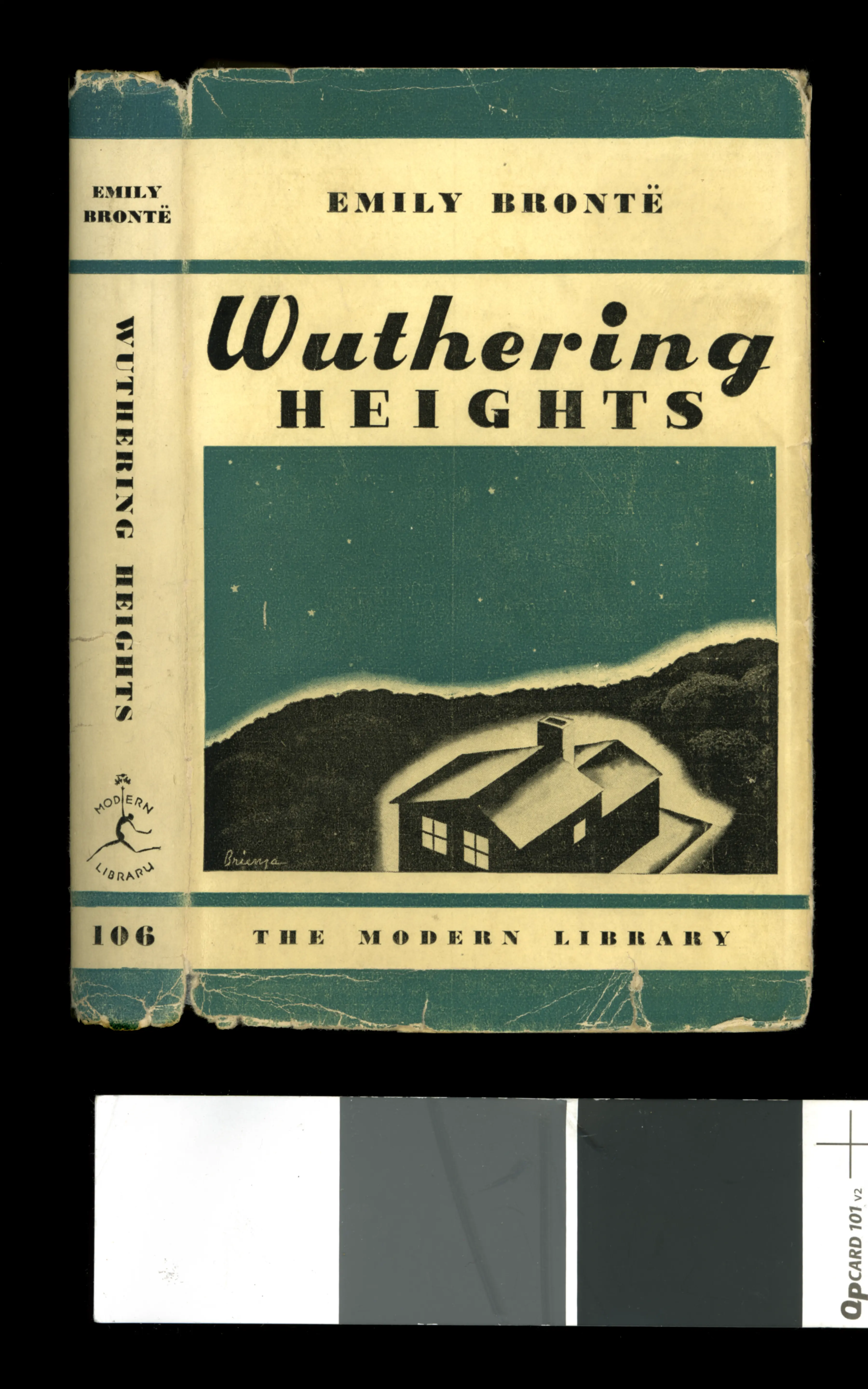
Jacket C: Pictorial in dark bluish green (165) and black on coated cream paper with inset illustration of a house on a moor with dark bluish green sky and stars in reverse; borders in dark bluish green, lettering in black. Signed: Brienza.
Front flap:
Emily Brontë’s brooding imagination evoked as thwarted and tragic a group of human creatures as ever walked the bleak moorlands or had their existence in the dark byways of life. The barren world in which their villanies [sic] flourished forms the background for deeds as weird as they are sinister and for passions as fierce as they are persistent. Wuthering Heights is by common consent one of the most compelling novels in the English language. It is a book compact of beauty and loveliness, hate and cruelty and heartrending pathos. (Fall 1933) Note: The misspelling of “villainies” is retained on jacket flaps at least through fall 1952.
120.1c. Title page reset (c. 1940)
[
Pp. [i–iv] v–xxvi, [2], 1–390 [391–404]. [1–13]16 [14]8
Contents as 120.1b variant B except: [ii] blank; [iv] publication and manufacturing statements. (Fall 1943; fall 1947)
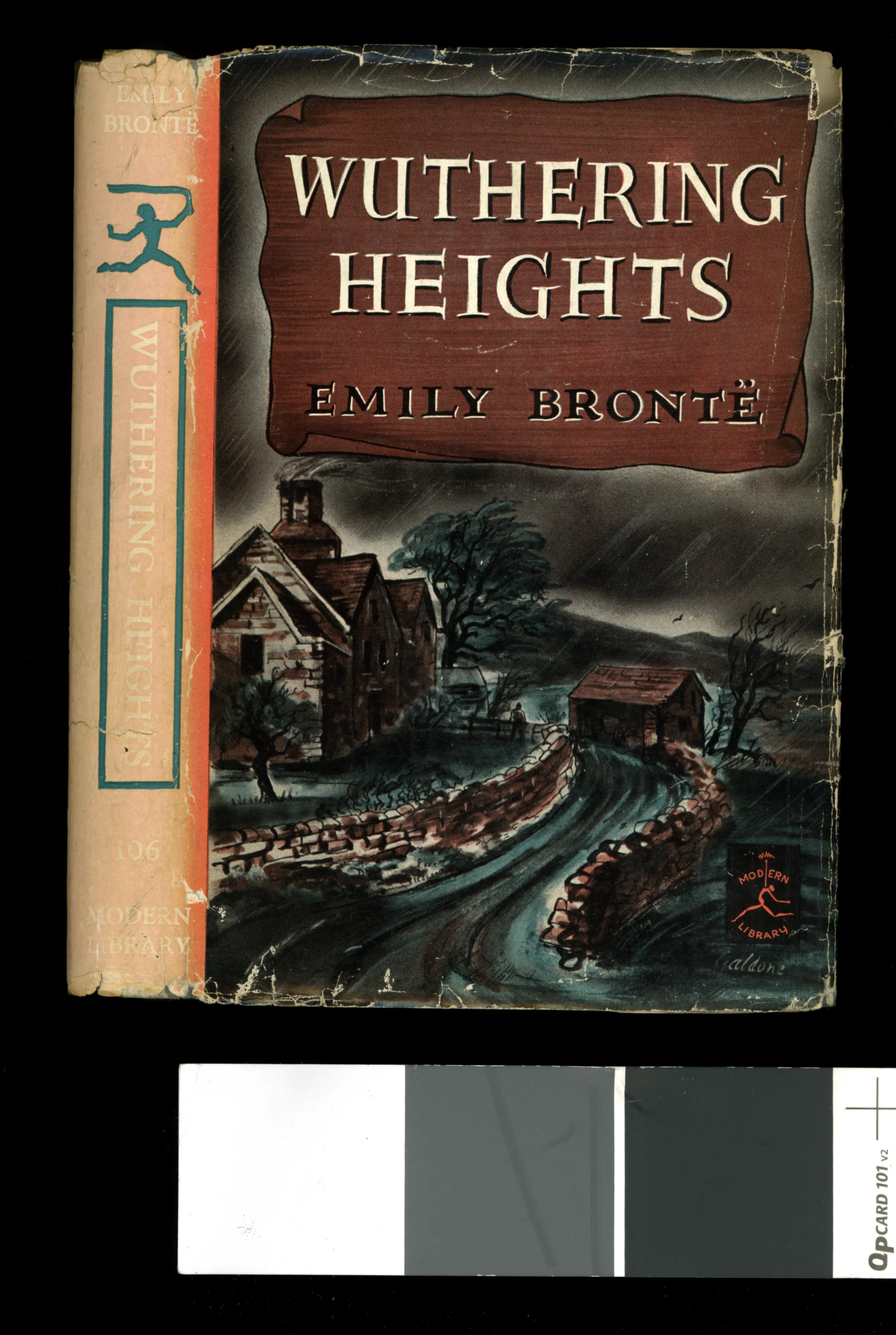
Jacket A: Pictorial in moderate reddish brown (43), strong green (141), strong reddish orange (35), dark gray (266) and black on coated white paper depicting a stone house and yard on a rainy moor; title in reverse with three-dimensional highlighting in black and author in black with three-dimensional highlighting in reverse on inset moderate reddish brown panel simulating parchment with curled edges. Backstrip in strong reddish orange with torchbearer and frame around title in strong green, lettering in reverse. Signed: Galdone.
Front flap as 120.1b jacket C. (Spring 1943)
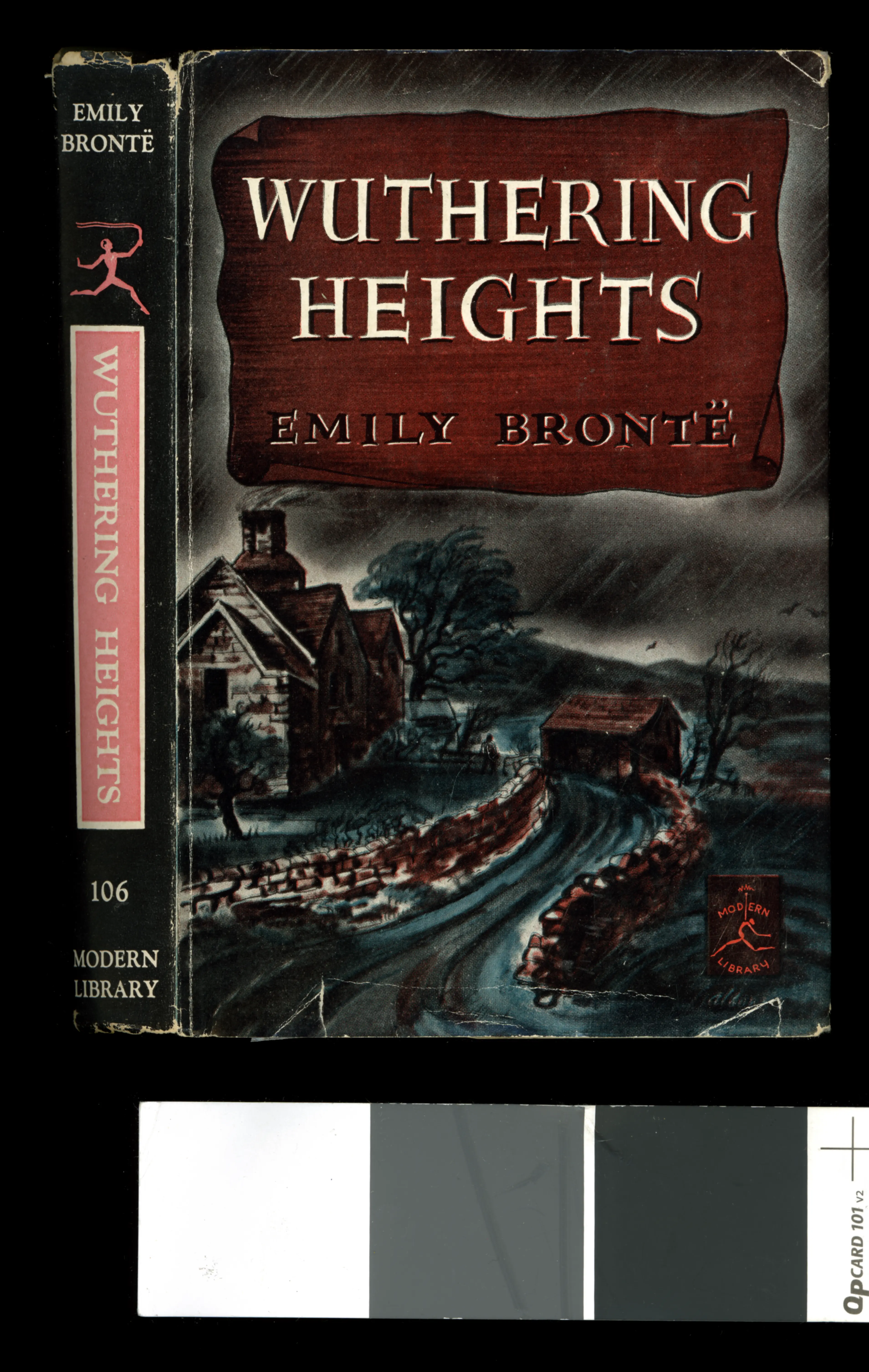
Jacket B: As jacket 5 except backstrip in black, torchbearer and title panel in strong pink (2), and lettering in reverse. (Spring 1947)
120.2a. Text reset; Gettmann introduction added (1950)
WUTHERING | HEIGHTS | BY EMILY BRONTË | INTRODUCTION BY | ROYAL A. GETTMANN | Professor of English | University of Illinois | WITH WOOD ENGRAVINGS BY | FRITZ EICHENBERG | [
Pp. [i–iv] v–xxxii, [1–2] 3–400. [1–12]16 [13]8 [14]16
[i] half title; [ii] blank; [iii] title; [iv] Copyright, 1950, by Random House, Inc.; v–xvi Introduction | BY ROYAL A. GETTMANN; xvii Bibliography; [xviii] genealogical table of Linton and Earnshaw families; xix–xxvi Biographical Notice | OF | ELLIS AND ACTON BELL signed p. xxvi: CURRER BELL | [within square brackets] Charlotte Brontë | September 19, 1850.; xxvii–xxxii Editor’s Preface | TO THE NEW EDITION OF | Wuthering Heights signed p. xxxii: CURRER BELL | [within square brackets] Charlotte Brontë; [1] fly title; [2] blank; 3–400 text.
Variant: Pagination as 120.2a. [1]16 [2–5]32 [6]24 [7]32 [8]16. Contents as 120.2b except: [iv] COPYRIGHT, 1950, BY RANDOM HOUSE, INC.
Jacket A: As 120.1c jacket B. (Fall 1952)
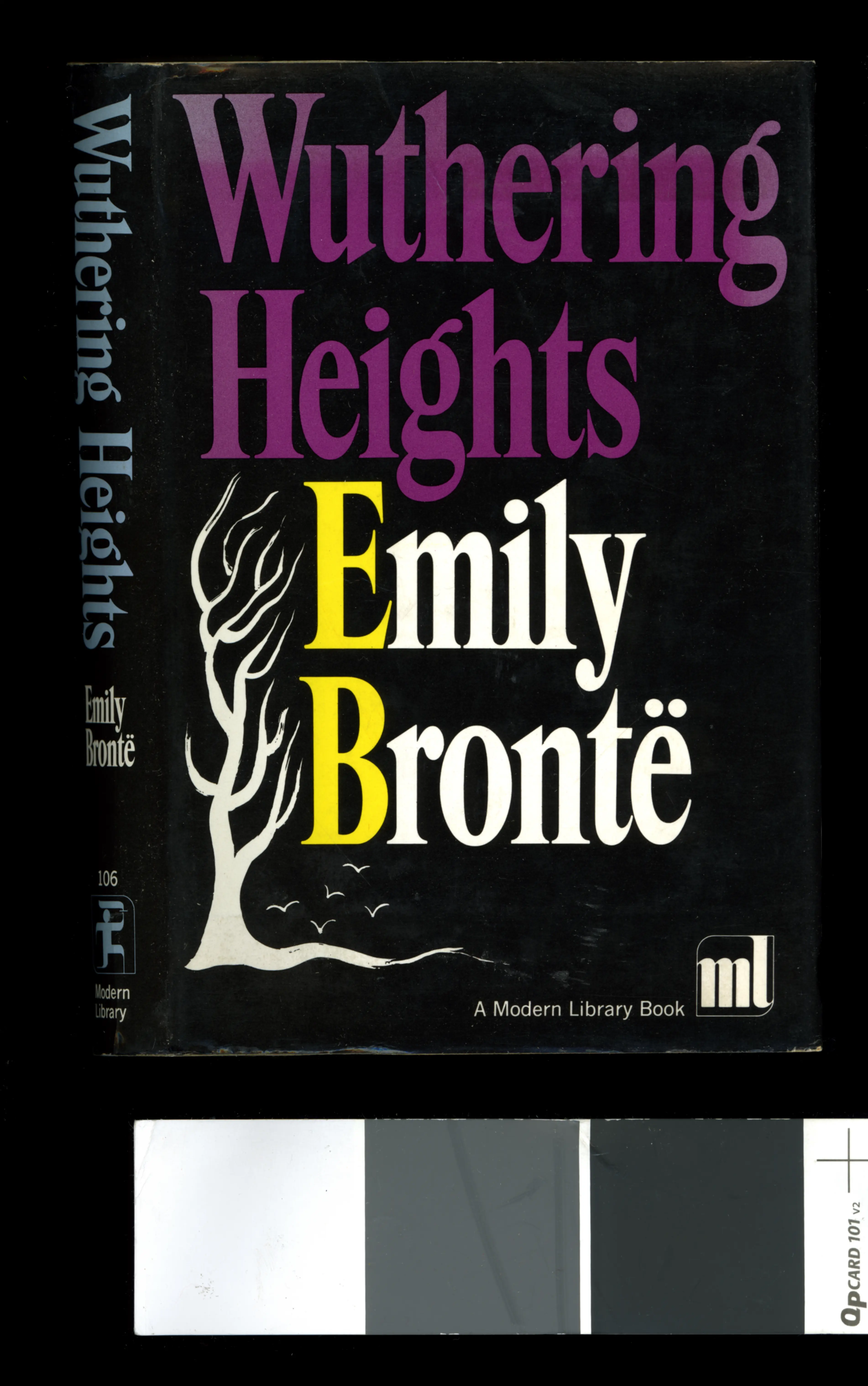
Jacket B: Fujita pictorial jacket in black, deep purplish red (256) and brilliant yellow (83) on coated white paper with silhouette of barren tree and birds in reverse and lettering in deep purplish red, brilliant yellow and in reverse, all against black background.
Front flap:
Though Wuthering Heights was written by a woman who remained a recluse all of her life, it is one of the most powerful and passionate novels in the English language. The romantic story of the destruction caused by the frustrated love of Catherine Earnshaw and Heathcliff, set against the moors of England, creates a rare blend of violence and beauty.
Originally published 1950 in MLCE and shortly thereafter in the regular ML. ML edition (pp. xxvii‑xxxii, [1]–400) printed from plates originally made for the Illustrated Modern Library with pagination of the Editor’s Preface revised. In ML and MLCE printings Charlotte Brontë’s Biographical Notice is reset in smaller type to match that of Gettman’s introduction. ML and MLCE printings include Eichenberg’s wood-engraved chapter heads that were made for the Book-of-the-Month Club and the Illustrated Modern Library (IML 18) but not the full-page wood engravings.
The Illustrated Modern Library edition of Wuthering Heights (IML 18), published in November 1946, was printed from plates made from a new typesetting. The 1943 Book-of-the-Month Club edition of Wuthering Heights had a wood-engraved chapter heading for the first chapter only. For the Illustrated Modern Library edition Eichenberg made 20 additional wood engravings for the chapter heads. Since Wuthering Heights consists of 34 chapters, several of the wood engravings were used twice and one (pp. 38, 141, 248) is used three times.
New plates made for the Illustrated Modern Library were usually used for subsequent printings of the regular ML edition. This appears to have been the intention, since the preliminaries for the regular ML edition of Wuthering Heights, including Macaulay’s introduction, were reset to match the rest of the text. However, the original plates were used when the regular ML edition of Wuthering Heights (120.1c) was reprinted in fall 1947. No regular ML printings with the reset text have been seen prior to 120.2a, when the Illustrated Modern Library plates were used with a new introduction by Royal A. Gettmann.
Gettmann received $150 for his introduction (Stein to Gettmann, 24 January 1950).
120.2b. Reissue format (1978)
[wood engraving of rooftop and barren tree] | WUTHERING | HEIGHTS | BY EMILY BRONTË | INTRODUCTION BY | ROYAL A. GETTMANN | WITH WOOD ENGRAVINGS BY | FRITZ EICHENBERG | [
Pagination as 120.2a. Perfect bound.
Contents as 120.2a except: [iv] FIRST MODERN LIBRARY EDITION, AUGUST 1950 | Copyright 1943, 1946, 1950 by Random House, Inc. | Copyright renewed 1971, 1974, 1978 by Random House, Inc.; [xvii] A Selected Bibliography [revised]. Note: The three copyright dates apply to Eichenberg’s wood engraving at the head of chapter 1, first used in the 1943 edition of Wuthering Heights published by Random House for the Book-of-the-Month Club; the 20 additional wood-engraved chapter headings he made for the 1946 Illustrated Modern Library edition; and Gettmann’s introduction.
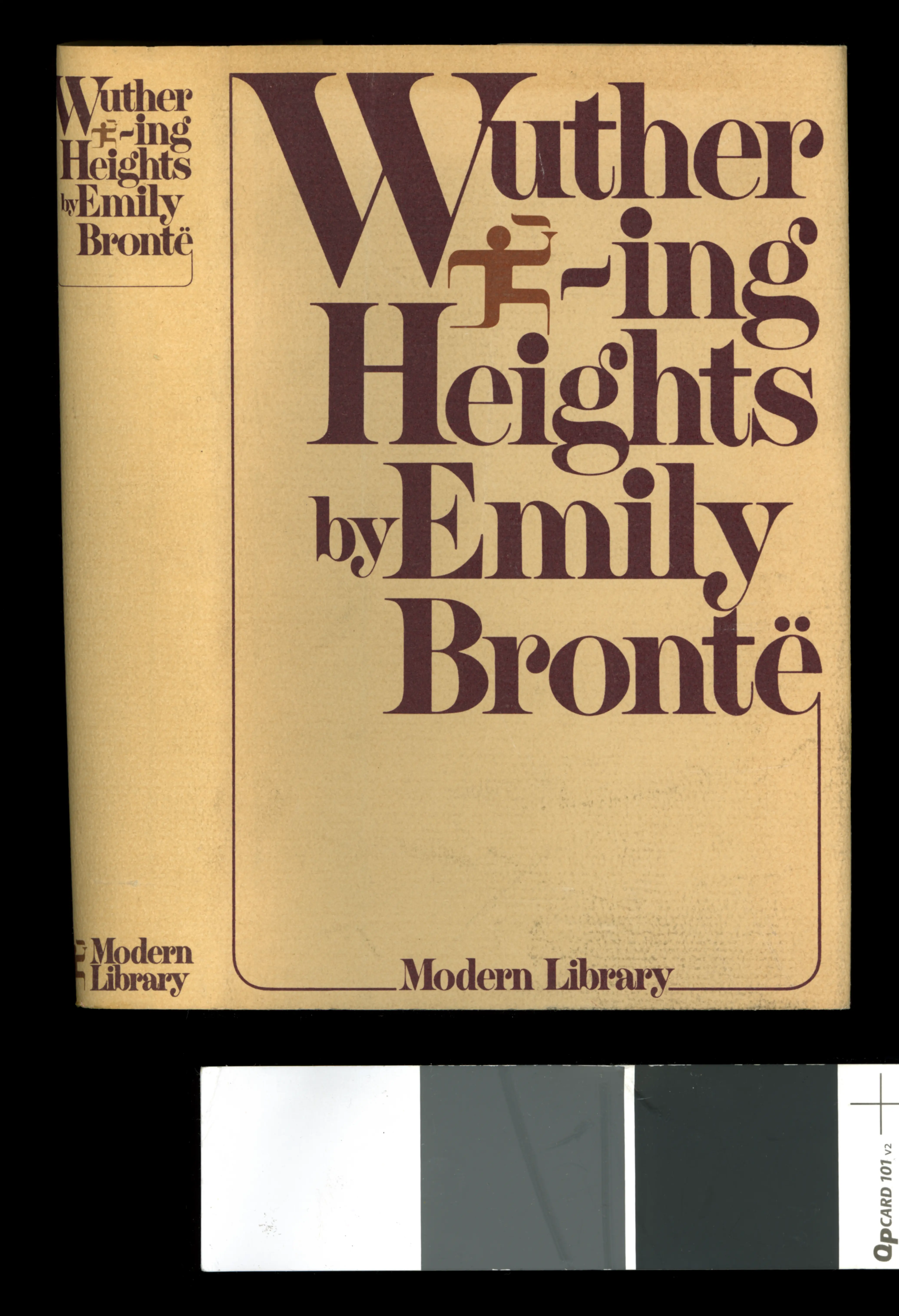
Jacket: Non-pictorial on kraft paper with lettering in dark reddish brown (44) and torchbearer in deep brown (56). Designed by R. D. Scudellari.
Front flap as 120.2b.
Published fall 1978 at $5.95. ISBN 0-394-60458-X.
{
  "full": "\n**EMILY BRONTË. WUTHERING HEIGHTS. 1926–1969; 1978– . (ML 106)**  \n\n#### 120.1a. First printing (1926)  \n\n[within double rules] WUTHERING HEIGHTS | [rule] | BY | EMILY BRONTE [*sic*] | [rule] | INTRODUCTION BY | ROSE MACAULEY [*sic*] | [rule] | [torchbearer A2] | [rule] | THE MODERN LIBRARY | PUBLISHERS · NEW YORK  \n\nPp. [i–iv] v–xxvi, [*2*], 1–390 [391–392]. [1–12]16 [13]18  \n\n[i] half title; [ii] pub. note D5; [iii] title; [iv] [short double rule] | *Introduction Copyright* 1926, *by* | THE MODERN LIBRARY, INC. | [short double rule] | *First Modern Library Edition* | *January,* 1926; v–x INTRODUCTION signed p. x: Rose Macaulay.; xi–xix BIOGRAPHICAL NOTICE | OF | ELLIS AND ACTON BELL signed p. xix: Currer Bell. | (Charlotte Brontë.) | *September* 19, 1850.; [xx] blank; xxi–xxvi EDITOR’S PREFACE | TO THE NEW EDITION OF | WUTHERING HEIGHTS signed p. xxvi: Currer Bell. | (Charlotte Brontë.); [*1*] fly title; [*2*] blank; 1–390 text; [291–392] blank.  \n\n*Jacket:* Uniform typographic jacket B1a without torchbearer.  \n\n> Text on front:
 ‘WUTHERING HEIGHTS’ was hewn in a wild workshop, with simple tools, out of homely materials. The statuary found a granite block on a solitary moor; gazing thereon, he saw how from the crag might be elicited a head, savage, swart, sinister; a form moulded with at least one element of grandeur—power. He wrought with a rude chisel, and from no model but the vision of his meditations. With time and labour, the crag took human shape; and there it stands colossal, dark, and frowning, half statue, half rock; in the former sense, terrible and goblin-like; in the latter, almost beautiful, for its colouring is of mellow grey, and moorland moss clothes it; and heath, with its blooming bells and balmy fragrance, grows faithfully close to the giant’s foot. CHARLOTTE BRONTË  \n\nML edition printed from duplicate plates of the edition published in 1926 in Jonathan Cape’s Travellers’ Library. Published January 1926. *WR* 6 February 1926. First printing: Not ascertained. Discontinued 1969/70. Reissued 1978.  \n\nMacaulay had agreed to write an introduction to *Wuthering Heights* when the ML was published by B&L. The ML edition was announced for May 1925 (B&L advertisement, *PW*, 14 March 1925, p. 847), but the introduction failed to arrive and publication was postponed. Cerf, who had just bought the ML from Liveright, hoped to call on Macaulay when he visited England in June but was unable to see her. Shortly after his return he wrote, “Do you remember telling Horace Liveright that you would write a short introduction for the Modern Library edition of Emily Bronte’s “Wuthering Heights”? We want to publish this volume in November, and I would therefore appreciate very much indeed, receiving this introduction within a month.” He indicated that it did not have to be longer than four or five pages and added, “. . .  the usual stupendous honorarium of \\$50 will be sent you immediately on its receipt” (Cerf to Macaulay, 6 August 1925). Macaulay sent the introduction on 23 August 1925. After thanking her he added: “I do hope before long we may have one of your own books in the series. I think that TOLD BY AN IDIOT would make an ideal addition to the Modern Library” (Cerf to Macaulay 10 September 1925).  \n\nA slightly abridged version of Macaulay’s introduction was also included in the British edition of *Wuthering Heights* published in 1926 in Jonathan Cape’s Travellers’ Library. In the ML edition the first paragraph of the introduction concludes with the following three sentences:  \n\n> There must be, there must always have been, something magnetic about these Irish Yorkshire parson’s daughters. One result of this is that every available fact about their personalities and lives is now familiar knowledge, together with some things that are not facts at all, such as the theory which attributes “Wuthering Heights” to the poor ineffectual dipsomaniac brother, Bramwell Brontë, who boasted to his friends that it was his work, but who, so far as has transpired, never wrote a good line of verse or prose in his life. It is supposed the only connection he had with “Wuthering Heights” was that Emily put some of his love-sick raving into the mouth of her Heathcliff.  \n\nIn the Traveller’s Library introduction the paragraph ends with the words, “. . . every available fact about their personalities and lives is now familiar knowledge, together with some things which are not facts at all.”  \n\nExcept for the preliminaries, ML and Travellers’ Library printings are printed from identical plates. The only difference is that the Travellers’ Library plates have signature numbers at the foot of the first page of each gathering. The typography is typical of other Travellers’ Library volumes, so the ML appears to have acquired a duplicate set of Travellers’ Library plates. The cooperative arrangement may have been worked out when Cerf was in London in the summer of 1925.  \n\nThe title-page misspellings of Brontë (“Bronte”) and Macaulay (“Macauley”) were corrected in the second printing.  \n\nBlue Ribbon Books used the ML plates, including the Macaulay introduction, for a 1939 printing of *Wuthering Heights* in its new reprint series Triangle Books. Books in the series were clothbound and sold for 39 cents a copy.  \n\nSales of *Wuthering Heights* during the first six months of 1928 placed it 72nd out of 147 ML titles. During the 18-month period May 1942–October 1943 it was solidly in the first quarter of ML titles in terms of sales. The regular ML edition slipped below the first quarter during the 12-month period November 1951–October 1952. This probably reflects a loss of sales in the academic market following the inclusion of *Wuthering Heights* as one of the first titles in Modern Library College Editions, a paperbound series launched in 1950 specifically for classroom use.  \n\n#### 120.1b. Title-page spellings corrected (1927)  \n\nTitle as 120.1a except lines 4 and 7: EMILY BRONTË | . . . | . . . | ROSE MACAULAY  \n\nPagination and collation as 120.1a.  \n\nContents as 120.1a, including *First* statement on p. [iv].  \n\n> *Variant A:* Pp. [i–iv] v–xxvi, [*2*], 1–390 [391–396]. [1–13]16 [14]4. Contents as 120.1a except: [ii] pub. note A6; [iv] manufacturing statement; [391–394] ML list; [395–396] blank. (*Fall 1928*) \n\n> *Variant B:* Pp. [i–iv] v–xxvi, [*2*], 1–390 [391–404]. [1–13]16 [14]8. Contents as variant A except: [391–395] ML list; [396–397] ML Giants list; [398–404] blank. (*Spring 1938*)  \n\n*Jacket A:* Uniform typographic jacket B2 with torchbearer.  \n\n> Text on front:
 ‘WUTHERING HEIGHTS’ was hewn in a wild workshop, with simple tools, out of homely materials. The statuary found a granite block on a solitary moor; gazing thereon, he saw how from the crag might be elicited a head, savage, swart, sinister; a form moulded with at least one element of grandeur—power. He wrought with a rude chisel, and from no model but the vision of his meditations. With time and labour, the crag took human shape; and there it stands colossal, dark, and frowning, half statue, half rock; in the former sense, terrible and goblin-like; in the latter, almost beautiful, for its colouring is of mellow grey, and moorland moss clothes it; and heath, with its blooming bells and balmy fragrance, grows faithfully close to the giant’s foot. CHARLOTTE BRONTË (*Fall 1927*)  \n\n*Jacket B:* Uniform typographic jacket D. (*Spring 1929*)  \n\n*Jacket C:* Pictorial in dark bluish green (165) and black on coated cream paper with inset illustration of a house on a moor with dark bluish green sky and stars in reverse; borders in dark bluish green, lettering in black. Signed: Brienza.  \n\n> Front flap:
 Emily Brontë’s brooding imagination evoked as thwarted and tragic a group of human creatures as ever walked the bleak moorlands or had their existence in the dark byways of life. The barren world in which their villanies [*sic*] flourished forms the background for deeds as weird as they are sinister and for passions as fierce as they are persistent. *Wuthering Heights* is by common consent one of the most compelling novels in the English language. It is a book compact of beauty and loveliness, hate and cruelty and heartrending pathos. (*Fall 1933*) *Note:* The misspelling of “villainies” is retained on jacket flaps at least through fall 1952.  \n\n#### 120.1c. Title page reset (c. 1940)  \n\n[torchbearer E3] | [6-line title and statement of responsibility within single rules] WUTHERING | HEIGHTS | BY | EMILY BRONTË | INTRODUCTION BY | ROSE MACAULAY | [below frame] THE MODERN LIBRARY · NEW YORK  \n\nPp. [i–iv] v–xxvi, [*2*], 1–390 [391–404]. [1–13]16 [14]8  \n\nContents as 120.1b variant B except: [ii] blank; [iv] publication and manufacturing statements. (*Fall 1943; fall 1947*)  \n\n*Jacket A:* Pictorial in moderate reddish brown (43), strong green (141), strong reddish orange (35), dark gray (266) and black on coated white paper depicting a stone house and yard on a rainy moor; title in reverse with three-dimensional highlighting in black and author in black with three-dimensional highlighting in reverse on inset moderate reddish brown panel simulating parchment with curled edges. Backstrip in strong reddish orange with torchbearer and frame around title in strong green, lettering in reverse. Signed: Galdone. \n\n> Front flap as 120.1b jacket C. (*Spring 1943*)  \n\n*Jacket B:* As jacket 5 except backstrip in black, torchbearer and title panel in strong pink (2), and lettering in reverse. (*Spring 1947*)  \n\n#### 120.2a. Text reset; Gettmann introduction added (1950)  \n\nWUTHERING | HEIGHTS | BY EMILY BRONTË | INTRODUCTION BY | ROYAL A. GETTMANN | *Professor of English* | *University of Illinois* | WITH WOOD ENGRAVINGS BY | FRITZ EICHENBERG | [torchbearer E5] | *THE MODERN LIBRARY · NEW YORK*  \n\nPp. [i–iv] v–xxxii, [1–2] 3–400. [1–12]16 [13]8 [14]16  \n\n[i] half title; [ii] blank; [iii] title; [iv] *Copyright, 1950, by Random House, Inc.*; v–xvi Introduction | BY ROYAL A. GETTMANN; xvii Bibliography; [xviii] genealogical table of Linton and Earnshaw families; xix–xxvi Biographical Notice | OF | ELLIS AND ACTON BELL signed p. xxvi: CURRER BELL | [within square brackets] Charlotte Brontë | *September* 19, 1850.; xxvii–xxxii Editor’s Preface | TO THE NEW EDITION OF | Wuthering Heights signed p. xxxii: CURRER BELL | [within square brackets] *Charlotte Brontë*; [1] fly title; [2] blank; 3–400 text.  \n\n> *Variant:* Pagination as 120.2a. [1]16 [2–5]32 [6]24 [7]32 [8]16. Contents as 120.2b except: [iv] COPYRIGHT, 1950, BY RANDOM HOUSE, INC.  \n\n*Jacket A:* As 120.1c jacket B. (*Fall 1952*)  \n\n*Jacket B:* Fujita pictorial jacket in black, deep purplish red (256) and brilliant yellow (83) on coated white paper with silhouette of barren tree and birds in reverse and lettering in deep purplish red, brilliant yellow and in reverse, all against black background.  \n\n> Front flap:
 Though *Wuthering Heights* was written by a woman who remained a recluse all of her life, it is one of the most powerful and passionate novels in the English language. The romantic story of the destruction caused by the frustrated love of Catherine Earnshaw and Heathcliff, set against the moors of England, creates a rare blend of violence and beauty.  \n\nOriginally published 1950 in MLCE and shortly thereafter in the regular ML. ML edition (pp. xxvii‑xxxii, [1]–400) printed from plates originally made for the Illustrated Modern Library with pagination of the Editor’s Preface revised. In ML and MLCE printings Charlotte Brontë’s Biographical Notice is reset in smaller type to match that of Gettman’s introduction. ML and MLCE printings include Eichenberg’s wood-engraved chapter heads that were made for the Book-of-the-Month Club and the Illustrated Modern Library (IML 18) but not the full-page wood engravings.  \n\nThe Illustrated Modern Library edition of *Wuthering Heights* (IML 18), published in November 1946, was printed from plates made from a new typesetting. The 1943 Book-of-the-Month Club edition of *Wuthering Heights* had a wood-engraved chapter heading for the first chapter only. For the Illustrated Modern Library edition Eichenberg made 20 additional wood engravings for the chapter heads. Since *Wuthering Heights* consists of 34 chapters, several of the wood engravings were used twice and one (pp. 38, 141, 248) is used three times.  \n\nNew plates made for the Illustrated Modern Library were usually used for subsequent printings of the regular ML edition. This appears to have been the intention, since the preliminaries for the regular ML edition of *Wuthering Heights*, including Macaulay’s introduction, were reset to match the rest of the text. However, the original plates were used when the regular ML edition of *Wuthering Heights* (120.1c) was reprinted in fall 1947. No regular ML printings with the reset text have been seen prior to 120.2a, when the Illustrated Modern Library plates were used with a new introduction by Royal A. Gettmann.  \n\nGettmann received \\$150 for his introduction (Stein to Gettmann, 24 January 1950).  \n\n#### 120.2b. Reissue format (1978)  \n\n[wood engraving of rooftop and barren tree] | WUTHERING | HEIGHTS | BY EMILY BRONTË | INTRODUCTION BY | ROYAL A. GETTMANN | WITH WOOD ENGRAVINGS BY | FRITZ EICHENBERG | [torchbearer M] | *THE MODERN LIBRARY · NEW YORK*  \n\nPagination as 120.2a. Perfect bound.  \n\nContents as 120.2a except: [iv] FIRST MODERN LIBRARY EDITION, AUGUST 1950 | Copyright 1943, 1946, 1950 by Random House, Inc. | Copyright renewed 1971, 1974, 1978 by Random House, Inc.; [xvii] *A Selected Bibliography* [revised]. *Note:* The three copyright dates apply to Eichenberg’s wood engraving at the head of chapter 1, first used in the 1943 edition of *Wuthering Heights* published by Random House for the Book-of-the-Month Club; the 20 additional wood-engraved chapter headings he made for the 1946 Illustrated Modern Library edition; and Gettmann’s introduction.  \n\n*Jacket:* Non-pictorial on kraft paper with lettering in dark reddish brown (44) and torchbearer in deep brown (56). Designed by R. D. Scudellari. \n\n> Front flap as 120.2b.  \n\nPublished fall 1978 at \\$5.95. ISBN 0-394-60458-X.  \n\n",
  "id": "120",
  "year": "1926",
  "label": "EMILY BRONTË. WUTHERING HEIGHTS. 1926–1969; 1978– . (ML 106)",
  "author": "EMILY BRONTË",
  "title": "WUTHERING HEIGHTS.",
  "date": "1926–1969; 1978– .",
  "something": "ML 106",
  "revisions": [],
  "type": "book"
}