
The Modern Library Bibliography
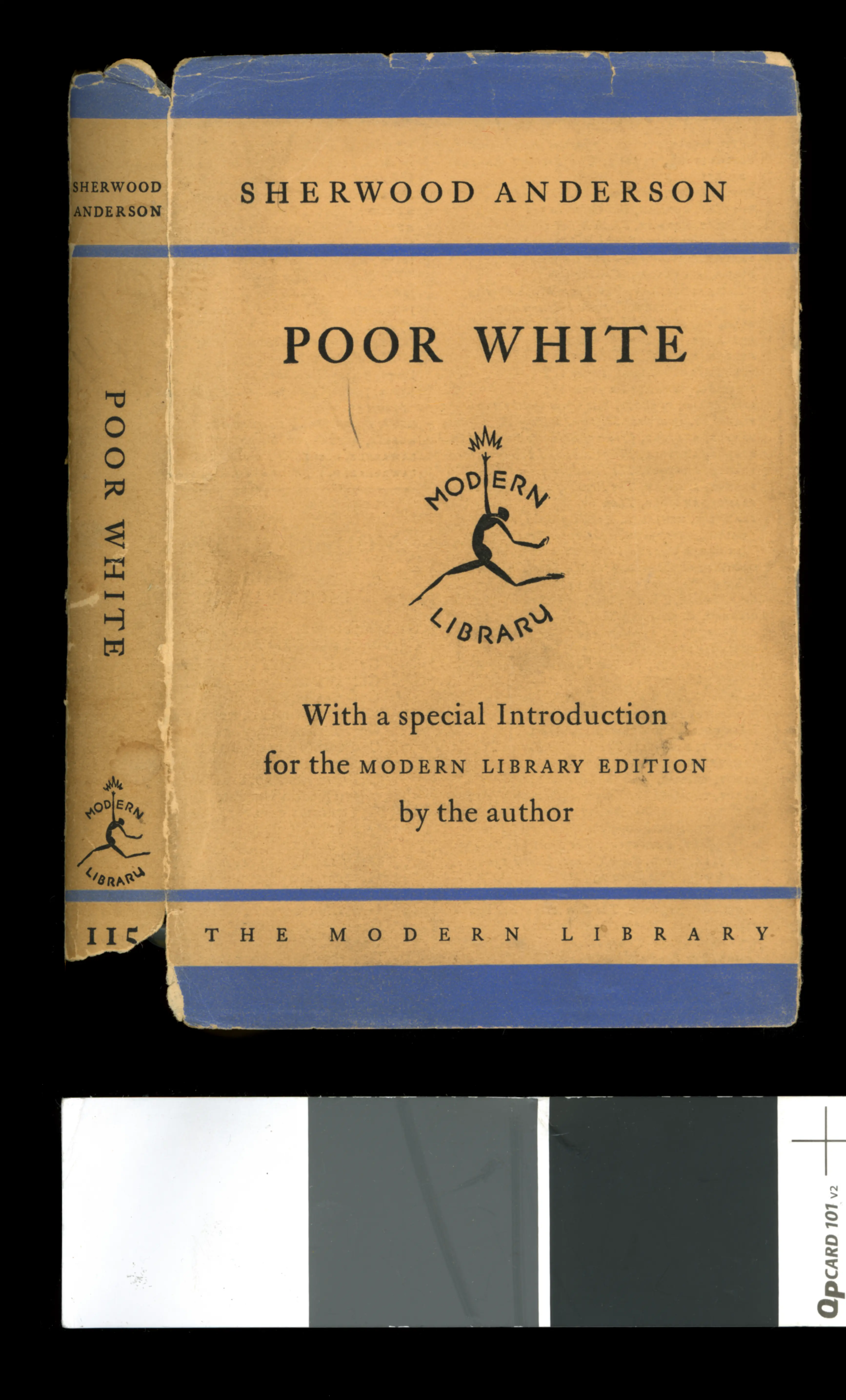
SHERWOOD ANDERSON. POOR WHITE. 1926–1939. (ML 115)
121. First printing (1926)
[within double rules] POOR WHITE | [rule] | BY | SHERWOOD ANDERSON | [rule] | [
Pp. [i–iv] v–viii, [1–2] 3–371 [372–380]. [1]18 [2–12]16
[i] half title; [ii]
Variant A: Pp. [i–iv] v–viii, [1–2] 3–371 [372–376]. [1–12]16. Contents as 121 except: [373–376] incomplete ML list; First statement retained on p. [iv]. (Fall 1925) Note: Priority with 121 not established. The “first printing” of 8,000 copies noted in RH records may have represented both printings with fall 1925 lists. If so they were probably placed on sale simultaneously.
Variant B: Pp. [i–iv] v–viii [ix–x], [2], [1–2] 3–371 [372]. [1–12]16. Contents as 121 except: [ii] pub. note about ML edition of Winesburg, Ohio; [iv] manufacturing statement; [ix] dedication: TO | TENNESSEE MITCHELL ANDERSON; [x] blank; [1] part title: BOOK I; [2] blank; [1] fly title; [372] blank. Note: Variant B includes the dedication to Tennessee Mitchell Anderson that was omitted from earlier ML printings at Anderson’s request, and the printing described transposes the fly and part titles. Some printings of variant B correct the order with the fly title on p. [1] and the part title on p. [1].
Jacket A:
Text on front:
POOR WHITE tells the story of the American power that dots a vast valley with cities overnight, and builds a network of industry, making quick men rich and fearful men poor. The hero works for this force although he doesn’t like or understand it. He is a dreamy, rather stupid “poor white” boy who “piddles around” with little mechanical tricks while he is a bored telegraph operator—until an invention made [sic] him suddenly rich and famous. Then comes the “poor white’s” love, and again the forces that twist men make Hugh McVey’s story a wild and terrible one, bigger than the mere story of one man. If, as the critics have said, Anderson’s WINESBURG, OHIO, marks the point of our literary adolescence, POOR WHITE testifies to our artistic majority. It transcends the limitations of his earlier books and develops their latent qualities the promise of his previous work is fulfilled. (Fall 1925)
Jacket B:
Front flap:
As the interpreter of Middle Western life, Sherwood Anderson holds a supreme position among American novelists. Poor White, like Winesburg, Ohio (No. 104 in the Modern Library), became immediately upon its appearance the forerunner of a vital school of contemporary writing. This story of new forces, creating cities overnight, making men rich and powerful or poor and rejected, takes its origin directly from our own soil and from the American way of life with all the naturalness and humanity for which Anderson has become world celebrated. (Spring 1934)
Originally published by B. W. Huebsch, 1920; Huebsch merged with Viking Press, August 1925. ML edition (pp. [1]–371) printed from Huebsch/Viking plates with the dedication omitted in early printings. Published February 1926. WR 13 February 1926. First printing: 8,000 copies. Discontinued fall 1939.
When Anderson became a B&L author in April 1925, Liveright expressed interest in taking over his earlier books from Huebsch and including Poor White in the ML in the fall (Liveright to Anderson, 11 April 1925; Anderson Papers, Newberry Library). A clause in Anderson’s contract with B&L stated: “The publisher further agrees to immediately endeavor to purchase from B. W. Huebsch, if the author so advises in writing, the reprint rights for Poor White for The Modern Library” (contract dated 10 April 1925; Anderson Papers). Liveright sold the ML before Poor White could be added to the series. It is not known whether reprint rights for the ML edition were negotiated before or after the sale.
For writing the introduction Anderson received a complete set of ML books instead of the usual $50 fee (Cerf to Anderson, 14 November 1925). He wrote in the introduction: “There is this book, ‘Poor White’—now to be published in The Modern Library, tricked out in a new dress, going to call on new people. The Modern Library is something magnificent. Long rows of names—illustrious names. My book, ‘Poor White,’ feels a little like a countryman going to live in a great modern sophisticated city” (ML ed., p. vi).
The dedication to Tennessee Mitchell Anderson, from whom Anderson was divorced in 1924, was omitted from the ML edition at his request (Anderson to Cerf, undated but before 14 November 1925). The dedication was inadvertently restored in later printings (see variant B).
Sales of Poor White during the first six months of 1928 placed it 85th out of 147 ML titles. Printings of the ML edition totaled 15,000 copies by April 1930, including printings of 4,000 copies (August 1927), 1,000 copies (August 1929), and 2,000 copies (April 1930).
Also in the Modern Library
Anderson, Winesburg, Ohio (1921–1973) 96
{
  "full": "\n**SHERWOOD ANDERSON. POOR WHITE. 1926–1939. (ML 115)**  \n\n#### 121. First printing (1926)  \n\n[within double rules] POOR WHITE | [rule] | BY | SHERWOOD ANDERSON | [rule] | [torchbearer A2] | [rule] | THE MODERN LIBRARY | PUBLISHERS · NEW YORK  \n\nPp. [i–iv] v–viii, [1–2] 3–371 [372–380]. [1]18 [2–12]16  \n\n[i] half title; [ii] pub. note A4; [iii] title; [iv] *Copyright* 1920, *by* B. W. HUEBSCH, INC. | [short double rule] | *Introduction Copyright* 1926, *by* | THE MODERN LIBRARY , INC. | [short double rule] | *First Modern Library Edition* | 1926; v–viii INTRODUCTION signed p. viii: Sherwood Anderson. | November 10, 1925.; [1] part title: BOOK I; [2] blank; 3–371 text; [372] pub. note about ML edition of *Winesburg, Ohio*; [373–378] ML list; [379–380] ML subject index. (*Fall 1925*) *Note:* Priority with variant A not established.  \n\n> *Variant A:* Pp. [i–iv] v–viii, [1–2] 3–371 [372–376]. [1–12]16. Contents as 121 except: [373–376] incomplete ML list; *First* statement retained on p. [iv]. (*Fall 1925*) *Note:* Priority with 121 not established. The “first printing” of 8,000 copies noted in RH records may have represented both printings with fall 1925 lists. If so they were probably placed on sale simultaneously. \n\n>*Variant B:* Pp. [i–iv] v–viii [ix–x], [*2*], [1–2] 3–371 [372]. [1–12]16. Contents as 121 except: [ii] pub. note about ML edition of *Winesburg, Ohio*; [iv] manufacturing statement; [ix] dedication: TO | TENNESSEE MITCHELL ANDERSON; [x] blank; [*1*] part title: BOOK I; [*2*] blank; [1] fly title; [372] blank. *Note:* Variant B includes the dedication to Tennessee Mitchell Anderson that was omitted from earlier ML printings at Anderson’s request, and the printing described transposes the fly and part titles. Some printings of variant B correct the order with the fly title on p. [*1*] and the part title on p. [1].  \n\n*Jacket A:* Uniform typographic jacket B1.  \n\n> Text on front:
 POOR WHITE tells the story of the American power that dots a vast valley with cities overnight, and builds a network of industry, making quick men rich and fearful men poor. The hero works for this force although he doesn’t like or understand it. He is a dreamy, rather stupid “poor white” boy who “piddles around” with little mechanical tricks while he is a bored telegraph operator—until an invention made [*sic*] him suddenly rich and famous. Then comes the “poor white’s” love, and again the forces that twist men make Hugh McVey’s story a wild and terrible one, bigger than the mere story of one man. If, as the critics have said, Anderson’s WINESBURG, OHIO, marks the point of our literary adolescence, POOR WHITE testifies to our artistic majority. It transcends the limitations of his earlier books and develops their latent qualities the promise of his previous work is fulfilled. (*Fall 1925)*  \n\n*Jacket B:* Uniform typographic jacket D. (*Spring 1930*)  \n\n> Front flap:
 As the interpreter of Middle Western life, Sherwood Anderson holds a supreme position among American novelists. *Poor White*, like *Winesburg, Ohio* (No. 104 in the Modern Library), became immediately upon its appearance the forerunner of a vital school of contemporary writing. This story of new forces, creating cities overnight, making men rich and powerful or poor and rejected, takes its origin directly from our own soil and from the American way of life with all the naturalness and humanity for which Anderson has become world celebrated. (*Spring 1934*)  \n\nOriginally published by B. W. Huebsch, 1920; Huebsch merged with Viking Press, August 1925. ML edition (pp. [1]–371) printed from Huebsch/Viking plates with the dedication omitted in early printings. Published February 1926. *WR* 13 February 1926. First printing: 8,000 copies. Discontinued fall 1939.  \n\nWhen Anderson became a B&L author in April 1925, Liveright expressed interest in taking over his earlier books from Huebsch and including *Poor White* in the ML in the fall (Liveright to Anderson, 11 April 1925; Anderson Papers, Newberry Library). A clause in Anderson’s contract with B&L stated: “The publisher further agrees to immediately endeavor to purchase from B. W. Huebsch, if the author so advises in writing, the reprint rights for Poor White for The Modern Library” (contract dated 10 April 1925; Anderson Papers). Liveright sold the ML before *Poor White* could be added to the series. It is not known whether reprint rights for the ML edition were negotiated before or after the sale.  \n\nFor writing the introduction Anderson received a complete set of ML books instead of the usual \\$50 fee (Cerf to Anderson, 14 November 1925). He wrote in the introduction: “There is this book, ‘Poor White’—now to be published in The Modern Library, tricked out in a new dress, going to call on new people. The Modern Library is something magnificent. Long rows of names—illustrious names. My book, ‘Poor White,’ feels a little like a countryman going to live in a great modern sophisticated city” (ML ed., p. vi).  \n\nThe dedication to Tennessee Mitchell Anderson, from whom Anderson was divorced in 1924, was omitted from the ML edition at his request (Anderson to Cerf, undated but before 14 November 1925). The dedication was inadvertently restored in later printings (see variant B).  \n\nSales of *Poor White* during the first six months of 1928 placed it 85th out of 147 ML titles. Printings of the ML edition totaled 15,000 copies by April 1930, including printings of 4,000 copies (August 1927), 1,000 copies (August 1929), and 2,000 copies (April 1930).  \n\nAlso in the Modern Library\nAnderson, *Winesburg, Ohio* (1921–1973) 96  \n\n",
  "id": "121",
  "year": "1926",
  "label": "SHERWOOD ANDERSON. POOR WHITE. 1926–1939. (ML 115)",
  "author": "SHERWOOD ANDERSON",
  "title": "POOR WHITE.",
  "date": "1926–1939.",
  "something": "ML 115",
  "revisions": [
    {
      "id": "121",
      "title": "First printing (1926)  ",
      "full": "\n\n[within double rules] POOR WHITE | [rule] | BY | SHERWOOD ANDERSON | [rule] | [torchbearer A2] | [rule] | THE MODERN LIBRARY | PUBLISHERS · NEW YORK  \n\nPp. [i–iv] v–viii, [1–2] 3–371 [372–380]. [1]18 [2–12]16  \n\n[i] half title; [ii] pub. note A4; [iii] title; [iv] *Copyright* 1920, *by* B. W. HUEBSCH, INC. | [short double rule] | *Introduction Copyright* 1926, *by* | THE MODERN LIBRARY , INC. | [short double rule] | *First Modern Library Edition* | 1926; v–viii INTRODUCTION signed p. viii: Sherwood Anderson. | November 10, 1925.; [1] part title: BOOK I; [2] blank; 3–371 text; [372] pub. note about ML edition of *Winesburg, Ohio*; [373–378] ML list; [379–380] ML subject index. (*Fall 1925*) *Note:* Priority with variant A not established.  \n\n> *Variant A:* Pp. [i–iv] v–viii, [1–2] 3–371 [372–376]. [1–12]16. Contents as 121 except: [373–376] incomplete ML list; *First* statement retained on p. [iv]. (*Fall 1925*) *Note:* Priority with 121 not established. The “first printing” of 8,000 copies noted in RH records may have represented both printings with fall 1925 lists. If so they were probably placed on sale simultaneously. \n\n>*Variant B:* Pp. [i–iv] v–viii [ix–x], [*2*], [1–2] 3–371 [372]. [1–12]16. Contents as 121 except: [ii] pub. note about ML edition of *Winesburg, Ohio*; [iv] manufacturing statement; [ix] dedication: TO | TENNESSEE MITCHELL ANDERSON; [x] blank; [*1*] part title: BOOK I; [*2*] blank; [1] fly title; [372] blank. *Note:* Variant B includes the dedication to Tennessee Mitchell Anderson that was omitted from earlier ML printings at Anderson’s request, and the printing described transposes the fly and part titles. Some printings of variant B correct the order with the fly title on p. [*1*] and the part title on p. [1].  \n\n*Jacket A:* Uniform typographic jacket B1.  \n\n> Text on front:
 POOR WHITE tells the story of the American power that dots a vast valley with cities overnight, and builds a network of industry, making quick men rich and fearful men poor. The hero works for this force although he doesn’t like or understand it. He is a dreamy, rather stupid “poor white” boy who “piddles around” with little mechanical tricks while he is a bored telegraph operator—until an invention made [*sic*] him suddenly rich and famous. Then comes the “poor white’s” love, and again the forces that twist men make Hugh McVey’s story a wild and terrible one, bigger than the mere story of one man. If, as the critics have said, Anderson’s WINESBURG, OHIO, marks the point of our literary adolescence, POOR WHITE testifies to our artistic majority. It transcends the limitations of his earlier books and develops their latent qualities the promise of his previous work is fulfilled. (*Fall 1925)*  \n\n*Jacket B:* Uniform typographic jacket D. (*Spring 1930*)  \n\n> Front flap:
 As the interpreter of Middle Western life, Sherwood Anderson holds a supreme position among American novelists. *Poor White*, like *Winesburg, Ohio* (No. 104 in the Modern Library), became immediately upon its appearance the forerunner of a vital school of contemporary writing. This story of new forces, creating cities overnight, making men rich and powerful or poor and rejected, takes its origin directly from our own soil and from the American way of life with all the naturalness and humanity for which Anderson has become world celebrated. (*Spring 1934*)  \n\nOriginally published by B. W. Huebsch, 1920; Huebsch merged with Viking Press, August 1925. ML edition (pp. [1]–371) printed from Huebsch/Viking plates with the dedication omitted in early printings. Published February 1926. *WR* 13 February 1926. First printing: 8,000 copies. Discontinued fall 1939.  \n\nWhen Anderson became a B&L author in April 1925, Liveright expressed interest in taking over his earlier books from Huebsch and including *Poor White* in the ML in the fall (Liveright to Anderson, 11 April 1925; Anderson Papers, Newberry Library). A clause in Anderson’s contract with B&L stated: “The publisher further agrees to immediately endeavor to purchase from B. W. Huebsch, if the author so advises in writing, the reprint rights for Poor White for The Modern Library” (contract dated 10 April 1925; Anderson Papers). Liveright sold the ML before *Poor White* could be added to the series. It is not known whether reprint rights for the ML edition were negotiated before or after the sale.  \n\nFor writing the introduction Anderson received a complete set of ML books instead of the usual \\$50 fee (Cerf to Anderson, 14 November 1925). He wrote in the introduction: “There is this book, ‘Poor White’—now to be published in The Modern Library, tricked out in a new dress, going to call on new people. The Modern Library is something magnificent. Long rows of names—illustrious names. My book, ‘Poor White,’ feels a little like a countryman going to live in a great modern sophisticated city” (ML ed., p. vi).  \n\nThe dedication to Tennessee Mitchell Anderson, from whom Anderson was divorced in 1924, was omitted from the ML edition at his request (Anderson to Cerf, undated but before 14 November 1925). The dedication was inadvertently restored in later printings (see variant B).  \n\nSales of *Poor White* during the first six months of 1928 placed it 85th out of 147 ML titles. Printings of the ML edition totaled 15,000 copies by April 1930, including printings of 4,000 copies (August 1927), 1,000 copies (August 1929), and 2,000 copies (April 1930).  \n\nAlso in the Modern Library\nAnderson, *Winesburg, Ohio* (1921–1973) 96  \n\n"
    }
  ],
  "type": "book"
}