
The Modern Library Bibliography
HERMAN MELVILLE. MOBY DICK. 1926–1976. (ML 119)
124a. First printing (1926)
[within double rules] MOBY DICK | [rule] | BY | HERMAN MELVILLE | [rule] | INTRODUCTION BY | RAYMOND WEAVER | [rule] | [
Pp. [i–iv] v–xxi [xxii], 1–565 [566–570]. [1–18]16 [19]8
[i] half title; [ii]
Variant: Pagination and collation as 124a. Contents as 124a except: [ii]
pub. note A5 ; [iv] Introduction Copyright, 1926, by | THE MODERN LIBRARY, INC. | [short double rule]; [567–570] ML list. (Fall 1927) Note: Copyright statement reset with first line entirely in italic.
Jacket A:
Text on front:
“In this wild, beautiful romance, Herman Melville seems to have spoken the very secret of the Sea, and to have drawn into his tale all the magic, all the sadness, all the wild joy of many waters. It stands quite alone; it strikes a note no other sea writer has ever struck. It is a work not only unique of its kind, but a great achievement—the expression of an imagination that rises to the highest, and so is amongst the world’s great works of art.” —John Masefield (The Modern Library edition of “Moby Dick” is complete and unabridged). (Fall 1926)
Jacket B:
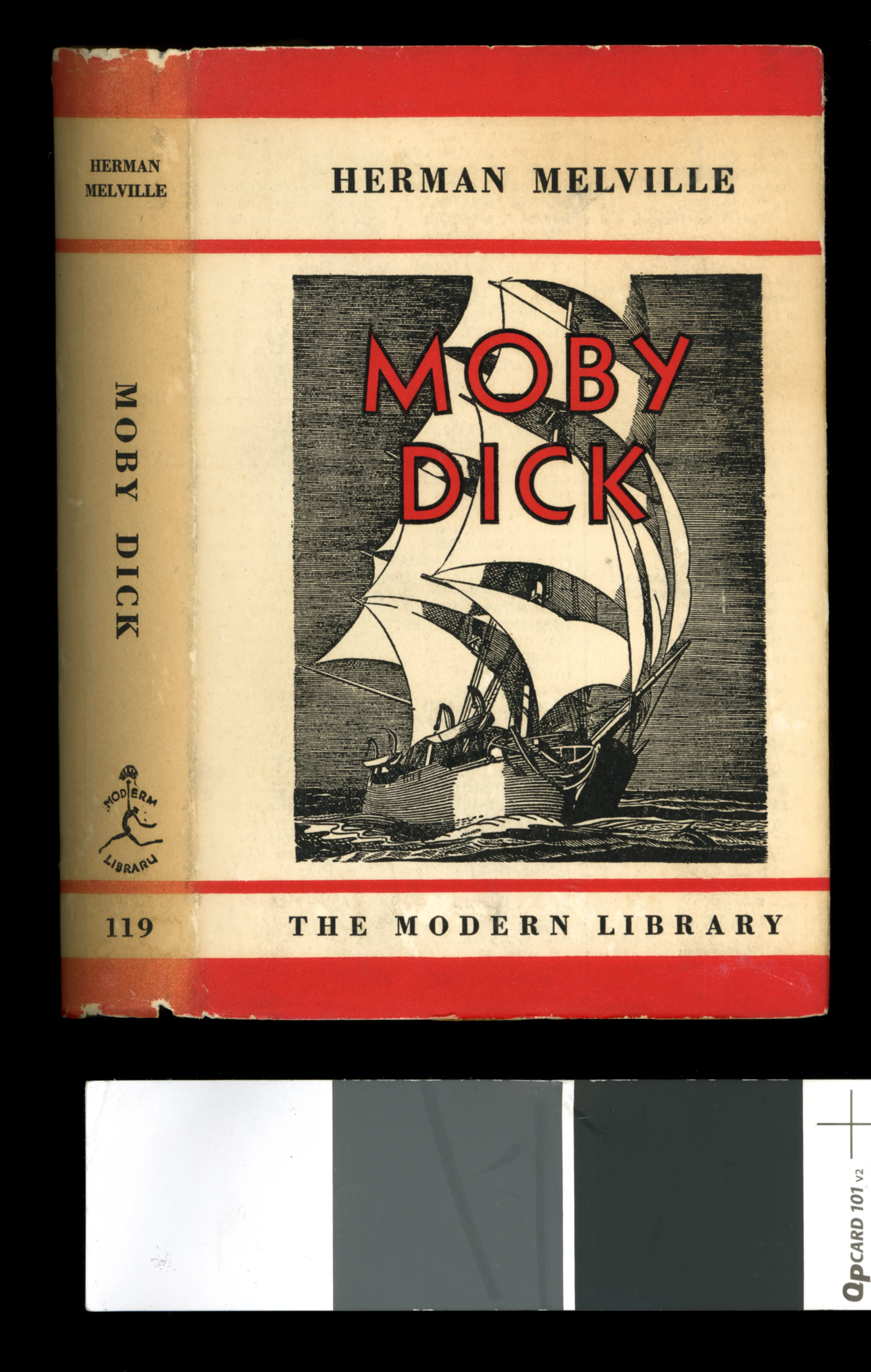
Jacket C: Pictorial in strong red (12) and black on cream paper with inset black-and-white illustration by Rockwell Kent of a ship under full sail; title and borders in strong red with title superimposed over Kent illustration, other lettering in black. (Spring 1932) Note: Kent’s illustration was created for the 3-volume limited edition of Moby Dick published by Lakeside Press in 1930. Later that year Random House published a one-volume trade edition printed from plates made from a new typesetting; the MLG edition (G65) printed from RH plates appeared in 1944. Kent’s illustration appears on p. 81 of RH/MLG printings. The reproduction of the illustration on jacket C is slightly cropped at the foot.
Front flap:
Of the comparatively few books in the world’s literature about which it is safe to foretell the verdict of posterity, Moby Dick stands in the first rank. Universally recognized as one of the greatest of all tales of the sea, it will live by its own surge and elemental force. This mighty history of the pursuit of the vindictive monster, upon which Herman Melville lavished all the resources of his imagination and Jovian hate, is the symbol and the substance of reckless adventure and indomitable courage. (Spring 1939)
ML edition printed from plates made from a new typesetting. Published June 1926. WR not found. First printing: Not ascertained. Discontinued 1976/77.
Melville was regarded as a minor American author before the 1920s. The Library of Congress classification for American Literature, the PS’s, published in 1915, assigns a range of 49 numbers each to nineteenth-century American authors who were perceived as first rank. Emerson and Hawthorne have ranges of 49 numbers, as does John Greenleaf Whittier. Works by and about Hawthorne are classified within the range PS 1850‑1898, for example. In contrast, Melville is assigned a range of nine numbers (PS 2380‑2388). This reflects Melville’s reputation in 1915, when he was regarded primarily as a minor author of South Sea romances like Typee and Omoo. Moby-Dick sold poorly when it was published in 1851 and was out of print by 1887.
The critical reevaluation of Melville began in the 1920s with the publication of Raymond Weaver’s biography, Herman Melville: Mariner and Mystic (George H. Doran, 1921), followed by the first publication of Billy Budd, a major work that Melville left in semi-final form. Weaver edited the manuscript and published it in Billy Budd and Other Prose Pieces (London: Constable, 1924); a revised version appeared four years later in Shorter Novels of Herman Melville (Horace Liveright, 1928).
Weaver had been one of Cerf’s favorite professors at Columbia. His biography of Melville was published a year or two after Cerf graduated with a degree in journalism. In his posthumously published autobiography, based on oral history interviews conducted by Columbia University’s Oral History Office, Cerf states: “Raymond Weaver’s course in Comparative Literature was extraordinary. Inside of three weeks this man had even the athletes reading Dante and Cervantes and Melville . . . and discussing them with deep interest. He was a persuasive teacher and a wonderfully nice man” (Cerf, At Random, pp. 17–18).
Weaver wrote introductions to two editions of Moby-Dick that were published as the revival of interest in Melville was getting under way. His introduction to the edition published by Albert & Charles Boni in 1925 is completely different from the introduction he wrote the following year for the ML.
The ML may have tried to position its edition of Moby-Dick to appeal both to readers looking for escapist romance and those who appreciated the darker, allegorical aspects of Melville’s work. The quote from Masefield on the front panel of jacket A refers to “this wild, beautiful romance” and to Melville’s having “drawn into his tale all the magic, all the sadness, all the wild joy of many waters.” In contrast, Weaver’s introduction refers to Melville’s having chosen “as a symbol of the malice and terror that he felt at the core of existence . . . a whale of leperous [sic] whiteness” and to “Melville’s dark intent” (p. vii).
Sales of Moby Dick during the first six months of 1928 placed it 20th out of 147 ML titles. During the 18-month period May 1942‑October 1943 it was in the middle of the first quarter of ML titles in terms of sales. It ranked 29th out of 360 titles during the 12-month period November 1951–October 1952. A complete list of ML printings of Moby Dick from January 1931 through October 1944 shows a surge of demand following American entry into the Second World War. There were eleven printings between 1931 and 1941 totaling 26,000 copies (an average of 2,360 copies a year) and seven printings between 1942 and 1944 totaling 23,000 copies (an average of 7,660 copies a year).
Cerf and Klopfer used the ML plates for a 1931 printing of Moby Dick under the imprint Carlton House, which was used mainly for dollar “specials” intended for sale in department stores. The 1931 Carlton House titles included at least 13 titles printed from ML plates. In a departure from the usual format, the 1931 titles used good quality paper, were bound in green, blue, or maroon leather, had gilt tops, and were sold in black slipcases at a retail price of $2.50. The ML printed 500 copies of each title. The books were placed in leading department stores in major cities as an experiment. Most of the stores did not do well with the books. One of the ML’s sales representatives indicated that they would have been all right before the Crash, but 1931 “was one of those years when even $2.50 was a high priced book” (Carl Smalley to Cerf, 18 August 1932).
The ML also published Moby Dick (G65) in 1944 in the Giants series, using plates of the RH edition illustrated by Rockwell Kent.
All ML editions of Melville’s novel, including the Giant, use the spelling “Moby Dick” on the title page and throughout the text instead of the conventional hyphenated spelling “Moby-Dick.” Most editions of the work, including the 1851 first printing and the 1983 Library of America edition, use the hyphen, but there are other reputable editions that omit it.
The Modern Library paperback edition, published in 2000 from a new typesetting with Kent’s illustrations and an introduction by Elizabeth Hardwick, is inconsistent. The title is Moby-Dick or, The Whale, but the biographical note (pp. v–vi) refers to Melville’s novel as Moby Dick, without the hyphen. Hardwick’s introduction uses the hyphenated form when referring to the title of the book and the unhyphenated form when referring to the whale. The Library of America edition (1983), which includes Redburn and White-Jacket as well as Moby-Dick, uses the hyphen as part of the title, and the running heads on verso pages (pp. 774–1406) are MOBY-DICK. Running heads on recto pages record chapter titles. Chapter 41 is titled “Moby Dick” without the hyphen, with the result that running heads on recto pages of Chapter 41 (pp. 985–991) are MOBY DICK.
124b. Title page reset (c. 1940)
Moby Dick | BY | HERMAN MELVILLE | Introduction by RAYMOND WEAVER | [
Pagination and collation as 124a.
Contents as 124a except: [ii] blank; [iv] INTRODUCTION COPYRIGHT, 1926, | BY THE MODERN LIBRARY, INC.; [567–570] blank.
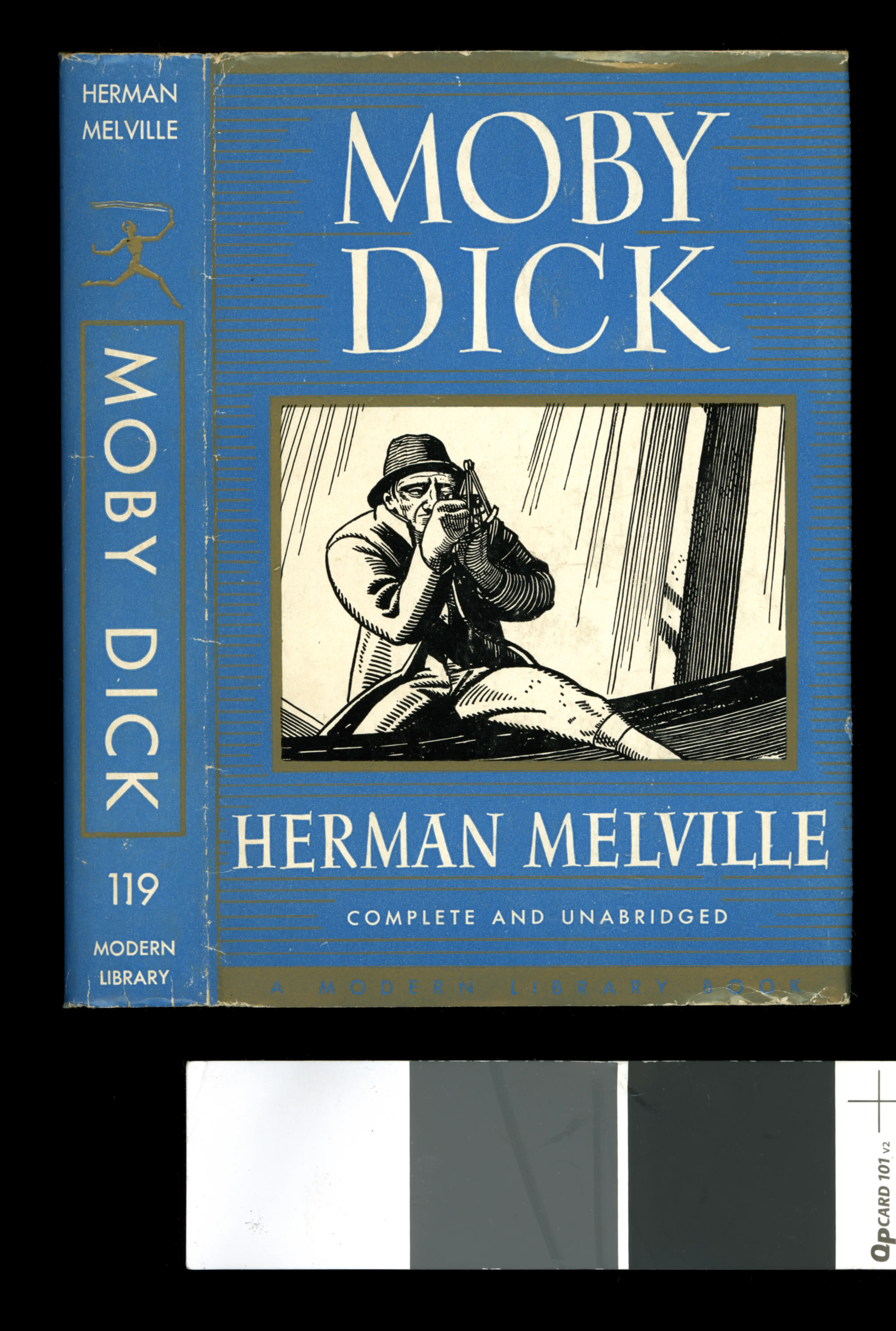
Jacket: Pictorial in moderate blue (182), dark grayish yellow (91) and black on coated white paper with inset black-and-white illustration by Rockwell Kent of Ahab with sextant; reprinted and slightly cropped from the 1930 edition of Moby Dick published by RH and reprinted in MLG (p. 715); lettering in reverse against moderate blue background ruled in dark grayish yellow. Designed by Paul Galdone, March 1940; unsigned.
Front flap as 124a jacket C. (Fall 1947)
124c. Howard introduction added (1950)
MOBY | DICK | OR, | THE WHALE | [rule] | By Herman Melville | [rule] | INTRODUCTION BY Leon Howard | Professor of English, The University of California | [
Pp. [i–iv] v–xxxi [xxxii], 1–565 [566–576]. [1–19]16
[i] half title; [ii] blank; [iii] title; [iv] Copyright, 1950, by Random House, Inc.; v–xvi INTRODUCTION | By Leon Howard; xvii BIBLIOGRAPHICAL NOTE; [xviii] blank; [xix] CONTENTS; [xx] dedication; [xxi–xxii] ETYMOLOGY; [xxiii]–xxxi EXTRACTS; [xxxii] blank; 1–[566] text; [567–572] ML list; [573–574] ML Giants list; [575–576] blank. (Spring 1952)
Variant: Pagination as 124c. [1]16 [2–8]32 [9]16 [10]32 [11]16. Contents as 124c except: [iv] COPYRIGHT, 1950, BY RANDOM HOUSE, INC.; [567–574] ML list; [575–576] ML Giants list. (Spring 1967)
Jacket A: As 124b. (Spring 1953)
Front flap revised:
In the little more than one hundred years since Moby Dick was first published, critics have probed its inexhaustible symbolic treasures. The general reader has also found great wealth as he participated in the hunt for the white whale. He encountered an adventure story of magnificent sweep and suspense. From its incomparably effective opening sentence, “Call me Ishmael,” to its dramatic end when the white whale triumphs and all hands, except Ishmael, perish, Melville makes everyone—the reader most of all—share Captain Ahab’s obsessive belief that he alone can destroy the white, evil leviathan. Moby Dick is more than a tale of the pursuit of a monster; it is an allegory of relentless hatred and evil redeemed by man’s indomitable courage. (Fall 1954)
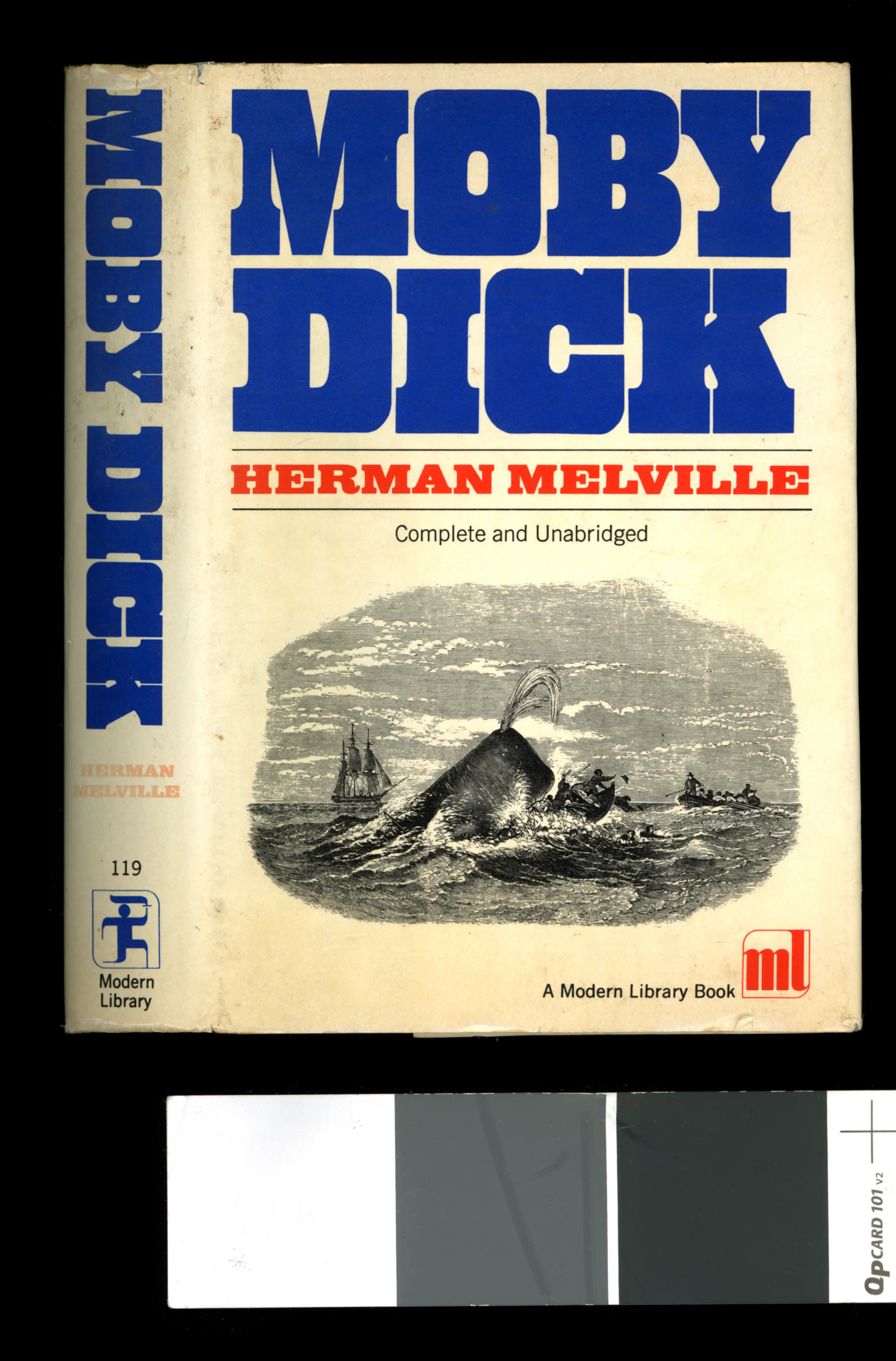
Jacket B: Fujita pictorial jacket in deep blue (179), deep reddish orange (36) and black on coated white paper with inset wood engraving of whale destroying a whaling boat; lettering in deep blue, deep reddish orange and black, all against white background.
Front flap:
“Moby Dick possesses an unusual, if not unique, literary form which cannot be compared to that of the conventional novel, drama or travel book. It is a realistic story of life aboard a whaling vessel, a romance of adventure and strange characters, a drama of heroic determination and conflict and a technical treatise on whaling. . . . Because of its unconventional complexity, it is a disturbing book. . . . Like all great books, Moby Dick has the potentiality of enriching itself with the substance of each new reader’s emotions and ideas, and it has grown greater in its implications with the passage of time.” —from the Introduction by Leon Howard
Originally published with the Howard introduction in MLCE (1950) and subsequently in the regular ML. Professor Austin Warren of the University of Michigan was originally invited to write the introduction. He agreed to a deadline of 30 March and a $200 fee but withdrew two days before it was due, pleading illness and expressing dissatisfaction with the fee compared to the royalty offered by the competing series Rinehart Editions (Albert Erskine to Warren, 26 January 1950; Warren to Erskine, 28 March 1950). Erskine turned to Leon Howard, then at Northwestern University, who agreed to write the introduction for the $200 fee (Erskine to Howard, 31 March 1950).
Melville’s dedication to Nathaniel Hawthorne, omitted from earlier ML printings, is included in 124c.
124d. Title-page device reset (1968/69)
Title as 124c except line 10: [
Pagination, collation and contents as 124c variant. (Spring 1967) Note: Torchbearer K was first used in fall 1968; ML lists were not updated after spring 1967.
Jacket: As 124c jacket B.
Also in the Modern Library
Melville, Moby Dick, illustrated by Rockwell Kent (Giant, 1944–1962; 1982– ) G65
Melville, Selected Writings (Giant, 1952– ) G80
{
  "full": "\n**HERMAN MELVILLE. MOBY DICK. 1926–1976. (ML 119)**  \n\n#### 124a. First printing (1926)  \n\n[within double rules] MOBY DICK | [rule] | BY | HERMAN MELVILLE | [rule] | INTRODUCTION BY | RAYMOND WEAVER | [rule] | [torchbearer A2] | [rule] | THE MODERN LIBRARY | PUBLISHERS : NEW YORK  \n\nPp. [i–iv] v–xxi [xxii], 1–565 [566–570]. [1–18]16 [19]8  \n\n[i] half title; [ii] pub. note A4; [iii] title; [iv] *Introduction Copyright,* 1926, *by* | THE MODERN LIBRARY, INC. | [short double rule] | *First Modern Library Edition* | 1926; v–viii INTRODUCTION signed p. viii: Raymond Weaver | *March,* 1926.; [ix] CONTENTS; [x] blank; [xi–xii] ETYMOLOGY; [xiii]–xxi EXTRACTS; [xxii] blank; 1–[566] text; [567–570] ML list. (*Fall 1925*) *Note:* *First* statement also appears on a printing with pub. note D5 on p. [ii] and [567–570] blank; probably the second printing but priority not established.  \n\n> *Variant:* Pagination and collation as 124a. Contents as 124a except: [ii] pub. note A5; [iv] *Introduction* *Copyright*, *1926*, *by* | THE MODERN LIBRARY, INC. | [short double rule]; [567–570] ML list. (*Fall 1927*) *Note:* Copyright statement reset with first line entirely in italic.  \n\n*Jacket A:* Uniform typographic jacket B2.  \n\n> Text on front:
 “In this wild, beautiful romance, Herman Melville seems to have spoken the very secret of the Sea, and to have drawn into his tale all the magic, all the sadness, all the wild joy of many waters. It stands quite alone; it strikes a note no other sea writer has ever struck. It is a work not only unique of its kind, but a great achievement—the expression of an imagination that rises to the highest, and so is amongst the world’s great works of art.” —John Masefield *(The Modern Library edition of “Moby Dick” is complete and unabridged).* (*Fall 1926*)  \n\n*Jacket B:* Uniform typographic jacket D. (*Fall 1930*)  \n\n*Jacket C:* Pictorial in strong red (12) and black on cream paper with inset black-and-white illustration by Rockwell Kent of a ship under full sail; title and borders in strong red with title superimposed over Kent illustration, other lettering in black. (*Spring 1932*) *Note:* Kent’s illustration was created for the 3-volume limited edition of *Moby Dick* published by Lakeside Press in 1930. Later that year Random House published a one-volume trade edition printed from plates made from a new typesetting; the MLG edition (G65) printed from RH plates appeared in 1944. Kent’s illustration appears on p. 81 of RH/MLG printings. The reproduction of the illustration on jacket C is slightly cropped at the foot.  \n\n> Front flap:
 Of the comparatively few books in the world’s literature about which it is safe to foretell the verdict of posterity, *Moby Dick* stands in the first rank. Universally recognized as one of the greatest of all tales of the sea, it will live by its own surge and elemental force. This mighty history of the pursuit of the vindictive monster, upon which Herman Melville lavished all the resources of his imagination and Jovian hate, is the symbol and the substance of reckless adventure and indomitable courage. (*Spring 1939*)  \n\nML edition printed from plates made from a new typesetting. Published June 1926. *WR* not found. First printing: Not ascertained. Discontinued 1976/77.  \n\nMelville was regarded as a minor American author before the 1920s. The Library of Congress classification for American Literature, the PS’s, published in 1915, assigns a range of 49 numbers each to nineteenth-century American authors who were perceived as first rank. Emerson and Hawthorne have ranges of 49 numbers, as does John Greenleaf Whittier. Works by and about Hawthorne are classified within the range PS 1850‑1898, for example. In contrast, Melville is assigned a range of nine numbers (PS 2380‑2388). This reflects Melville’s reputation in 1915, when he was regarded primarily as a minor author of South Sea romances like *Typee* and *Omoo*. *Moby-Dick* sold poorly when it was published in 1851 and was out of print by 1887.  \n\nThe critical reevaluation of Melville began in the 1920s with the publication of Raymond Weaver’s biography, *Herman Melville: Mariner and Mystic* (George H. Doran, 1921), followed by the first publication of *Billy Budd*, a major work that Melville left in semi-final form. Weaver edited the manuscript and published it in *Billy Budd and Other Prose Pieces* (London: Constable, 1924); a revised version appeared four years later in *Shorter Novels of Herman Melville* (Horace Liveright, 1928).  \n\nWeaver had been one of Cerf’s favorite professors at Columbia. His biography of Melville was published a year or two after Cerf graduated with a degree in journalism. In his posthumously published autobiography, based on oral history interviews conducted by Columbia University’s Oral History Office, Cerf states: “Raymond Weaver’s course in Comparative Literature was extraordinary. Inside of three weeks this man had even the athletes reading Dante and Cervantes and Melville . . . and discussing them with deep interest. He was a persuasive teacher and a wonderfully nice man” (Cerf, *At Random*, pp. 17–18).  \n\nWeaver wrote introductions to two editions of *Moby-Dick* that were published as the revival of interest in Melville was getting under way. His introduction to the edition published by Albert & Charles Boni in 1925 is completely different from the introduction he wrote the following year for the ML.  \n\nThe ML may have tried to position its edition of *Moby-Dick* to appeal both to readers looking for escapist romance and those who appreciated the darker, allegorical aspects of Melville’s work. The quote from Masefield on the front panel of jacket A refers to “this wild, beautiful romance” and to Melville’s having “drawn into his tale all the magic, all the sadness, all the wild joy of many waters.” In contrast, Weaver’s introduction refers to Melville’s having chosen “as a symbol of the malice and terror that he felt at the core of existence . . . a whale of leperous [*sic*] whiteness” and to “Melville’s dark intent” (p. vii).  \n\nSales of *Moby Dick* during the first six months of 1928 placed it 20th out of 147 ML titles. During the 18-month period May 1942‑October 1943 it was in the middle of the first quarter of ML titles in terms of sales. It ranked 29th out of 360 titles during the 12-month period November 1951–October 1952. A complete list of ML printings of *Moby Dick* from January 1931 through October 1944 shows a surge of demand following American entry into the Second World War. There were eleven printings between 1931 and 1941 totaling 26,000 copies (an average of 2,360 copies a year) and seven printings between 1942 and 1944 totaling 23,000 copies (an average of 7,660 copies a year).  \n\nCerf and Klopfer used the ML plates for a 1931 printing of *Moby Dick* under the imprint Carlton House, which was used mainly for dollar “specials” intended for sale in department stores. The 1931 Carlton House titles included at least 13 titles printed from ML plates. In a departure from the usual format, the 1931 titles used good quality paper, were bound in green, blue, or maroon leather, had gilt tops, and were sold in black slipcases at a retail price of \\$2.50. The ML printed 500 copies of each title. The books were placed in leading department stores in major cities as an experiment. Most of the stores did not do well with the books. One of the ML’s sales representatives indicated that they would have been all right before the Crash, but 1931 “was one of those years when even \\$2.50 was a high priced book” (Carl Smalley to Cerf, 18 August 1932).  \n\nThe ML also published *Moby Dick* (G65) in 1944 in the Giants series, using plates of the RH edition illustrated by Rockwell Kent.  \n\nAll ML editions of Melville’s novel, including the Giant, use the spelling “Moby Dick” on the title page and throughout the text instead of the conventional hyphenated spelling “Moby-Dick.” Most editions of the work, including the 1851 first printing and the 1983 Library of America edition, use the hyphen, but there are other reputable editions that omit it.  \n\nThe Modern Library paperback edition, published in 2000 from a new typesetting with Kent’s illustrations and an introduction by Elizabeth Hardwick, is inconsistent. The title is *Moby-Dick or, The Whale*, but the biographical note (pp. v–vi) refers to Melville’s novel as *Moby Dick*, without the hyphen. Hardwick’s introduction uses the hyphenated form when referring to the title of the book and the unhyphenated form when referring to the whale. The Library of America edition (1983), which includes *Redburn* and *White-Jacket* as well as *Moby-Dick*, uses the hyphen as part of the title, and the running heads on verso pages (pp. 774–1406) are MOBY-DICK. Running heads on recto pages record chapter titles. Chapter 41 is titled “Moby Dick” without the hyphen, with the result that running heads on recto pages of Chapter 41 (pp. 985–991) are MOBY DICK.  \n\n#### 124b. Title page reset (c. 1940)  \n\nMoby Dick | BY | HERMAN MELVILLE | *Introduction by* RAYMOND WEAVER | [torchbearer D1 at right; 3-line imprint at left] THE | MODERN LIBRARY | NEW YORK | [rule]  \n\nPagination and collation as 124a.  \n\nContents as 124a except: [ii] blank; [iv] INTRODUCTION COPYRIGHT, 1926, | BY THE MODERN LIBRARY, INC.; [567–570] blank.  \n\n*Jacket:* Pictorial in moderate blue (182), dark grayish yellow (91) and black on coated white paper with inset black-and-white illustration by Rockwell Kent of Ahab with sextant; reprinted and slightly cropped from the 1930 edition of *Moby Dick* published by RH and reprinted in MLG (p. 715); lettering in reverse against moderate blue background ruled in dark grayish yellow. Designed by Paul Galdone, March 1940; unsigned. \n\n> Front flap as 124a jacket C. (*Fall 1947*)  \n\n#### 124c. Howard introduction added (1950)  \n\nMOBY | DICK | OR, | THE WHALE | [rule] | *By Herman Melville* | [rule] | INTRODUCTION BY *Leon Howard* | *Professor of English, The University of California* | [torchbearer E5] | THE MODERN LIBRARY · NEW YORK  \n\nPp. [i–iv] v–xxxi [xxxii], 1–565 [566–576]. [1–19]16  \n\n[i] half title; [ii] blank; [iii] title; [iv] *Copyright, 1950, by Random House, Inc.*; v–xvi INTRODUCTION | By Leon Howard; xvii BIBLIOGRAPHICAL NOTE; [xviii] blank; [xix] CONTENTS; [xx] dedication; [xxi–xxii] ETYMOLOGY; [xxiii]–xxxi EXTRACTS; [xxxii] blank; 1–[566] text; [567–572] ML list; [573–574] ML Giants list; [575–576] blank. (*Spring 1952*)  \n\n> *Variant:* Pagination as 124c. [1]16 [2–8]32 [9]16 [10]32 [11]16. Contents as 124c except: [iv] COPYRIGHT, 1950, BY RANDOM HOUSE, INC.; [567–574] ML list; [575–576] ML Giants list. (*Spring 1967*)  \n\n*Jacket A:* As 124b. (*Spring 1953*)  \n\n> Front flap revised:
 In the little more than one hundred years since *Moby Dick* was first published, critics have probed its inexhaustible symbolic treasures. The general reader has also found great wealth as he participated in the hunt for the white whale. He encountered an adventure story of magnificent sweep and suspense. From its incomparably effective opening sentence, “Call me Ishmael,” to its dramatic end when the white whale triumphs and all hands, except Ishmael, perish, Melville makes everyone—the reader most of all—share Captain Ahab’s obsessive belief that he alone can destroy the white, evil leviathan. *Moby Dick* is more than a tale of the pursuit of a monster; it is an allegory of relentless hatred and evil redeemed by man’s indomitable courage. (*Fall 1954*)  \n\n*Jacket B:* Fujita pictorial jacket in deep blue (179), deep reddish orange (36) and black on coated white paper with inset wood engraving of whale destroying a whaling boat; lettering in deep blue, deep reddish orange and black, all against white background.  \n\n> Front flap:
 “*Moby Dick* possesses an unusual, if not unique, literary form which cannot be compared to that of the conventional novel, drama or travel book. It is a realistic story of life aboard a whaling vessel, a romance of adventure and strange characters, a drama of heroic determination and conflict and a technical treatise on whaling. . . . Because of its unconventional complexity, it is a disturbing book. . . . Like all great books, *Moby Dick* has the potentiality of enriching itself with the substance of each new reader’s emotions and ideas, and it has grown greater in its implications with the passage of time.” —from the Introduction by Leon Howard \n\nOriginally published with the Howard introduction in MLCE (1950) and subsequently in the regular ML. Professor Austin Warren of the University of Michigan was originally invited to write the introduction. He agreed to a deadline of 30 March and a \\$200 fee but withdrew two days before it was due, pleading illness and expressing dissatisfaction with the fee compared to the royalty offered by the competing series Rinehart Editions (Albert Erskine to Warren, 26 January 1950; Warren to Erskine, 28 March 1950). Erskine turned to Leon Howard, then at Northwestern University, who agreed to write the introduction for the \\$200 fee (Erskine to Howard, 31 March 1950).  \n\nMelville’s dedication to Nathaniel Hawthorne, omitted from earlier ML printings, is included in 124c.  \n\n#### 124d. Title-page device reset (1968/69)  \n\nTitle as 124c except line 10: [torchbearer K]  \n\nPagination, collation and contents as 124c variant. (*Spring 1967*) *Note:* Torchbearer K was first used in fall 1968; ML lists were not updated after spring 1967.  \n\n*Jacket:* As 124c jacket B.  \n\nAlso in the Modern Library
 Melville, *Moby Dick*, illustrated by Rockwell Kent (Giant, 1944–1962; 1982– ) G65
 Melville, *Selected Writings* (Giant, 1952– ) G80  \n\n",
  "id": "124",
  "year": "1926",
  "label": "HERMAN MELVILLE. MOBY DICK. 1926–1976. (ML 119)",
  "author": "HERMAN MELVILLE",
  "title": "MOBY DICK.",
  "date": "1926–1976.",
  "something": "ML 119",
  "revisions": [
    {
      "id": "124a",
      "title": "First printing (1926)  ",
      "full": "\n\n[within double rules] MOBY DICK | [rule] | BY | HERMAN MELVILLE | [rule] | INTRODUCTION BY | RAYMOND WEAVER | [rule] | [torchbearer A2] | [rule] | THE MODERN LIBRARY | PUBLISHERS : NEW YORK  \n\nPp. [i–iv] v–xxi [xxii], 1–565 [566–570]. [1–18]16 [19]8  \n\n[i] half title; [ii] pub. note A4; [iii] title; [iv] *Introduction Copyright,* 1926, *by* | THE MODERN LIBRARY, INC. | [short double rule] | *First Modern Library Edition* | 1926; v–viii INTRODUCTION signed p. viii: Raymond Weaver | *March,* 1926.; [ix] CONTENTS; [x] blank; [xi–xii] ETYMOLOGY; [xiii]–xxi EXTRACTS; [xxii] blank; 1–[566] text; [567–570] ML list. (*Fall 1925*) *Note:* *First* statement also appears on a printing with pub. note D5 on p. [ii] and [567–570] blank; probably the second printing but priority not established.  \n\n> *Variant:* Pagination and collation as 124a. Contents as 124a except: [ii] pub. note A5; [iv] *Introduction* *Copyright*, *1926*, *by* | THE MODERN LIBRARY, INC. | [short double rule]; [567–570] ML list. (*Fall 1927*) *Note:* Copyright statement reset with first line entirely in italic.  \n\n*Jacket A:* Uniform typographic jacket B2.  \n\n> Text on front:
 “In this wild, beautiful romance, Herman Melville seems to have spoken the very secret of the Sea, and to have drawn into his tale all the magic, all the sadness, all the wild joy of many waters. It stands quite alone; it strikes a note no other sea writer has ever struck. It is a work not only unique of its kind, but a great achievement—the expression of an imagination that rises to the highest, and so is amongst the world’s great works of art.” —John Masefield *(The Modern Library edition of “Moby Dick” is complete and unabridged).* (*Fall 1926*)  \n\n*Jacket B:* Uniform typographic jacket D. (*Fall 1930*)  \n\n*Jacket C:* Pictorial in strong red (12) and black on cream paper with inset black-and-white illustration by Rockwell Kent of a ship under full sail; title and borders in strong red with title superimposed over Kent illustration, other lettering in black. (*Spring 1932*) *Note:* Kent’s illustration was created for the 3-volume limited edition of *Moby Dick* published by Lakeside Press in 1930. Later that year Random House published a one-volume trade edition printed from plates made from a new typesetting; the MLG edition (G65) printed from RH plates appeared in 1944. Kent’s illustration appears on p. 81 of RH/MLG printings. The reproduction of the illustration on jacket C is slightly cropped at the foot.  \n\n> Front flap:
 Of the comparatively few books in the world’s literature about which it is safe to foretell the verdict of posterity, *Moby Dick* stands in the first rank. Universally recognized as one of the greatest of all tales of the sea, it will live by its own surge and elemental force. This mighty history of the pursuit of the vindictive monster, upon which Herman Melville lavished all the resources of his imagination and Jovian hate, is the symbol and the substance of reckless adventure and indomitable courage. (*Spring 1939*)  \n\nML edition printed from plates made from a new typesetting. Published June 1926. *WR* not found. First printing: Not ascertained. Discontinued 1976/77.  \n\nMelville was regarded as a minor American author before the 1920s. The Library of Congress classification for American Literature, the PS’s, published in 1915, assigns a range of 49 numbers each to nineteenth-century American authors who were perceived as first rank. Emerson and Hawthorne have ranges of 49 numbers, as does John Greenleaf Whittier. Works by and about Hawthorne are classified within the range PS 1850‑1898, for example. In contrast, Melville is assigned a range of nine numbers (PS 2380‑2388). This reflects Melville’s reputation in 1915, when he was regarded primarily as a minor author of South Sea romances like *Typee* and *Omoo*. *Moby-Dick* sold poorly when it was published in 1851 and was out of print by 1887.  \n\nThe critical reevaluation of Melville began in the 1920s with the publication of Raymond Weaver’s biography, *Herman Melville: Mariner and Mystic* (George H. Doran, 1921), followed by the first publication of *Billy Budd*, a major work that Melville left in semi-final form. Weaver edited the manuscript and published it in *Billy Budd and Other Prose Pieces* (London: Constable, 1924); a revised version appeared four years later in *Shorter Novels of Herman Melville* (Horace Liveright, 1928).  \n\nWeaver had been one of Cerf’s favorite professors at Columbia. His biography of Melville was published a year or two after Cerf graduated with a degree in journalism. In his posthumously published autobiography, based on oral history interviews conducted by Columbia University’s Oral History Office, Cerf states: “Raymond Weaver’s course in Comparative Literature was extraordinary. Inside of three weeks this man had even the athletes reading Dante and Cervantes and Melville . . . and discussing them with deep interest. He was a persuasive teacher and a wonderfully nice man” (Cerf, *At Random*, pp. 17–18).  \n\nWeaver wrote introductions to two editions of *Moby-Dick* that were published as the revival of interest in Melville was getting under way. His introduction to the edition published by Albert & Charles Boni in 1925 is completely different from the introduction he wrote the following year for the ML.  \n\nThe ML may have tried to position its edition of *Moby-Dick* to appeal both to readers looking for escapist romance and those who appreciated the darker, allegorical aspects of Melville’s work. The quote from Masefield on the front panel of jacket A refers to “this wild, beautiful romance” and to Melville’s having “drawn into his tale all the magic, all the sadness, all the wild joy of many waters.” In contrast, Weaver’s introduction refers to Melville’s having chosen “as a symbol of the malice and terror that he felt at the core of existence . . . a whale of leperous [*sic*] whiteness” and to “Melville’s dark intent” (p. vii).  \n\nSales of *Moby Dick* during the first six months of 1928 placed it 20th out of 147 ML titles. During the 18-month period May 1942‑October 1943 it was in the middle of the first quarter of ML titles in terms of sales. It ranked 29th out of 360 titles during the 12-month period November 1951–October 1952. A complete list of ML printings of *Moby Dick* from January 1931 through October 1944 shows a surge of demand following American entry into the Second World War. There were eleven printings between 1931 and 1941 totaling 26,000 copies (an average of 2,360 copies a year) and seven printings between 1942 and 1944 totaling 23,000 copies (an average of 7,660 copies a year).  \n\nCerf and Klopfer used the ML plates for a 1931 printing of *Moby Dick* under the imprint Carlton House, which was used mainly for dollar “specials” intended for sale in department stores. The 1931 Carlton House titles included at least 13 titles printed from ML plates. In a departure from the usual format, the 1931 titles used good quality paper, were bound in green, blue, or maroon leather, had gilt tops, and were sold in black slipcases at a retail price of \\$2.50. The ML printed 500 copies of each title. The books were placed in leading department stores in major cities as an experiment. Most of the stores did not do well with the books. One of the ML’s sales representatives indicated that they would have been all right before the Crash, but 1931 “was one of those years when even \\$2.50 was a high priced book” (Carl Smalley to Cerf, 18 August 1932).  \n\nThe ML also published *Moby Dick* (G65) in 1944 in the Giants series, using plates of the RH edition illustrated by Rockwell Kent.  \n\nAll ML editions of Melville’s novel, including the Giant, use the spelling “Moby Dick” on the title page and throughout the text instead of the conventional hyphenated spelling “Moby-Dick.” Most editions of the work, including the 1851 first printing and the 1983 Library of America edition, use the hyphen, but there are other reputable editions that omit it.  \n\nThe Modern Library paperback edition, published in 2000 from a new typesetting with Kent’s illustrations and an introduction by Elizabeth Hardwick, is inconsistent. The title is *Moby-Dick or, The Whale*, but the biographical note (pp. v–vi) refers to Melville’s novel as *Moby Dick*, without the hyphen. Hardwick’s introduction uses the hyphenated form when referring to the title of the book and the unhyphenated form when referring to the whale. The Library of America edition (1983), which includes *Redburn* and *White-Jacket* as well as *Moby-Dick*, uses the hyphen as part of the title, and the running heads on verso pages (pp. 774–1406) are MOBY-DICK. Running heads on recto pages record chapter titles. Chapter 41 is titled “Moby Dick” without the hyphen, with the result that running heads on recto pages of Chapter 41 (pp. 985–991) are MOBY DICK.  \n\n"
    },
    {
      "id": "124b",
      "title": "Title page reset (c. 1940)  ",
      "full": "\n\nMoby Dick | BY | HERMAN MELVILLE | *Introduction by* RAYMOND WEAVER | [torchbearer D1 at right; 3-line imprint at left] THE | MODERN LIBRARY | NEW YORK | [rule]  \n\nPagination and collation as 124a.  \n\nContents as 124a except: [ii] blank; [iv] INTRODUCTION COPYRIGHT, 1926, | BY THE MODERN LIBRARY, INC.; [567–570] blank.  \n\n*Jacket:* Pictorial in moderate blue (182), dark grayish yellow (91) and black on coated white paper with inset black-and-white illustration by Rockwell Kent of Ahab with sextant; reprinted and slightly cropped from the 1930 edition of *Moby Dick* published by RH and reprinted in MLG (p. 715); lettering in reverse against moderate blue background ruled in dark grayish yellow. Designed by Paul Galdone, March 1940; unsigned. \n\n> Front flap as 124a jacket C. (*Fall 1947*)  \n\n"
    },
    {
      "id": "124c",
      "title": "Howard introduction added (1950)  ",
      "full": "\n\nMOBY | DICK | OR, | THE WHALE | [rule] | *By Herman Melville* | [rule] | INTRODUCTION BY *Leon Howard* | *Professor of English, The University of California* | [torchbearer E5] | THE MODERN LIBRARY · NEW YORK  \n\nPp. [i–iv] v–xxxi [xxxii], 1–565 [566–576]. [1–19]16  \n\n[i] half title; [ii] blank; [iii] title; [iv] *Copyright, 1950, by Random House, Inc.*; v–xvi INTRODUCTION | By Leon Howard; xvii BIBLIOGRAPHICAL NOTE; [xviii] blank; [xix] CONTENTS; [xx] dedication; [xxi–xxii] ETYMOLOGY; [xxiii]–xxxi EXTRACTS; [xxxii] blank; 1–[566] text; [567–572] ML list; [573–574] ML Giants list; [575–576] blank. (*Spring 1952*)  \n\n> *Variant:* Pagination as 124c. [1]16 [2–8]32 [9]16 [10]32 [11]16. Contents as 124c except: [iv] COPYRIGHT, 1950, BY RANDOM HOUSE, INC.; [567–574] ML list; [575–576] ML Giants list. (*Spring 1967*)  \n\n*Jacket A:* As 124b. (*Spring 1953*)  \n\n> Front flap revised:
 In the little more than one hundred years since *Moby Dick* was first published, critics have probed its inexhaustible symbolic treasures. The general reader has also found great wealth as he participated in the hunt for the white whale. He encountered an adventure story of magnificent sweep and suspense. From its incomparably effective opening sentence, “Call me Ishmael,” to its dramatic end when the white whale triumphs and all hands, except Ishmael, perish, Melville makes everyone—the reader most of all—share Captain Ahab’s obsessive belief that he alone can destroy the white, evil leviathan. *Moby Dick* is more than a tale of the pursuit of a monster; it is an allegory of relentless hatred and evil redeemed by man’s indomitable courage. (*Fall 1954*)  \n\n*Jacket B:* Fujita pictorial jacket in deep blue (179), deep reddish orange (36) and black on coated white paper with inset wood engraving of whale destroying a whaling boat; lettering in deep blue, deep reddish orange and black, all against white background.  \n\n> Front flap:
 “*Moby Dick* possesses an unusual, if not unique, literary form which cannot be compared to that of the conventional novel, drama or travel book. It is a realistic story of life aboard a whaling vessel, a romance of adventure and strange characters, a drama of heroic determination and conflict and a technical treatise on whaling. . . . Because of its unconventional complexity, it is a disturbing book. . . . Like all great books, *Moby Dick* has the potentiality of enriching itself with the substance of each new reader’s emotions and ideas, and it has grown greater in its implications with the passage of time.” —from the Introduction by Leon Howard \n\nOriginally published with the Howard introduction in MLCE (1950) and subsequently in the regular ML. Professor Austin Warren of the University of Michigan was originally invited to write the introduction. He agreed to a deadline of 30 March and a \\$200 fee but withdrew two days before it was due, pleading illness and expressing dissatisfaction with the fee compared to the royalty offered by the competing series Rinehart Editions (Albert Erskine to Warren, 26 January 1950; Warren to Erskine, 28 March 1950). Erskine turned to Leon Howard, then at Northwestern University, who agreed to write the introduction for the \\$200 fee (Erskine to Howard, 31 March 1950).  \n\nMelville’s dedication to Nathaniel Hawthorne, omitted from earlier ML printings, is included in 124c.  \n\n"
    },
    {
      "id": "124d",
      "title": "Title-page device reset (1968/69)  ",
      "full": "\n\nTitle as 124c except line 10: [torchbearer K]  \n\nPagination, collation and contents as 124c variant. (*Spring 1967*) *Note:* Torchbearer K was first used in fall 1968; ML lists were not updated after spring 1967.  \n\n*Jacket:* As 124c jacket B.  \n\nAlso in the Modern Library
 Melville, *Moby Dick*, illustrated by Rockwell Kent (Giant, 1944–1962; 1982– ) G65
 Melville, *Selected Writings* (Giant, 1952– ) G80  \n\n"
    }
  ],
  "type": "book"
}