
The Modern Library Bibliography
LUDWIG LEWISOHN. UP STREAM. 1926–1939. (ML 123)
128a. First printing (1926)
[within double rules] UP STREAM | AN AMERICAN CHRONICLE | [rule] | BY | LUDWIG LEWISOHN | [rule] | [
Pp. [i–vi] vii–xii, 1–299 [300–308]. [1–10]16
[i] half title; [ii]
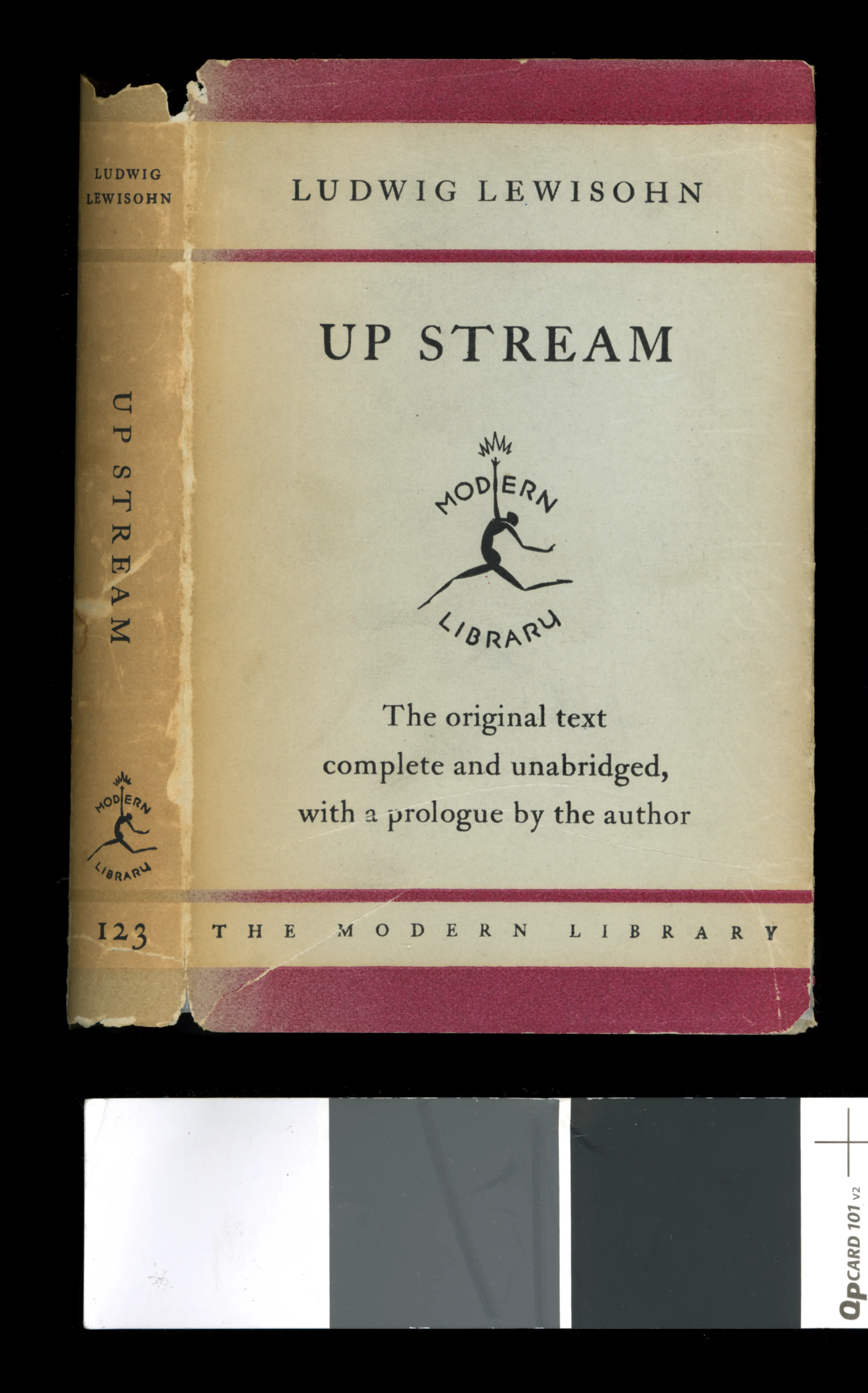
Jacket:
Text on front:
Ludwig Lewisohn’s “Up Stream” appeared first in the Spring of 1922. The color and charm of the book and the continuous beauty of its prose established it immediately as an important and permanent contribution to American letters. The Modern Library edition, containing a new introduction by the author, and certain revisions that he deemed vital in the text, will undoubtedly win a tremendous new audience for the book. (Fall 1926)
Originally published by Boni & Liveright, 1922. The B&L plates were too large for the ML’s format; ML edition printed from plates made from a new typesetting with revisions by the author. Published October 1926. WR 20 November 1926. First printing: Not ascertained. Discontinued 1 January 1940.
Sales of Up Stream during the first six months of 1928 placed it 36th out of 147 ML titles.
Klopfer invited Stephen S. Wise, rabbi of the Free Synagogue of New York, to write the introduction. “Our honorarium for such an introduction is only fifty dollars,” he noted, “but we would really like to have your name among the people who have written introductions to our volumes” (Klopfer to Wise, 18 December 1925). Wise replied that he had not liked Up Stream but would be willing to write an introduction to a ML edition of Lewisohn’s Israel (Wise to Klopfer, 21 December 1925). In the end Lewisohn wrote his own introduction to the ML edition.
Lewisohn took advantage of the new typesetting to revise the text. He informed Klopfer: “The revision of the book is a matter of great moral and literary importance to me . . . I shall write a fairly extended—not too extended—new introduction etc. At all events you shall have the book in such shape as I should wish it to be read in the future” (Lewisohn to Klopfer, 26 June 1926). The passages Lewisohn revised concerned his marriage to Mary Lewisohn, from whom he had recently separated. He removed a number of references to his wife from the ML text and rewrote others. In the B&L edition, for example, after noting that he sold his fourth story to Uncle Remus’s Magazine for $125, Lewisohn wrote:
My father was, characteristically, aglow; he saw visions of grandeur. My mother’s womanly and solitary heart yearned over Mary. So Mary and I were married and we all settled down in an old, roomy house in Queenshaven. The house overlooked the bay and from our study windows Mary and I watched the horned moon float over the silken swell of the dark waters and listened to the tide. . . . (B&L, p. 135; suspension points are in the original of all quoted passages from the B&L and ML texts).
Lewisohn revised the passage as follows for the ML edition:
My father was, characteristically, aglow; he saw visions of grandeur. Mary, furthermore, insisted that we must be married to save her honor and her very life. I was a gentleman still and a Southerner. I was sorry, helpless and confused. I tried to hope that my mother would be less lonely. I tried to hope many things to still the fatal monitions within me. . . .
We all settled down together in an old house overlooking the bay. I think that, in spite of youth and inexperience and their faults, I tried to make the best of things. But Mary’s responsibilities to her family robbed her of the power, even though she had had the will, to be my wife or—despite her age, the daughter of my parents. It was perhaps not all her fault that she was a burden and unhelpful; it was absurd that, under these circumstances, she had neither humility nor true kindness, but was as exacting as a bride of eighteen. She was a middle-aged woman who had insisted on marrying a man not much older than her oldest child. She acted like Dora Copperfield. . . . Something indomitable must have been in me that I did not go under . . . a strength and a faith. . . . (128a, pp. 159–60)
A complete inventory of changes in the ML text that have been noted are the following, with the page of the 1922 Boni & Liveright edition given first, followed by the corresponding page of the 1926 Modern Library printing: pp. 131/154; 135–36/159–60; 138/162; 141/167; 145/171; 146/172; 148/175; 150/177; 154/181–82; 177/210; 180/214; 187/222; 188/223; 189/225; 218/263; 221/266.
When Mary Lewisohn saw the revised edition of Up Stream she threatened to sue the ML for libel. She specifically objected to the passage: “Mary, furthermore, insisted that we must be married to save her honor and her very life. I was a gentleman still and a Southerner.” Cerf asked Lewisohn to write a long letter giving in detail his reasons for including the sentences. “The entire affair promises to be a dreadful nuisance, but the lady is determined in her course and I suppose we will all have to go through with it. I await a letter from you at your very earliest convenience” (Cerf to Lewisohn, 19 January 1927).
128b1. Second printing, first state (1927)
Title as 128a.
Pp. [i–vi] vii–xi [xii], 1–299 [300–304]. [1–9]16 [10]14
Contents as 128a except: [ii]
Two changes were made in the second printing in response to Mary Lewisohn’s objections. The original B&L text was substituted for the passage on pp. 159–60 quoted above, and the following passage was omitted from the introduction:
I say this in all humility and say it in order to record the fact that the general texture of Up Stream remained free, has always been free, of the unveracity that marked a small number of passages now changed or expunged. Why, in my ardent search for the truth of things, did I deliberately falsify one element in my life and draw falsely one character? Through a mistaken kindliness? Yes. But more through shame—shame of the all but unbelievable physical and moral facts. . . . That blot on the book has now been wiped out. . . . If Up Stream is still worthy of being read; if it is worthy of being remembered—let it be read and remembered in the form in which it is now definitively printed here. . . . (128a, p. xi)
128b2. Second printing, second state with introduction cancelled (1927)
Title as 128a.
Pp. [i–iv], 1–299 [300–304]. [1]16(-3,4,5,6) [2–9]16 [10]14
Contents as 128b1 except: [v]–[xii] cancelled.
Mary Lewisohn was not satisfied with the changes in the second printing. On 29 November 1927, three days after the date of the second printing, the ML agreed to substitute the original B&L text for the revisions supplied by Ludwig Lewisohn and to drop the introduction altogether. The introduction was cancelled in remaining copies of the second printing. The table of contents which listed the introduction is also cancelled in all copies of 128b2 examined.
128c. Third printing (1928)
Title as 128a.
Pp. [i–vi], [2], 1–299 [300–304]. [1]16(-4,5,±6) [2–9]16 [10]14
Contents as 128b1 except: [ii]
Variant: Pp. [i–vi], [2], 1–299 [300–308]. [1]16(-4,5,±6) [2–10]16. Contents as 128c except: [305–308] blank. (Fall 1928) Note: Copies have been seen without the replacement leaf. It appears likely that 128c and 128c variant are two states of the same printing, differing only in the number of leaves in the final gathering.
The third printing (12 July 1928) inadvertently retained Lewisohn’s introduction. The introduction was cancelled, apparently before any copies were distributed, and the textual note required by the ML’s agreement with Mary Lewisohn was inserted as a replacement leaf.
128d. Fourth printing (1929)
Title as 128a.
Pp. [8], 1–299 [300–304]. [1–9]16 [10]12
[1] half title; [2]
Variant: Pp. [8], 1–299 [300–312]. [1–10]16. Contents as 128d except: [301–305] ML list; [306–312] blank. (Spring 1932)
Jacket:
Front flap:n Burning indignation and the will to find a way into a full creative life have been the essence of Ludwig Lewisohn’s writings. Up Stream is at once his spiritual autobiography and the lyrical, yet savage, outcry against the forces that stifled him. It is a book of protest and affirmation, honest, unashamed and electrical with fierce passion. In the literature of America’s coming of age, Up Stream occupies a unique place; it is the record of a soul’s awakening and its final declaration of creative independence. (Spring 1935)
The fourth printing was the first to satisfy the requirements of the ML’s agreement with Mary Lewisohn without resorting to cancellation. Lewisohn had made many small changes in the text when he revised Up Stream for the ML, and a number of these remained in the ML text after those that Mary Lewisohn objected to had been removed. Cerf wrote to Ludwig Lewisohn in 1936 that Up Stream continued to sell at the rate of 1,000 copies or more each year “and considering the length of time that the book has been in print, I regard that as a pretty gratifying record” (Cerf to Lewisohn, 13 November 1936).
Three other books by Lewisohn appeared in the ML. A Modern Book of Criticism (75), an original ML anthology that he edited, was published in spring 1920 and remained in print through 1936. The Story of American Literature (G43), originally published as Expression in America, was added to the Giants in spring 1939. Lewisohn began to lobby for the inclusion of his novel The Island Within shortly after the Giant was published. Cerf thought that two Lewisohn titles in the series were “more than enough” but suggested that Up Stream might be dropped and The Island Within published in its place. Lewisohn approved “with all the vociferousness at his command” (Cerf to Cass Canfield, Harper & Bros., 12 October 1939). The Island Within (329) sold poorly and was discontinued two and a half years later.
Also in the Modern Libraryn
Lewisohn, ed., A Modern Book of Criticism (1920–1936) 75
Lewisohn, Story of American Literature (Giant, 1939–1956) G43
Lewisohn, The Island Within (1940–1942) 329
{
  "full": "\n**LUDWIG LEWISOHN. UP STREAM. 1926–1939. (ML 123)**  \n\n#### 128a. First printing (1926)  \n\n[within double rules] UP STREAM | AN AMERICAN CHRONICLE | [rule] | BY | LUDWIG LEWISOHN | [rule] | [torchbearer A2] | [rule] | THE MODERN LIBRARY | PUBLISHERS : NEW YORK  \n\nPp. [i–vi] vii–xii, 1–299 [300–308]. [1–10]16  \n\n[i] half title; [ii] pub. note A4; [iii] title; [iv] *Copyright,* 1926, *by* | THE MODERN LIBRARY, INC. | [short double rule] | *First Modern Library Edition* | 1926; [v] CONTENTS; [vi] blank; vii–xii INTRODUCTION TO THE MODERN | LIBRARY EDITION OF UP STREAM signed p. xii: Ludwig Lewisohn. | July 16, 1926.; 1–2 PROLOGUE; 3–299 text; [300] blank; [301–306] ML list; [307] ML subject index: Russian literature in the Modern Library; [308] Distinguished writers who have written introductions to titles in the Modern Library. (*Fall 1925*)  \n\n*Jacket:* Uniform typographic jacket B2.  \n\n> Text on front:
 Ludwig Lewisohn’s “Up Stream” appeared first in the Spring of 1922. The color and charm of the book and the continuous beauty of its prose established it immediately as an important and permanent contribution to American letters. The Modern Library edition, containing a new introduction by the author, and certain revisions that he deemed vital in the text, will undoubtedly win a tremendous new audience for the book. (*Fall 1926*)  \n\nOriginally published by Boni & Liveright, 1922. The B&L plates were too large for the ML’s format; ML edition printed from plates made from a new typesetting with revisions by the author. Published October 1926. *WR* 20 November 1926. First printing: Not ascertained. Discontinued 1 January 1940.  \n\nSales of *Up Stream* during the first six months of 1928 placed it 36th out of 147 ML titles.  \n\nKlopfer invited Stephen S. Wise, rabbi of the Free Synagogue of New York, to write the introduction. “Our honorarium for such an introduction is only fifty dollars,” he noted, “but we would really like to have your name among the people who have written introductions to our volumes” (Klopfer to Wise, 18 December 1925). Wise replied that he had not liked *Up Stream* but would be willing to write an introduction to a ML edition of Lewisohn’s *Israel* (Wise to Klopfer, 21 December 1925). In the end Lewisohn wrote his own introduction to the ML edition.  \n\nLewisohn took advantage of the new typesetting to revise the text. He informed Klopfer: “The revision of the book is a matter of great moral and literary importance to me . . . I shall write a fairly extended—not too extended—new introduction etc. At all events you shall have the book in such shape as I should wish it to be read in the future” (Lewisohn to Klopfer, 26 June 1926). The passages Lewisohn revised concerned his marriage to Mary Lewisohn, from whom he had recently separated. He removed a number of references to his wife from the ML text and rewrote others. In the B&L edition, for example, after noting that he sold his fourth story to *Uncle Remus’s Magazine* for \\$125, Lewisohn wrote:  \n\n> My father was, characteristically, aglow; he saw visions of grandeur. My mother’s womanly and solitary heart yearned over Mary. So Mary and I were married and we all settled down in an old, roomy house in Queenshaven. The house overlooked the bay and from our study windows Mary and I watched the horned moon float over the silken swell of the dark waters and listened to the tide. . . . (B&L, p. 135; suspension points are in the original of all quoted passages from the B&L and ML texts).  \n\nLewisohn revised the passage as follows for the ML edition:  \n\n> My father was, characteristically, aglow; he saw visions of grandeur. Mary, furthermore, insisted that we must be married to save her honor and her very life. I was a gentleman still and a Southerner. I was sorry, helpless and confused. I tried to hope that my mother would be less lonely. I tried to hope many things to still the fatal monitions within me. . . . \nWe all settled down together in an old house overlooking the bay. I think that, in spite of youth and inexperience and their faults, I tried to make the best of things. But Mary’s responsibilities to her family robbed her of the power, even though she had had the will, to be my wife or—despite her age, the daughter of my parents. It was perhaps not all her fault that she was a burden and unhelpful; it was absurd that, under these circumstances, she had neither humility nor true kindness, but was as exacting as a bride of eighteen. She was a middle-aged woman who had insisted on marrying a man not much older than her oldest child. She acted like Dora Copperfield. . . . Something indomitable must have been in me that I did not go under . . . a strength and a faith. . . . (128a, pp. 159–60)  \n\nA complete inventory of changes in the ML text that have been noted are the following, with the page of the 1922 Boni & Liveright edition given first, followed by the corresponding page of the 1926 Modern Library printing: pp. 131/154; 135–36/159–60; 138/162; 141/167; 145/171; 146/172; 148/175; 150/177; 154/181–82; 177/210; 180/214; 187/222; 188/223; 189/225; 218/263; 221/266.  \n\nWhen Mary Lewisohn saw the revised edition of *Up Stream* she threatened to sue the ML for libel. She specifically objected to the passage: “Mary, furthermore, insisted that we must be married to save her honor and her very life. I was a gentleman still and a Southerner.” Cerf asked Lewisohn to write a long letter giving in detail his reasons for including the sentences. “The entire affair promises to be a dreadful nuisance, but the lady is determined in her course and I suppose we will all have to go through with it. I await a letter from you at your very earliest convenience” (Cerf to Lewisohn, 19 January 1927).  \n\n#### 128b1. Second printing, first state (1927)  \n\nTitle as 128a.  \n\nPp. [i–vi] vii–xi [xii], 1–299 [300–304]. [1–9]16 [10]14  \n\nContents as 128a except: [ii] pub. note A5; [iv] *Copyright,* 1926, *by* | THE MODERN LIBRARY, INC. | [short double rule]; | vii–xi INTRODUCTION TO THE MODERN | LIBRARY EDITION OF UP STREAM signed p. xi: Ludwig Lewisohn. | July 16, 1926.; [xii] blank; [301–304] ML list. (*Spring 1927*) *Note:* Pp. xi and 159–160 are reset; the introduction is a page shorter than in 128a.  \n\nTwo changes were made in the second printing in response to Mary Lewisohn’s objections. The original B&L text was substituted for the passage on pp. 159–60 quoted above, and the following passage was omitted from the introduction:  \n\n> I say this in all humility and say it in order to record the fact that the general texture of Up Stream remained free, has always been free, of the unveracity that marked a small number of passages now changed or expunged. Why, in my ardent search for the truth of things, did I deliberately falsify *one* element in my life and draw falsely *one* character? Through a mistaken kindliness? Yes. But more through shame—shame of the all but unbelievable physical and moral facts. . . . That blot on the book has now been wiped out. . . . If Up Stream is still worthy of being read; if it is worthy of being remembered—let it be read and remembered in the form in which it is now definitively printed here. . . . (128a, p. xi)  \n\n#### 128b2. Second printing, second state with introduction cancelled (1927)  \n\nTitle as 128a.  \n\nPp. [i–iv], 1–299 [300–304]. [1]16(-3,4,5,6) [2–9]16 [10]14  \n\nContents as 128b1 except: [v]–[xii] cancelled.  \n\nMary Lewisohn was not satisfied with the changes in the second printing. On 29 November 1927, three days after the date of the second printing, the ML agreed to substitute the original B&L text for the revisions supplied by Ludwig Lewisohn and to drop the introduction altogether. The introduction was cancelled in remaining copies of the second printing. The table of contents which listed the introduction is also cancelled in all copies of 128b2 examined.  \n\n#### 128c. Third printing (1928)  \n\nTitle as 128a.  \n\nPp. [i–vi], [*2*], 1–299 [300–304]. [1]16(-4,5,±6) [2–9]16 [10]14  \n\nContents as 128b1 except: [ii] pub. note A6; [*1*] textual note: The Modern Library announces with this de- | finitive edition, the final form of UP STREAM | corrected to correspond with the original text | published by Boni & Liveright, 1922.; [*2*] blank. (*Fall 1928*) *Note:* Pp. vii–[xii] cancelled; [*1–2*] are inserted as a replacement leaf.  \n\n> *Variant:* Pp. [i–vi], [*2*], 1–299 [300–308]. [1]16(-4,5,±6) [2–10]16. Contents as 128c except: [305–308] blank. (*Fall 1928*) *Note:* Copies have been seen without the replacement leaf. It appears likely that 128c and 128c variant are two states of the same printing, differing only in the number of leaves in the final gathering.  \n\nThe third printing (12 July 1928) inadvertently retained Lewisohn’s introduction. The introduction was cancelled, apparently before any copies were distributed, and the textual note required by the ML’s agreement with Mary Lewisohn was inserted as a replacement leaf.  \n\n#### 128d. Fourth printing (1929)  \n\nTitle as 128a.  \n\nPp. [*8*], 1–299 [300–304]. [1–9]16 [10]12  \n\n[*1*] half title; [*2*] pub. note A6; [*3*] title; [*4*] *Copyright,* 1926, *by* | THE MODERN LIBRARY, INC. | [short double rule]; [*5*] textual note as 128c; [*6*] blank; [*7*] CONTENTS; [*8*] blank; 1–2 PROLOGUE; 3–299 text; [300] blank; [301–304] ML list. (*Spring 1929*)  \n\n> *Variant:* Pp. [*8*], 1–299 [300–312]. [1–10]16. Contents as 128d except: [301–305] ML list; [306–312] blank. (*Spring 1932*)  \n\n*Jacket:* Uniform typographic jacket D. Text on front: “The original text complete and unabridged, with a prologue by the author.” (*Spring 1929*) *Note:* The Prologue was not new to the ML edition; it had been part of *Up Stream* since its original publication in 1922. The jacket statement somewhat disingenuously covers up the fact that the introduction which Lewisohn wrote for the ML edition was no longer included.  \n\nFront flap:n Burning indignation and the will to find a way into a full creative life have been the essence of Ludwig Lewisohn’s writings. *Up Stream* is at once his spiritual autobiography and the lyrical, yet savage, outcry against the forces that stifled him. It is a book of protest and affirmation, honest, unashamed and electrical with fierce passion. In the literature of America’s coming of age, *Up Stream* occupies a unique place; it is the record of a soul’s awakening and its final declaration of creative independence. (*Spring 1935*)  \n\nThe fourth printing was the first to satisfy the requirements of the ML’s agreement with Mary Lewisohn without resorting to cancellation. Lewisohn had made many small changes in the text when he revised *Up Stream* for the ML, and a number of these remained in the ML text after those that Mary Lewisohn objected to had been removed. Cerf wrote to Ludwig Lewisohn in 1936 that *Up Stream* continued to sell at the rate of 1,000 copies or more each year “and considering the length of time that the book has been in print, I regard that as a pretty gratifying record” (Cerf to Lewisohn, 13 November 1936).  \n\nThree other books by Lewisohn appeared in the ML. *A Modern Book of Criticism* (75), an original ML anthology that he edited, was published in spring 1920 and remained in print through 1936. *The Story of American Literature* (G43), originally published as *Expression in America*, was added to the Giants in spring 1939. Lewisohn began to lobby for the inclusion of his novel *The Island Within* shortly after the Giant was published. Cerf thought that two Lewisohn titles in the series were “more than enough” but suggested that *Up Stream* might be dropped and *The Island Within* published in its place. Lewisohn approved “with all the vociferousness at his command” (Cerf to Cass Canfield, Harper & Bros., 12 October 1939). *The Island Within* (329) sold poorly and was discontinued two and a half years later.  \n\nAlso in the Modern Libraryn\\\nLewisohn, ed., *A Modern Book of Criticism* (1920–1936) 75 \nLewisohn, *Story of American Literature* (Giant, 1939–1956) G43 \nLewisohn, *The Island Within* (1940–1942) 329  \n\n",
  "id": "128",
  "year": "1926",
  "label": "LUDWIG LEWISOHN. UP STREAM. 1926–1939. (ML 123)",
  "author": "LUDWIG LEWISOHN",
  "title": "UP STREAM.",
  "date": "1926–1939.",
  "something": "ML 123",
  "revisions": [
    {
      "id": "128a",
      "title": "First printing (1926)  ",
      "full": "\n\n[within double rules] UP STREAM | AN AMERICAN CHRONICLE | [rule] | BY | LUDWIG LEWISOHN | [rule] | [torchbearer A2] | [rule] | THE MODERN LIBRARY | PUBLISHERS : NEW YORK  \n\nPp. [i–vi] vii–xii, 1–299 [300–308]. [1–10]16  \n\n[i] half title; [ii] pub. note A4; [iii] title; [iv] *Copyright,* 1926, *by* | THE MODERN LIBRARY, INC. | [short double rule] | *First Modern Library Edition* | 1926; [v] CONTENTS; [vi] blank; vii–xii INTRODUCTION TO THE MODERN | LIBRARY EDITION OF UP STREAM signed p. xii: Ludwig Lewisohn. | July 16, 1926.; 1–2 PROLOGUE; 3–299 text; [300] blank; [301–306] ML list; [307] ML subject index: Russian literature in the Modern Library; [308] Distinguished writers who have written introductions to titles in the Modern Library. (*Fall 1925*)  \n\n*Jacket:* Uniform typographic jacket B2.  \n\n> Text on front:
 Ludwig Lewisohn’s “Up Stream” appeared first in the Spring of 1922. The color and charm of the book and the continuous beauty of its prose established it immediately as an important and permanent contribution to American letters. The Modern Library edition, containing a new introduction by the author, and certain revisions that he deemed vital in the text, will undoubtedly win a tremendous new audience for the book. (*Fall 1926*)  \n\nOriginally published by Boni & Liveright, 1922. The B&L plates were too large for the ML’s format; ML edition printed from plates made from a new typesetting with revisions by the author. Published October 1926. *WR* 20 November 1926. First printing: Not ascertained. Discontinued 1 January 1940.  \n\nSales of *Up Stream* during the first six months of 1928 placed it 36th out of 147 ML titles.  \n\nKlopfer invited Stephen S. Wise, rabbi of the Free Synagogue of New York, to write the introduction. “Our honorarium for such an introduction is only fifty dollars,” he noted, “but we would really like to have your name among the people who have written introductions to our volumes” (Klopfer to Wise, 18 December 1925). Wise replied that he had not liked *Up Stream* but would be willing to write an introduction to a ML edition of Lewisohn’s *Israel* (Wise to Klopfer, 21 December 1925). In the end Lewisohn wrote his own introduction to the ML edition.  \n\nLewisohn took advantage of the new typesetting to revise the text. He informed Klopfer: “The revision of the book is a matter of great moral and literary importance to me . . . I shall write a fairly extended—not too extended—new introduction etc. At all events you shall have the book in such shape as I should wish it to be read in the future” (Lewisohn to Klopfer, 26 June 1926). The passages Lewisohn revised concerned his marriage to Mary Lewisohn, from whom he had recently separated. He removed a number of references to his wife from the ML text and rewrote others. In the B&L edition, for example, after noting that he sold his fourth story to *Uncle Remus’s Magazine* for \\$125, Lewisohn wrote:  \n\n> My father was, characteristically, aglow; he saw visions of grandeur. My mother’s womanly and solitary heart yearned over Mary. So Mary and I were married and we all settled down in an old, roomy house in Queenshaven. The house overlooked the bay and from our study windows Mary and I watched the horned moon float over the silken swell of the dark waters and listened to the tide. . . . (B&L, p. 135; suspension points are in the original of all quoted passages from the B&L and ML texts).  \n\nLewisohn revised the passage as follows for the ML edition:  \n\n> My father was, characteristically, aglow; he saw visions of grandeur. Mary, furthermore, insisted that we must be married to save her honor and her very life. I was a gentleman still and a Southerner. I was sorry, helpless and confused. I tried to hope that my mother would be less lonely. I tried to hope many things to still the fatal monitions within me. . . . \nWe all settled down together in an old house overlooking the bay. I think that, in spite of youth and inexperience and their faults, I tried to make the best of things. But Mary’s responsibilities to her family robbed her of the power, even though she had had the will, to be my wife or—despite her age, the daughter of my parents. It was perhaps not all her fault that she was a burden and unhelpful; it was absurd that, under these circumstances, she had neither humility nor true kindness, but was as exacting as a bride of eighteen. She was a middle-aged woman who had insisted on marrying a man not much older than her oldest child. She acted like Dora Copperfield. . . . Something indomitable must have been in me that I did not go under . . . a strength and a faith. . . . (128a, pp. 159–60)  \n\nA complete inventory of changes in the ML text that have been noted are the following, with the page of the 1922 Boni & Liveright edition given first, followed by the corresponding page of the 1926 Modern Library printing: pp. 131/154; 135–36/159–60; 138/162; 141/167; 145/171; 146/172; 148/175; 150/177; 154/181–82; 177/210; 180/214; 187/222; 188/223; 189/225; 218/263; 221/266.  \n\nWhen Mary Lewisohn saw the revised edition of *Up Stream* she threatened to sue the ML for libel. She specifically objected to the passage: “Mary, furthermore, insisted that we must be married to save her honor and her very life. I was a gentleman still and a Southerner.” Cerf asked Lewisohn to write a long letter giving in detail his reasons for including the sentences. “The entire affair promises to be a dreadful nuisance, but the lady is determined in her course and I suppose we will all have to go through with it. I await a letter from you at your very earliest convenience” (Cerf to Lewisohn, 19 January 1927).  \n\n"
    },
    {
      "id": "128c",
      "title": "Third printing (1928)  ",
      "full": "\n\nTitle as 128a.  \n\nPp. [i–vi], [*2*], 1–299 [300–304]. [1]16(-4,5,±6) [2–9]16 [10]14  \n\nContents as 128b1 except: [ii] pub. note A6; [*1*] textual note: The Modern Library announces with this de- | finitive edition, the final form of UP STREAM | corrected to correspond with the original text | published by Boni & Liveright, 1922.; [*2*] blank. (*Fall 1928*) *Note:* Pp. vii–[xii] cancelled; [*1–2*] are inserted as a replacement leaf.  \n\n> *Variant:* Pp. [i–vi], [*2*], 1–299 [300–308]. [1]16(-4,5,±6) [2–10]16. Contents as 128c except: [305–308] blank. (*Fall 1928*) *Note:* Copies have been seen without the replacement leaf. It appears likely that 128c and 128c variant are two states of the same printing, differing only in the number of leaves in the final gathering.  \n\nThe third printing (12 July 1928) inadvertently retained Lewisohn’s introduction. The introduction was cancelled, apparently before any copies were distributed, and the textual note required by the ML’s agreement with Mary Lewisohn was inserted as a replacement leaf.  \n\n"
    },
    {
      "id": "128d",
      "title": "Fourth printing (1929)  ",
      "full": "\n\nTitle as 128a.  \n\nPp. [*8*], 1–299 [300–304]. [1–9]16 [10]12  \n\n[*1*] half title; [*2*] pub. note A6; [*3*] title; [*4*] *Copyright,* 1926, *by* | THE MODERN LIBRARY, INC. | [short double rule]; [*5*] textual note as 128c; [*6*] blank; [*7*] CONTENTS; [*8*] blank; 1–2 PROLOGUE; 3–299 text; [300] blank; [301–304] ML list. (*Spring 1929*)  \n\n> *Variant:* Pp. [*8*], 1–299 [300–312]. [1–10]16. Contents as 128d except: [301–305] ML list; [306–312] blank. (*Spring 1932*)  \n\n*Jacket:* Uniform typographic jacket D. Text on front: “The original text complete and unabridged, with a prologue by the author.” (*Spring 1929*) *Note:* The Prologue was not new to the ML edition; it had been part of *Up Stream* since its original publication in 1922. The jacket statement somewhat disingenuously covers up the fact that the introduction which Lewisohn wrote for the ML edition was no longer included.  \n\nFront flap:n Burning indignation and the will to find a way into a full creative life have been the essence of Ludwig Lewisohn’s writings. *Up Stream* is at once his spiritual autobiography and the lyrical, yet savage, outcry against the forces that stifled him. It is a book of protest and affirmation, honest, unashamed and electrical with fierce passion. In the literature of America’s coming of age, *Up Stream* occupies a unique place; it is the record of a soul’s awakening and its final declaration of creative independence. (*Spring 1935*)  \n\nThe fourth printing was the first to satisfy the requirements of the ML’s agreement with Mary Lewisohn without resorting to cancellation. Lewisohn had made many small changes in the text when he revised *Up Stream* for the ML, and a number of these remained in the ML text after those that Mary Lewisohn objected to had been removed. Cerf wrote to Ludwig Lewisohn in 1936 that *Up Stream* continued to sell at the rate of 1,000 copies or more each year “and considering the length of time that the book has been in print, I regard that as a pretty gratifying record” (Cerf to Lewisohn, 13 November 1936).  \n\nThree other books by Lewisohn appeared in the ML. *A Modern Book of Criticism* (75), an original ML anthology that he edited, was published in spring 1920 and remained in print through 1936. *The Story of American Literature* (G43), originally published as *Expression in America*, was added to the Giants in spring 1939. Lewisohn began to lobby for the inclusion of his novel *The Island Within* shortly after the Giant was published. Cerf thought that two Lewisohn titles in the series were “more than enough” but suggested that *Up Stream* might be dropped and *The Island Within* published in its place. Lewisohn approved “with all the vociferousness at his command” (Cerf to Cass Canfield, Harper & Bros., 12 October 1939). *The Island Within* (329) sold poorly and was discontinued two and a half years later.  \n\nAlso in the Modern Libraryn\\\nLewisohn, ed., *A Modern Book of Criticism* (1920–1936) 75 \nLewisohn, *Story of American Literature* (Giant, 1939–1956) G43 \nLewisohn, *The Island Within* (1940–1942) 329  \n\n"
    }
  ],
  "type": "book"
}