
The Modern Library Bibliography
FRIEDRICH NIETZSCHE. ECCE HOMO & THE BIRTH OF TRAGEDY. 1927–1936. (ML 68)
135. First printing (1927)
[within double rules] ECCE HOMO | AND | THE BIRTH OF TRAGEDY | [rule] | BY | FRIEDRICH NIETZSCHE | [rule] | TRANSLATED BY | CLIFTON P. FADIMAN | [rule] | [
Pp. [i–iv] v–x, [1–2] 3–340 [341–342]. [1–11]16
[i] half title; [ii]
Variant: Pagination and collation as 135. Contents as 135 except: [ii]
pub. note D5 ; [iv] copyright and First statements omitted; list of books by Nietzsche in ML added. (Balloon cloth binding)
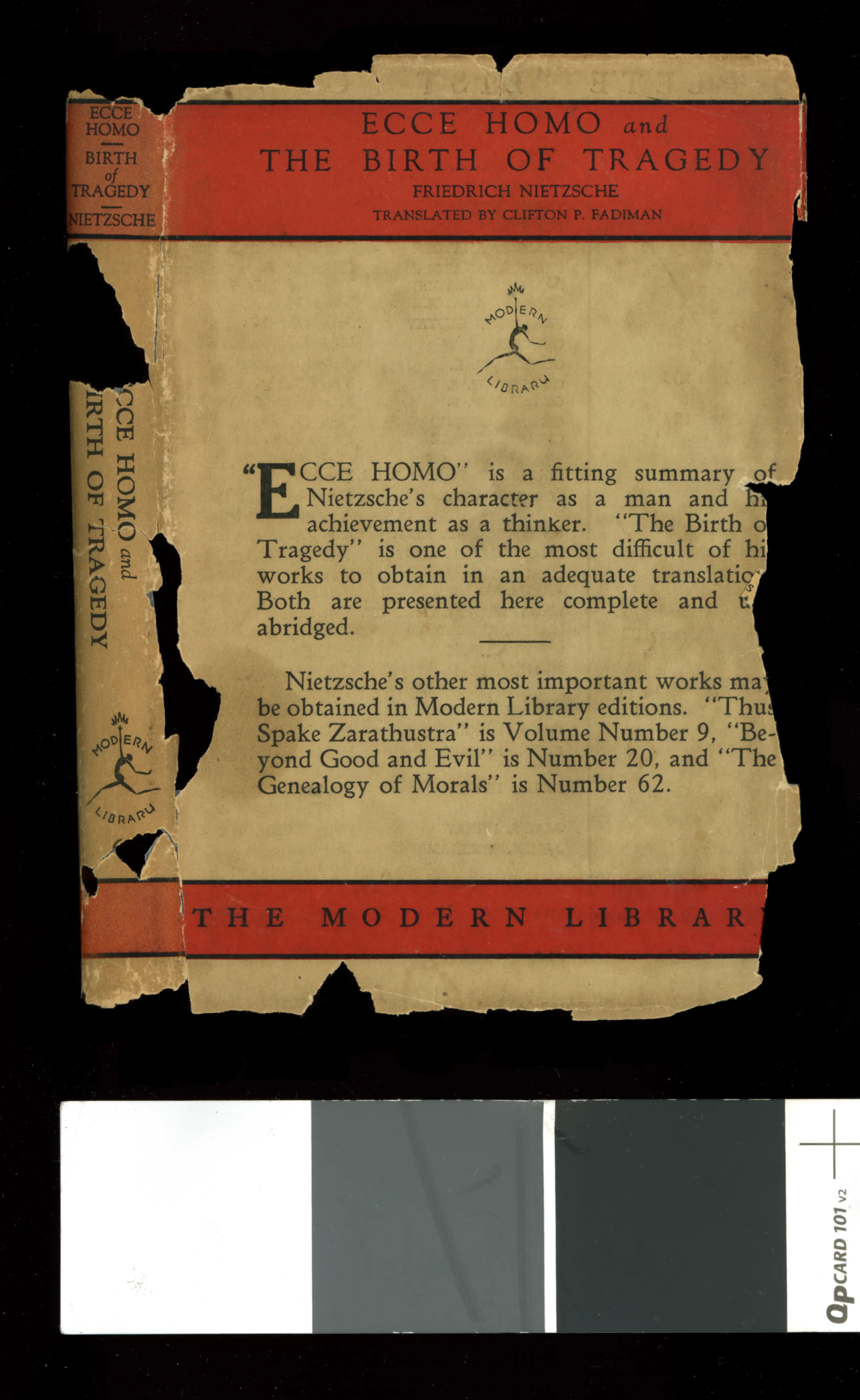
Jacket A:
Text on front:
“ECCE HOMO” is a fitting summary of Nietzsche’s character as a man and his achievement as a thinker. “The Birth of Tragedy” is one of the most difficult of his works to obtain in an adequate translation. Both are presented here complete and unabridged.
Nietzsche’s other most important works may be obtained in Modern Library editions. “Thus Spake Zarathustra” is Volume Number 9, “Beyond Good and Evil” is Number 20, and “The Genealogy of Morals” is Number 62. (Spring 1927)
Jacket B:
Front flap:
Ecce Homo is a summary of Friedrich Nietzsche’s philosophy and his most robust affirmation of life. In these respects it is a spiritual and intellectual autobiography that proclaims with vigorous emphasis the virtues of strength and pride. The juxtaposition of Ecce Homo and The Birth of Tragedy in one volume gains significance by opposite attitudes towards Richard Wagner. The latter work is dedicated to him “as my noble champion,” and the former contains many of Nietzsche’s most virulent attacks on the Master of Bayreuth. (Fall 1933)
Original ML translation. Published February 1927. WR 12 March 1927. First printing: Not ascertained. Discontinued 1 January 1937 after the four Nietzsche volumes in the regular ML were repackaged as The Philosophy of Nietzsche (G32).
After discussing a ML edition of Nietzsche’s Dawn of Day with Macmillan, Cerf and Klopfer decided they wanted Ecce Homo instead. They hoped to use the translation that Macmillan imported from England and offered an advance of $200 against royalties of 4 cents a copy. They asked for rights to the translation for ten years and wanted assurance that Macmillan would not put Ecce Homo into its series of inexpensive reprints, Modern Readers Series (Klopfer to George P. Brett, Jr., Macmillan, 2 June 1926). Macmillan had to submit the offer to its parent firm in London but the response was slow in coming.
After waiting four months Cerf and Klopfer decided to commission their own translation (Klopfer to Brett, 5 October 1926). Irwin Edman of Columbia University was asked to suggest a translator. He recommended Horace Freiss, a colleague in the Philosophy Department. Freiss indicated that he could do it within six months, but this was longer than they wanted to wait. Edman then suggested Clifton Fadiman, one of his graduate students. Fadiman agreed to undertake the translation of Ecce Homo and The Birth of Tragedy and to submit the manuscript by 6 December.
Approval for use of the Macmillan translation arrived from London in mid-October, but Cerf and Klopfer had already made arrangements with Fadiman (Brett to Cerf, 14 October 1926; Cerf to Brett, 21 October 1926). Fadiman submitted his translation shortly after the deadline but in time for February publication. Cerf later noted that the ML edition of Ecce Homo & The Birth of Tragedy was the first time Fadiman’s name was attached to a literary work (“Trade Winds,” SRL, 22 May 1943, p. 37).
Also in the Modern Library
Nietzsche, Thus Spake Zarathustra (1917–) 9
Nietzsche, Beyond Good and Evil (1917–1936) 28
Nietzsche, Genealogy of Morals (1918–1936) 59
Nietzsche, Philosophy (Giant, 1937–1970) G32
Nietzsche, Basic Writings (Giant, 1968–) G113
{
  "full": "\n**FRIEDRICH NIETZSCHE. ECCE HOMO & THE BIRTH OF TRAGEDY. 1927–1936. (ML 68)** \n\n#### 135. First printing (1927) \n\n[within double rules] ECCE HOMO | AND | THE BIRTH OF TRAGEDY | [rule] | BY | FRIEDRICH NIETZSCHE | [rule] | TRANSLATED BY | CLIFTON P. FADIMAN | [rule] | [torchbearer A2] | [rule] | THE MODERN LIBRARY | PUBLISHERS : NEW YORK \n\nPp. [i–iv] v–x, [1–2] 3–340 [341–342]. [1–11]16 \n\n[i] half title; [ii] pub. note A5; [iii] title; [iv] *Copyright,* 1927, *by* | THE MODERN LIBRARY, INC. | [short double rule] | *First Edition,* 1927; v–x PREFACE [to *Ecce Homo*] signed p. x: Friedrich Nietzsche.; [1] author’s note; [2] blank; 3–161 text headed: ECCE HOMO | HOW ONE BECOMES | WHAT ONE IS; [162] blank; [163] part title: THE BIRTH OF TRAGEDY | FROM THE SPIRIT OF MUSIC; [164] blank; 165–166 FOREWORD TO RICHARD WAGNER; 167–340 text; [341–342] blank. \n\n> *Variant:* Pagination and collation as 135. Contents as 135 except: [ii] pub. note D5; [iv] copyright and *First* statements omitted; list of books by Nietzsche in ML added. (*Balloon cloth binding*) \n\n*Jacket A:* Uniform typographic jacket B. \n\n> Text on front:
 “ECCE HOMO” is a fitting summary of Nietzsche’s character as a man and his achievement as a thinker. “The Birth of Tragedy” is one of the most difficult of his works to obtain in an adequate translation. Both are presented here complete and unabridged. \n> Nietzsche’s other most important works may be obtained in Modern Library editions. “Thus Spake Zarathustra” is Volume Number 9, “Beyond Good and Evil” is Number 20, and “The Genealogy of Morals” is Number 62. (*Spring 1927*) \n\n*Jacket B:* Uniform typographic jacket D. (*Fall 1930*) \n\n> Front flap:
 *Ecce Homo* is a summary of Friedrich Nietzsche’s philosophy and his most robust affirmation of life. In these respects it is a spiritual and intellectual autobiography that proclaims with vigorous emphasis the virtues of strength and pride. The juxtaposition of *Ecce Homo* and *The Birth of Tragedy* in one volume gains significance by opposite attitudes towards Richard Wagner. The latter work is dedicated to him “as my noble champion,” and the former contains many of Nietzsche’s most virulent attacks on the Master of Bayreuth. (*Fall 1933*) \n\nOriginal ML translation. Published February 1927. *WR* 12 March 1927. First printing: Not ascertained. Discontinued 1 January 1937 after the four Nietzsche volumes in the regular ML were repackaged as *The Philosophy of Nietzsche* (G32). \n\nAfter discussing a ML edition of Nietzsche’s *Dawn of Day* with Macmillan, Cerf and Klopfer decided they wanted *Ecce Homo* instead. They hoped to use the translation that Macmillan imported from England and offered an advance of \\$200 against royalties of 4 cents a copy. They asked for rights to the translation for ten years and wanted assurance that Macmillan would not put *Ecce Homo* into its series of inexpensive reprints, Modern Readers Series (Klopfer to George P. Brett, Jr., Macmillan, 2 June 1926). Macmillan had to submit the offer to its parent firm in London but the response was slow in coming. \n\nAfter waiting four months Cerf and Klopfer decided to commission their own translation (Klopfer to Brett, 5 October 1926). Irwin Edman of Columbia University was asked to suggest a translator. He recommended Horace Freiss, a colleague in the Philosophy Department. Freiss indicated that he could do it within six months, but this was longer than they wanted to wait. Edman then suggested Clifton Fadiman, one of his graduate students. Fadiman agreed to undertake the translation of *Ecce Homo* and *The Birth of Tragedy* and to submit the manuscript by 6 December. \n\nApproval for use of the Macmillan translation arrived from London in mid-October, but Cerf and Klopfer had already made arrangements with Fadiman (Brett to Cerf, 14 October 1926; Cerf to Brett, 21 October 1926). Fadiman submitted his translation shortly after the deadline but in time for February publication. Cerf later noted that the ML edition of *Ecce Homo & The Birth of Tragedy* was the first time Fadiman’s name was attached to a literary work (“Trade Winds,” *SRL*, 22 May 1943, p. 37). \n\nAlso in the Modern Library
 Nietzsche, *Thus Spake Zarathustra* (1917–) 9
 Nietzsche, *Beyond Good and Evil* (1917–1936) 28
 Nietzsche, *Genealogy of Morals* (1918–1936) 59
 Nietzsche, *Philosophy* (Giant, 1937–1970) G32
 Nietzsche, *Basic Writings* (Giant, 1968–) G113
 \n\n",
  "id": "135",
  "year": "1927",
  "label": "FRIEDRICH NIETZSCHE. ECCE HOMO & THE BIRTH OF TRAGEDY. 1927–1936. (ML 68)",
  "author": "FRIEDRICH NIETZSCHE",
  "title": "ECCE HOMO & THE BIRTH OF TRAGEDY.",
  "date": "1927–1936.",
  "something": "ML 68",
  "revisions": [
    {
      "id": "135",
      "title": "First printing (1927) ",
      "full": "\n\n[within double rules] ECCE HOMO | AND | THE BIRTH OF TRAGEDY | [rule] | BY | FRIEDRICH NIETZSCHE | [rule] | TRANSLATED BY | CLIFTON P. FADIMAN | [rule] | [torchbearer A2] | [rule] | THE MODERN LIBRARY | PUBLISHERS : NEW YORK \n\nPp. [i–iv] v–x, [1–2] 3–340 [341–342]. [1–11]16 \n\n[i] half title; [ii] pub. note A5; [iii] title; [iv] *Copyright,* 1927, *by* | THE MODERN LIBRARY, INC. | [short double rule] | *First Edition,* 1927; v–x PREFACE [to *Ecce Homo*] signed p. x: Friedrich Nietzsche.; [1] author’s note; [2] blank; 3–161 text headed: ECCE HOMO | HOW ONE BECOMES | WHAT ONE IS; [162] blank; [163] part title: THE BIRTH OF TRAGEDY | FROM THE SPIRIT OF MUSIC; [164] blank; 165–166 FOREWORD TO RICHARD WAGNER; 167–340 text; [341–342] blank. \n\n> *Variant:* Pagination and collation as 135. Contents as 135 except: [ii] pub. note D5; [iv] copyright and *First* statements omitted; list of books by Nietzsche in ML added. (*Balloon cloth binding*) \n\n*Jacket A:* Uniform typographic jacket B. \n\n> Text on front:
 “ECCE HOMO” is a fitting summary of Nietzsche’s character as a man and his achievement as a thinker. “The Birth of Tragedy” is one of the most difficult of his works to obtain in an adequate translation. Both are presented here complete and unabridged. \n> Nietzsche’s other most important works may be obtained in Modern Library editions. “Thus Spake Zarathustra” is Volume Number 9, “Beyond Good and Evil” is Number 20, and “The Genealogy of Morals” is Number 62. (*Spring 1927*) \n\n*Jacket B:* Uniform typographic jacket D. (*Fall 1930*) \n\n> Front flap:
 *Ecce Homo* is a summary of Friedrich Nietzsche’s philosophy and his most robust affirmation of life. In these respects it is a spiritual and intellectual autobiography that proclaims with vigorous emphasis the virtues of strength and pride. The juxtaposition of *Ecce Homo* and *The Birth of Tragedy* in one volume gains significance by opposite attitudes towards Richard Wagner. The latter work is dedicated to him “as my noble champion,” and the former contains many of Nietzsche’s most virulent attacks on the Master of Bayreuth. (*Fall 1933*) \n\nOriginal ML translation. Published February 1927. *WR* 12 March 1927. First printing: Not ascertained. Discontinued 1 January 1937 after the four Nietzsche volumes in the regular ML were repackaged as *The Philosophy of Nietzsche* (G32). \n\nAfter discussing a ML edition of Nietzsche’s *Dawn of Day* with Macmillan, Cerf and Klopfer decided they wanted *Ecce Homo* instead. They hoped to use the translation that Macmillan imported from England and offered an advance of \\$200 against royalties of 4 cents a copy. They asked for rights to the translation for ten years and wanted assurance that Macmillan would not put *Ecce Homo* into its series of inexpensive reprints, Modern Readers Series (Klopfer to George P. Brett, Jr., Macmillan, 2 June 1926). Macmillan had to submit the offer to its parent firm in London but the response was slow in coming. \n\nAfter waiting four months Cerf and Klopfer decided to commission their own translation (Klopfer to Brett, 5 October 1926). Irwin Edman of Columbia University was asked to suggest a translator. He recommended Horace Freiss, a colleague in the Philosophy Department. Freiss indicated that he could do it within six months, but this was longer than they wanted to wait. Edman then suggested Clifton Fadiman, one of his graduate students. Fadiman agreed to undertake the translation of *Ecce Homo* and *The Birth of Tragedy* and to submit the manuscript by 6 December. \n\nApproval for use of the Macmillan translation arrived from London in mid-October, but Cerf and Klopfer had already made arrangements with Fadiman (Brett to Cerf, 14 October 1926; Cerf to Brett, 21 October 1926). Fadiman submitted his translation shortly after the deadline but in time for February publication. Cerf later noted that the ML edition of *Ecce Homo & The Birth of Tragedy* was the first time Fadiman’s name was attached to a literary work (“Trade Winds,” *SRL*, 22 May 1943, p. 37). \n\nAlso in the Modern Library
 Nietzsche, *Thus Spake Zarathustra* (1917–) 9
 Nietzsche, *Beyond Good and Evil* (1917–1936) 28
 Nietzsche, *Genealogy of Morals* (1918–1936) 59
 Nietzsche, *Philosophy* (Giant, 1937–1970) G32
 Nietzsche, *Basic Writings* (Giant, 1968–) G113
 \n\n"
    }
  ],
  "type": "book"
}