
The Modern Library Bibliography
SPINOZA. THE PHILOSOPHY OF SPINOZA. 1927–1971. (ML 60)
136a. First printing (1927)
[within double rules] THE PHILOSOPHY OF | SPINOZA | SELECTED FROM HIS CHIEF WORKS | [rule] | WITH A LIFE OF SPINOZA | AND AN INTRODUCTION BY | JOSEPH RATNER | OF COLUMBIA UNIVERSITY | [rule] | [
Pp. [i–iv] v–lxx, [1–2] 3–376 [377–378]. [1–9]16 [10]16(±16) [11–14]16
[i] half title; [ii]
Variant: Pagination as 136a. [1–14]16. Contents as 136a except: [1] part title: FIRST PART | ON GOD | [4-line epigraph from Spinoza in italic type, signed (on the fifth line) Spinoza.]. Note: The other epigraphs are also reset in italic type with the single-rule frame omitted. (Imitation leather binding; probably the second printing)
Format: The first printing is in the standard 6½ by 4¼ inch format with very narrow margins at the top and foot. Several later printings of 136a are about ¼ inch taller and wider than the standard format. Narrow margins were sometimes unavoidable when the ML printed from other publishers’ plates, but it was unusual for a typesetting designed for the ML to have such narrow margins. It is possible that the size of the type page was determined by an economic decision to limit the volume to fourteen gatherings of sixteen leaves each.
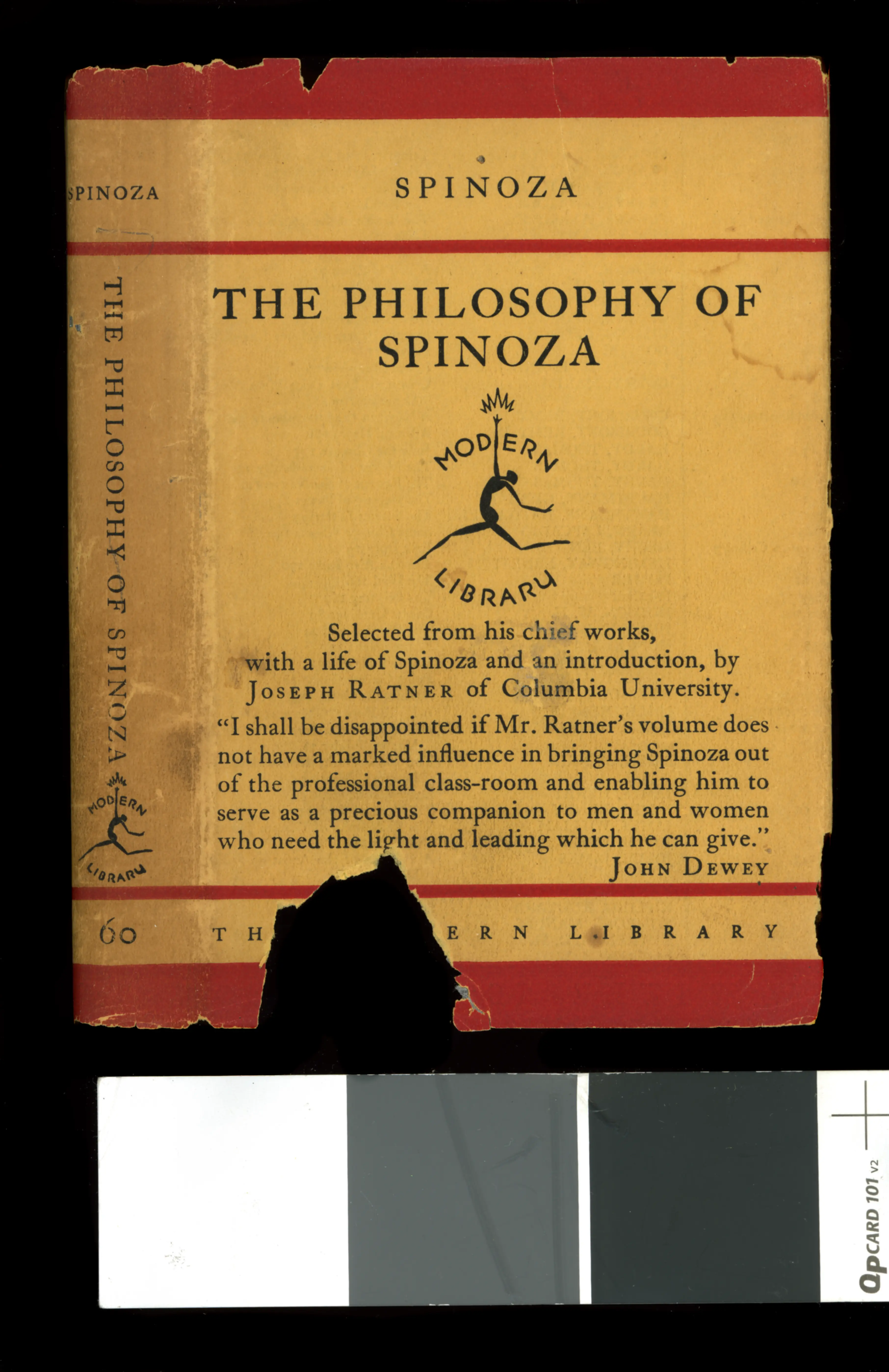
Jacket A:
Text on front:
Mr. Ratner remarks that “after having been one of the liberating thinkers of mankind who was read but not honored, Spinoza is fast becoming one of the canonized of mankind who are honored but not read.” This volume with its Life, Introduction, and Selections will immensely assist to get Spinoza read and understood as well as honored. If Mr. Ratner had not actually accomplished the task, I should not have thought it possible to render evident and outstanding the significant ideas of Spinoza, freed from obscuring technicalities; and to do it in such a way as to make clear to the reader their kinship with perplexing religious, moral and intellectual questions of our own day. But Mr. Ratner has had the happy thought to set the extracts from Spinoza’s Ethics between selections from his more popular writings on the scriptures, miracles, etc., on one hand, and his views of the state, government, freedom of thought and speech, etc., on the other. This fact alone illuminates the value of Spinoza’s thought for the present in an extraordinary way. I shall be disappointed if Mr. Ratner’s volume does not have a marked influence in bringing Spinoza out of the professional class-room and enabling him to serve as a precious companion to men and women who need the light and leading which he can give.” —John Dewey. (Spring 1927)
Jacket B:
Jacket C: Pictorial philosophy jacket in moderate blue (182) and brown on tan paper depicting a helmeted woman holding a scroll and lamp; borders in moderate blue, lettering in brown. Signed: WC. (Fall 1932)
Front flap:
Professor Ratner’s masterly arrangement of Spinoza’s philosophy has become the standard text in leading universities throughout the country. John Dewey writes: “I shall be disappointed if Mr. Ratner’s volume does not have a marked influence in bringing Spinoza out of the professional class-room and enabling him to serve as a precious companion to men and women who need the light and leading which he can give.” (Spring 1935)
Original ML collection. Published February 1927. WR 12 March 1927. First printing: Not ascertained. Discontinued 1971/72.
Ratner was born in 1901 and received his M.A. from Columbia University in 1923. He was a lecturer and doctoral student in the philosophy department at Columbia when he compiled The Philosophy of Spinoza. He received his Ph.D. from Columbia in 1930.
Cerf asked Morris R. Cohen of the City College of New York to comment on Ratner’s manuscript. Cohen suggested leaving out some of the sections on Biblical interpretation and substituting “some sections from the tract on Politics e.g. the section of government by law in a democracy. I believe the latter will interest ‘Modern’ readers more than the excessive amount devoted to biblical interpretation” (Cohen to Cerf, 6 October 1926). A few months after publication Cerf wrote, “Spinoza continues to sell far in excess of our expectations” (Cerf to Ratner, 7 June 1927).
In April 1940, when he was an instructor at City College of New York, Ratner sold his rights to The Philosophy of Spinoza and John Dewey’s Intelligence in the Modern World (G41) for $500. He also retained the unearned advance for the Dewey volume, which had been published the previous year; the unearned advance appears to have amounted to $700. The two books became the absolute property of the ML, and Ratner received no further royalties. He had the option to buy back the contracts at any time within the next two years for $1,200 minus royalties accrued from 1 January 1940.
136b. Title page reset (1941)
THE PHILOSOPHY OF | SPINOZA | SELECTED FROM HIS CHIEF WORKS | With a Life of Spinoza and an Introduction by | JOSEPH RATNER of Columbia University | “All our modern philosophers, though often perhaps | unconsciously, see through the glasses which | Baruch Spinoza ground.” HEINE | [
Pagination as 136a. [1–14]16
Contents as 136a variant except: [ii] blank; [iv] COPYRIGHT, 1927, BY THE MODERN LIBRARY, INC.
Variant: Pagination and collation as 136b. Contents as 136b except: [iv] COPYRIGHT 1927, 1954, BY THE MODERN LIBRARY, INC.
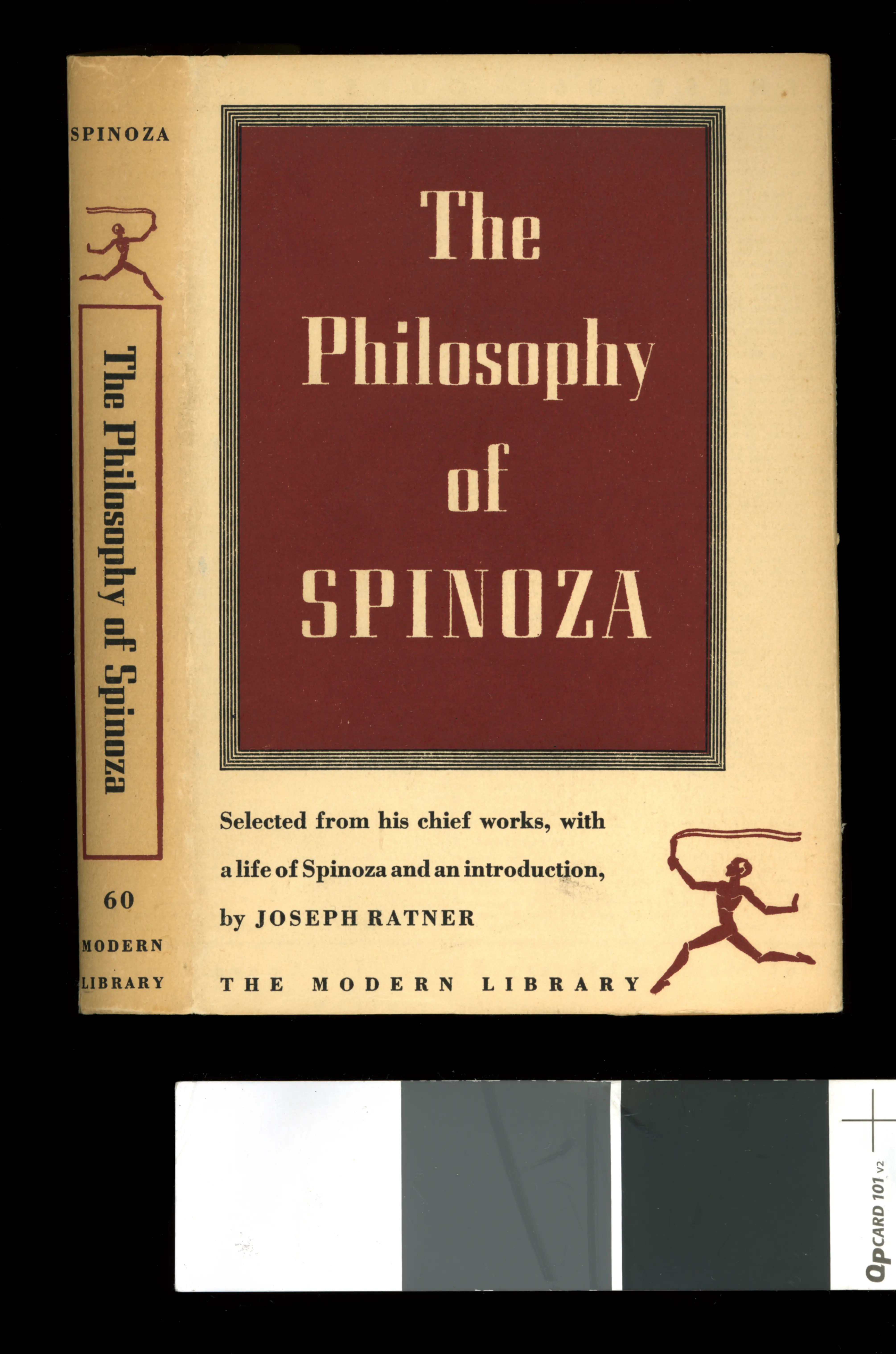
Jacket: Non-pictorial in dark red (16) and black on cream paper with title in reverse on inset dark red panel, other lettering in black. Designed by Joseph Blumenthal.
Front flap as 136a jacket C. (Spring 1941)
Front flap revised with quotation from Dewey (which drops the hyphen from “class-room”) preceded by the following:
That saintly and exalted philosopher, Baruch de Spinoza, wrote and lived as a man of reason and a champion of the freedom of thought and speech. For three centuries his writings have been one of the great glories of the human spirit. The selections in this volume offer the essence of Spinoza’s contribution to philosophy as derived from Tractatus Theologica-Politicus, Improvement of the Understanding and Ethics. John Dewey wrote of this book: “I shall be disappointed . . .” (Fall 1953)
136c. Title page with Fujita torchbearer; 7½ inch format (1969/70)
Title as 135b except: [
Pagination as 136a. [1]16 [2–7]32 [8]16. Contents as 136b variant.
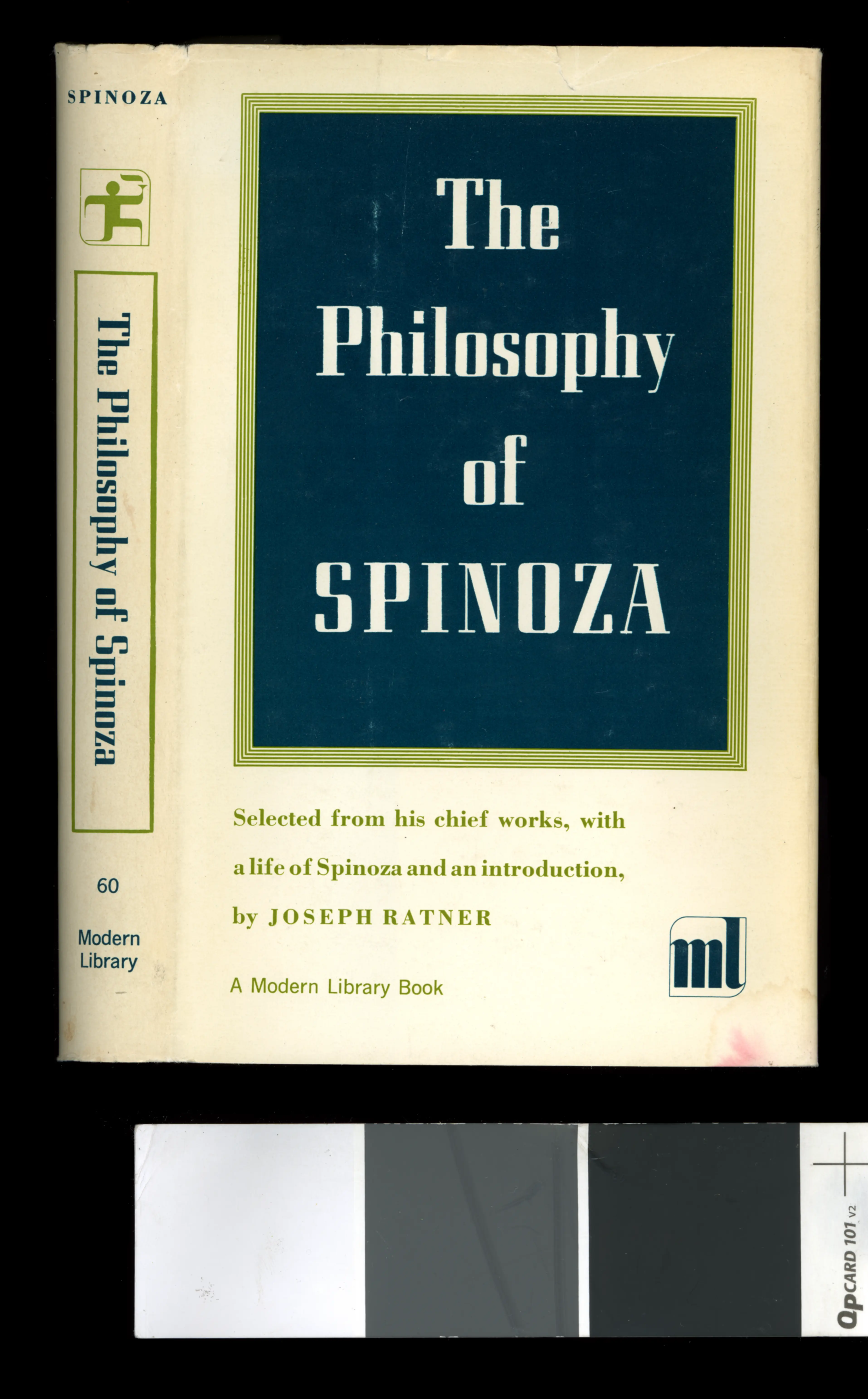
Jacket: As 136b in dark bluish green (165) and moderate yellow green (120) on coated white paper with title in reverse on inset dark bluish green panel, other lettering in moderate yellow green; Fujita torchbearer on spine.
Front flap as 136b revised text.
{
  "full": "\n**SPINOZA. THE PHILOSOPHY OF SPINOZA. 1927–1971. (ML 60)** \n\n#### 136a. First printing (1927) \n\n[within double rules] THE PHILOSOPHY OF | SPINOZA | SELECTED FROM HIS CHIEF WORKS | [rule] | WITH A LIFE OF SPINOZA | AND AN INTRODUCTION BY | JOSEPH RATNER | OF COLUMBIA UNIVERSITY | [rule] | [torchbearer A2] | *All our modern philosophers, though often perhaps uncon- | sciously, see through the glasses which Baruch Spinoza ground.* | Heine. | [rule] | THE MODERN LIBRARY | PUBLISHERS : NEW YORK \n\nPp. [i–iv] v–lxx, [1–2] 3–376 [377–378]. [1–9]16 [10]16(±16) [11–14]16 \n\n[i] half title; [ii] pub. note D6; [iii] title; [iv] *Copyright,* 1927, *by* | THE MODERN LIBRARY, INC. | [short double rule] | *First Modern Library Edition* | 1927; v–viii PREFACE signed p. viii: Joseph Ratner. | *October,* 1926.; ix–x CONTENTS; xi–xxvi THE LIFE OF SPINOZA; xxvii–lxx INTRODUCTION TO THE PHILOSOPHY OF | SPINOZA signed p. lxx: Joseph Ratner.; [1] part title: *FIRST PART* | ON GOD | [4-line epigraph signed (on the fifth line) Spinoza.; all within single rules]; [2] blank; 3–376 text; [377] APPENDIX; [378] blank. *Note:* The second and third part titles are entirely in roman type. The third part title (pp. [249–250]) is a tipped-in replacement leaf. The content of the leaf is as follows: THIRD PART | ON MAN’S WELL-BEING | [5-line epigraph enclosed in a single-rule frame] All happiness or unhappiness solely depends upon the | quality of the object to which we are attached by love. | Love for an object external and infinite feeds the mind | with joy alone, a joy that is free from all sorrow. | Spinoza. \n\n> *Variant:* Pagination as 136a. [1–14]16. Contents as 136a except: [1] part title: FIRST PART | ON GOD | [4-line epigraph from Spinoza in italic type, signed (on the fifth line) Spinoza.]. *Note:* The other epigraphs are also reset in italic type with the single-rule frame omitted. (*Imitation leather binding; probably the second printing*) \n\n*Format:* The first printing is in the standard 6½ by 4¼ inch format with very narrow margins at the top and foot. Several later printings of 136a are about ¼ inch taller and wider than the standard format. Narrow margins were sometimes unavoidable when the ML printed from other publishers’ plates, but it was unusual for a typesetting designed for the ML to have such narrow margins. It is possible that the size of the type page was determined by an economic decision to limit the volume to fourteen gatherings of sixteen leaves each. \n\n*Jacket A:* Uniform typographic jacket B. \n\n> Text on front:
 Mr. Ratner remarks that “after having been one of the liberating thinkers of mankind who was read but not honored, Spinoza is fast becoming one of the canonized of mankind who are honored but not read.” This volume with its Life, Introduction, and Selections will immensely assist to get Spinoza read and understood as well as honored. If Mr. Ratner had not actually accomplished the task, I should not have thought it possible to render evident and outstanding the significant ideas of Spinoza, freed from obscuring technicalities; and to do it in such a way as to make clear to the reader their kinship with perplexing religious, moral and intellectual questions of our own day. But Mr. Ratner has had the happy thought to set the extracts from Spinoza’s *Ethics* between selections from his more popular writings on the scriptures, miracles, etc., on one hand, and his views of the state, government, freedom of thought and speech, etc., on the other. This fact alone illuminates the value of Spinoza’s thought for the present in an extraordinary way. I shall be disappointed if Mr. Ratner’s volume does not have a marked influence in bringing Spinoza out of the professional class-room and enabling him to serve as a precious companion to men and women who need the light and leading which he can give.” —John Dewey. (*Spring 1927*) \n\n*Jacket B:* Uniform typographic jacket D. (*Spring 1929*) \n\n*Jacket C:* Pictorial philosophy jacket in moderate blue (182) and brown on tan paper depicting a helmeted woman holding a scroll and lamp; borders in moderate blue, lettering in brown. Signed: WC. (*Fall 1932*) \n\n> Front flap:
 Professor Ratner’s masterly arrangement of Spinoza’s philosophy has become the standard text in leading universities throughout the country. John Dewey writes: “I shall be disappointed if Mr. Ratner’s volume does not have a marked influence in bringing Spinoza out of the professional class-room and enabling him to serve as a precious companion to men and women who need the light and leading which he can give.” (*Spring 1935*) \n\nOriginal ML collection. Published February 1927. *WR* 12 March 1927. First printing: Not ascertained. Discontinued 1971/72. \n\nRatner was born in 1901 and received his M.A. from Columbia University in 1923. He was a lecturer and doctoral student in the philosophy department at Columbia when he compiled *The Philosophy of Spinoza*. He received his Ph.D. from Columbia in 1930. \n\nCerf asked Morris R. Cohen of the City College of New York to comment on Ratner’s manuscript. Cohen suggested leaving out some of the sections on Biblical interpretation and substituting “some sections from the tract on Politics e.g. the section of government by law in a democracy. I believe the latter will interest ‘Modern’ readers more than the excessive amount devoted to biblical interpretation” (Cohen to Cerf, 6 October 1926). A few months after publication Cerf wrote, “Spinoza continues to sell far in excess of our expectations” (Cerf to Ratner, 7 June 1927). \n\nIn April 1940, when he was an instructor at City College of New York, Ratner sold his rights to *The Philosophy of Spinoza* and John Dewey’s *Intelligence in the Modern World* (G41) for \\$500. He also retained the unearned advance for the Dewey volume, which had been published the previous year; the unearned advance appears to have amounted to \\$700. The two books became the absolute property of the ML, and Ratner received no further royalties. He had the option to buy back the contracts at any time within the next two years for \\$1,200 minus royalties accrued from 1 January 1940. \n\n#### 136b. Title page reset (1941) \n\n*THE PHILOSOPHY OF* | SPINOZA | SELECTED FROM HIS CHIEF WORKS | *With a Life of Spinoza and an Introduction by* | JOSEPH RATNER *of Columbia University* | “All our modern philosophers, though often perhaps | unconsciously, see through the glasses which | Baruch Spinoza ground.” HEINE | [torchbearer D3 at right; 3-line imprint at left] THE | MODERN LIBRARY | NEW YORK | [rule] \n\nPagination as 136a. [1–14]16 \n\nContents as 136a variant except: [ii] blank; [iv] COPYRIGHT, 1927, BY THE MODERN LIBRARY, INC. \n\n> *Variant:* Pagination and collation as 136b. Contents as 136b except: [iv] COPYRIGHT 1927, 1954, BY THE MODERN LIBRARY, INC. \n\n*Jacket:* Non-pictorial in dark red (16) and black on cream paper with title in reverse on inset dark red panel, other lettering in black. Designed by Joseph Blumenthal. \n\n> Front flap as 136a jacket C. (*Spring 1941*) \n\n> Front flap revised with quotation from Dewey (which drops the hyphen from “class-room”) preceded by the following:
 That saintly and exalted philosopher, Baruch de Spinoza, wrote and lived as a man of reason and a champion of the freedom of thought and speech. For three centuries his writings have been one of the great glories of the human spirit. The selections in this volume offer the essence of Spinoza’s contribution to philosophy as derived from *Tractatus Theologica-Politicus*, *Improvement of the Understanding* and *Ethics*. John Dewey wrote of this book: “I shall be disappointed . . .” (*Fall 1953*) \n\n#### 136c. Title page with Fujita torchbearer; 7½ inch format (1969/70) \n\nTitle as 135b except: [torchbearer K]. \n\nPagination as 136a. [1]16 [2–7]32 [8]16. Contents as 136b variant. \n\n*Jacket:* As 136b in dark bluish green (165) and moderate yellow green (120) on coated white paper with title in reverse on inset dark bluish green panel, other lettering in moderate yellow green; Fujita torchbearer on spine. \n\n> Front flap as 136b revised text. \n\n",
  "id": "136",
  "year": "1927",
  "label": "SPINOZA. THE PHILOSOPHY OF SPINOZA. 1927–1971. (ML 60)",
  "author": "SPINOZA",
  "title": "THE PHILOSOPHY OF SPINOZA.",
  "date": "1927–1971.",
  "something": "ML 60",
  "revisions": [
    {
      "id": "136a",
      "title": "First printing (1927) ",
      "full": "\n\n[within double rules] THE PHILOSOPHY OF | SPINOZA | SELECTED FROM HIS CHIEF WORKS | [rule] | WITH A LIFE OF SPINOZA | AND AN INTRODUCTION BY | JOSEPH RATNER | OF COLUMBIA UNIVERSITY | [rule] | [torchbearer A2] | *All our modern philosophers, though often perhaps uncon- | sciously, see through the glasses which Baruch Spinoza ground.* | Heine. | [rule] | THE MODERN LIBRARY | PUBLISHERS : NEW YORK \n\nPp. [i–iv] v–lxx, [1–2] 3–376 [377–378]. [1–9]16 [10]16(±16) [11–14]16 \n\n[i] half title; [ii] pub. note D6; [iii] title; [iv] *Copyright,* 1927, *by* | THE MODERN LIBRARY, INC. | [short double rule] | *First Modern Library Edition* | 1927; v–viii PREFACE signed p. viii: Joseph Ratner. | *October,* 1926.; ix–x CONTENTS; xi–xxvi THE LIFE OF SPINOZA; xxvii–lxx INTRODUCTION TO THE PHILOSOPHY OF | SPINOZA signed p. lxx: Joseph Ratner.; [1] part title: *FIRST PART* | ON GOD | [4-line epigraph signed (on the fifth line) Spinoza.; all within single rules]; [2] blank; 3–376 text; [377] APPENDIX; [378] blank. *Note:* The second and third part titles are entirely in roman type. The third part title (pp. [249–250]) is a tipped-in replacement leaf. The content of the leaf is as follows: THIRD PART | ON MAN’S WELL-BEING | [5-line epigraph enclosed in a single-rule frame] All happiness or unhappiness solely depends upon the | quality of the object to which we are attached by love. | Love for an object external and infinite feeds the mind | with joy alone, a joy that is free from all sorrow. | Spinoza. \n\n> *Variant:* Pagination as 136a. [1–14]16. Contents as 136a except: [1] part title: FIRST PART | ON GOD | [4-line epigraph from Spinoza in italic type, signed (on the fifth line) Spinoza.]. *Note:* The other epigraphs are also reset in italic type with the single-rule frame omitted. (*Imitation leather binding; probably the second printing*) \n\n*Format:* The first printing is in the standard 6½ by 4¼ inch format with very narrow margins at the top and foot. Several later printings of 136a are about ¼ inch taller and wider than the standard format. Narrow margins were sometimes unavoidable when the ML printed from other publishers’ plates, but it was unusual for a typesetting designed for the ML to have such narrow margins. It is possible that the size of the type page was determined by an economic decision to limit the volume to fourteen gatherings of sixteen leaves each. \n\n*Jacket A:* Uniform typographic jacket B. \n\n> Text on front:
 Mr. Ratner remarks that “after having been one of the liberating thinkers of mankind who was read but not honored, Spinoza is fast becoming one of the canonized of mankind who are honored but not read.” This volume with its Life, Introduction, and Selections will immensely assist to get Spinoza read and understood as well as honored. If Mr. Ratner had not actually accomplished the task, I should not have thought it possible to render evident and outstanding the significant ideas of Spinoza, freed from obscuring technicalities; and to do it in such a way as to make clear to the reader their kinship with perplexing religious, moral and intellectual questions of our own day. But Mr. Ratner has had the happy thought to set the extracts from Spinoza’s *Ethics* between selections from his more popular writings on the scriptures, miracles, etc., on one hand, and his views of the state, government, freedom of thought and speech, etc., on the other. This fact alone illuminates the value of Spinoza’s thought for the present in an extraordinary way. I shall be disappointed if Mr. Ratner’s volume does not have a marked influence in bringing Spinoza out of the professional class-room and enabling him to serve as a precious companion to men and women who need the light and leading which he can give.” —John Dewey. (*Spring 1927*) \n\n*Jacket B:* Uniform typographic jacket D. (*Spring 1929*) \n\n*Jacket C:* Pictorial philosophy jacket in moderate blue (182) and brown on tan paper depicting a helmeted woman holding a scroll and lamp; borders in moderate blue, lettering in brown. Signed: WC. (*Fall 1932*) \n\n> Front flap:
 Professor Ratner’s masterly arrangement of Spinoza’s philosophy has become the standard text in leading universities throughout the country. John Dewey writes: “I shall be disappointed if Mr. Ratner’s volume does not have a marked influence in bringing Spinoza out of the professional class-room and enabling him to serve as a precious companion to men and women who need the light and leading which he can give.” (*Spring 1935*) \n\nOriginal ML collection. Published February 1927. *WR* 12 March 1927. First printing: Not ascertained. Discontinued 1971/72. \n\nRatner was born in 1901 and received his M.A. from Columbia University in 1923. He was a lecturer and doctoral student in the philosophy department at Columbia when he compiled *The Philosophy of Spinoza*. He received his Ph.D. from Columbia in 1930. \n\nCerf asked Morris R. Cohen of the City College of New York to comment on Ratner’s manuscript. Cohen suggested leaving out some of the sections on Biblical interpretation and substituting “some sections from the tract on Politics e.g. the section of government by law in a democracy. I believe the latter will interest ‘Modern’ readers more than the excessive amount devoted to biblical interpretation” (Cohen to Cerf, 6 October 1926). A few months after publication Cerf wrote, “Spinoza continues to sell far in excess of our expectations” (Cerf to Ratner, 7 June 1927). \n\nIn April 1940, when he was an instructor at City College of New York, Ratner sold his rights to *The Philosophy of Spinoza* and John Dewey’s *Intelligence in the Modern World* (G41) for \\$500. He also retained the unearned advance for the Dewey volume, which had been published the previous year; the unearned advance appears to have amounted to \\$700. The two books became the absolute property of the ML, and Ratner received no further royalties. He had the option to buy back the contracts at any time within the next two years for \\$1,200 minus royalties accrued from 1 January 1940. \n\n"
    },
    {
      "id": "136b",
      "title": "Title page reset (1941) ",
      "full": "\n\n*THE PHILOSOPHY OF* | SPINOZA | SELECTED FROM HIS CHIEF WORKS | *With a Life of Spinoza and an Introduction by* | JOSEPH RATNER *of Columbia University* | “All our modern philosophers, though often perhaps | unconsciously, see through the glasses which | Baruch Spinoza ground.” HEINE | [torchbearer D3 at right; 3-line imprint at left] THE | MODERN LIBRARY | NEW YORK | [rule] \n\nPagination as 136a. [1–14]16 \n\nContents as 136a variant except: [ii] blank; [iv] COPYRIGHT, 1927, BY THE MODERN LIBRARY, INC. \n\n> *Variant:* Pagination and collation as 136b. Contents as 136b except: [iv] COPYRIGHT 1927, 1954, BY THE MODERN LIBRARY, INC. \n\n*Jacket:* Non-pictorial in dark red (16) and black on cream paper with title in reverse on inset dark red panel, other lettering in black. Designed by Joseph Blumenthal. \n\n> Front flap as 136a jacket C. (*Spring 1941*) \n\n> Front flap revised with quotation from Dewey (which drops the hyphen from “class-room”) preceded by the following:
 That saintly and exalted philosopher, Baruch de Spinoza, wrote and lived as a man of reason and a champion of the freedom of thought and speech. For three centuries his writings have been one of the great glories of the human spirit. The selections in this volume offer the essence of Spinoza’s contribution to philosophy as derived from *Tractatus Theologica-Politicus*, *Improvement of the Understanding* and *Ethics*. John Dewey wrote of this book: “I shall be disappointed . . .” (*Fall 1953*) \n\n"
    },
    {
      "id": "136c",
      "title": "Title page with Fujita torchbearer; 7½ inch format (1969/70) ",
      "full": "\n\nTitle as 135b except: [torchbearer K]. \n\nPagination as 136a. [1]16 [2–7]32 [8]16. Contents as 136b variant. \n\n*Jacket:* As 136b in dark bluish green (165) and moderate yellow green (120) on coated white paper with title in reverse on inset dark bluish green panel, other lettering in moderate yellow green; Fujita torchbearer on spine. \n\n> Front flap as 136b revised text. \n\n"
    }
  ],
  "type": "book"
}