
The Modern Library Bibliography
OLIVE SCHREINER. THE STORY OF AN AFRICAN FARM. 1927–1942. (ML 132)
142a. First printing (1927)
[within double rules] THE STORY OF AN | AFRICAN FARM | [rule] | BY | OLIVE SCHREINER | [rule] | INTRODUCTION BY | FRANCIS BRETT YOUNG | [rule] | [
Pp. [1–6] 7–14, [vii] viii–ix [x], [1–3] 4–5 [6], [15–17] 18–375 [376–378]. [1–11]16 [12]16(16+1.2)
[1] half title; [2]
< Variant A: Pagination as 142a except: [376–382]. [1–12]16 [13]4. Contents as 142a except: [2]
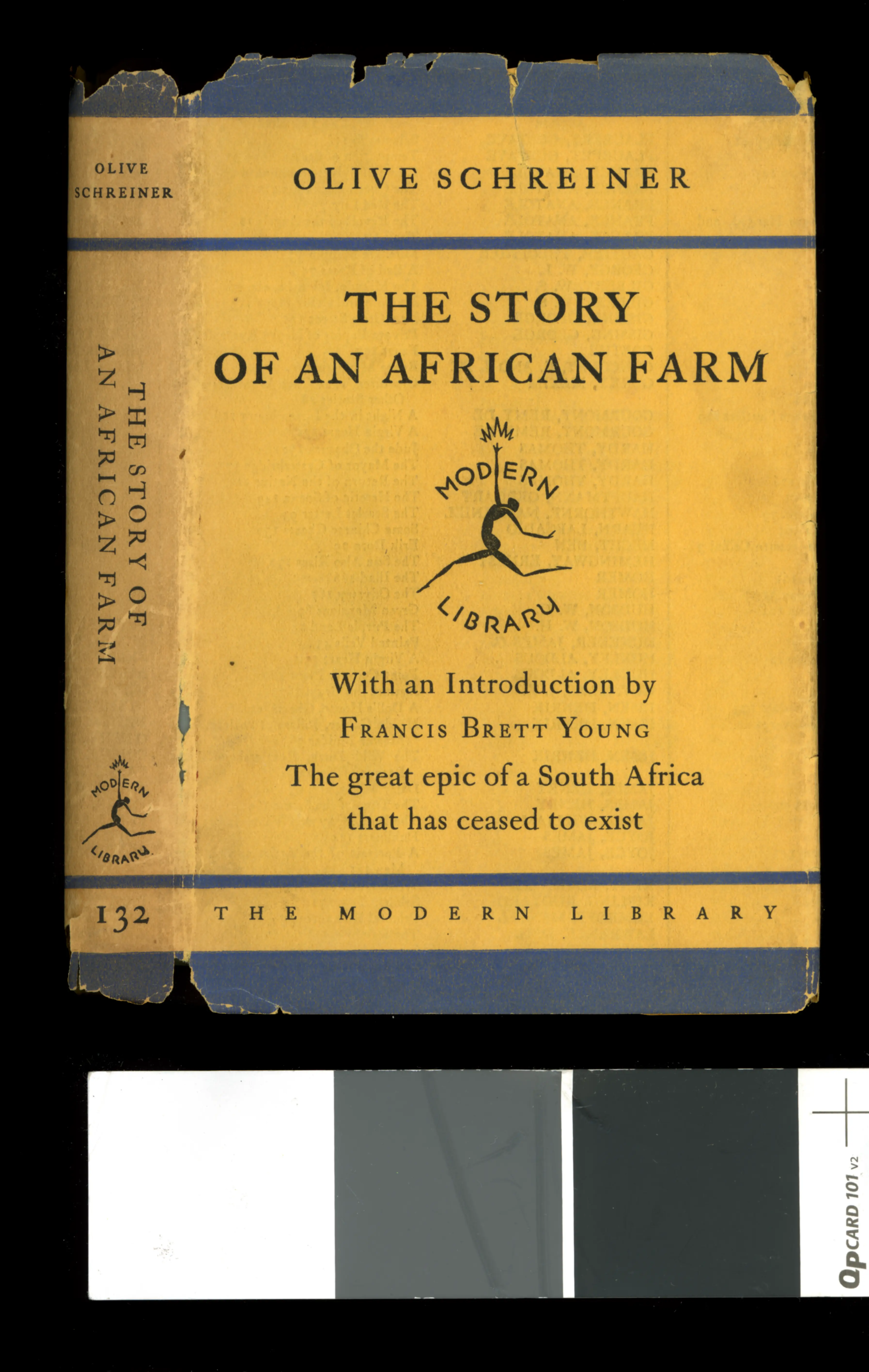
Jacket A:
Text on front:
Olive Schreiner finished “The Story of An African Farm” in 1879. Like many other good books, it was promptly rejected times without number, but was accepted finally by the London house of Chapman and Hall, on the advice of their reader, George Meredith.
The book was an immediate success. It is difficult to imagine that a work so singular in atmosphere, so potent in its passion, should ever have been anything else. To this day, it ranks as the great epic of a South Africa that has ceased to exist—a civilization that heard its sentence of death when gold was discovered on the Ridge of the White Waters. (Spring 1927)
Jacket B:
Front flap:
To George Meredith, then a publisher’s reader, belongs the credit for having saved from oblivion a manuscript that has become the spiritual expression of South Africa. Upon its publication in 1879, The Story of an African Farm won world-wide acclaim for its author as a writer of genius. The burning passion that illuminates its pages gives conviction to a story unique in the annals of literature. Olive Schreiner was a child of the South Africa that has ceased to exist; her book is its crowning monument and memorial. (Fall 1933)
Originally published in U.S. by Roberts Brothers, 1888, and from 1898 by Little, Brown & Co. ML edition (pp. [5], [vii]–ix, [1]–5, [15]–375) printed from Roberts Brothers/Little, Brown plates with the reset dedication, repaginated preliminaries, and the added fly title of the 1924 Little, Brown printing. Young’s introduction replaced the introduction by S. C. Cronwright-Schreiner on pp. 7–14 of the 1924 Little, Brown printing. Publication announced for July 1927. WR 20 August 1927. First printing: Not ascertained. Discontinued fall 1942.
Young received the ML’s standard $50 fee for writing the introduction.
142b. Title page reset (1941)
THE STORY | OF AN | AFRICAN | FARM | BY | OLIVE SCHREINER | WITH AN INTRODUCTION BY | FRANCIS BRETT YOUNG | [
Pagination and collation as 142a variant B.
Contents as 142a variant except: [2] blank; [4] INTRODUCTION, COPYRIGHT, 1927, | BY THE MODERN LIBRARY, INC. (Spring 1941)
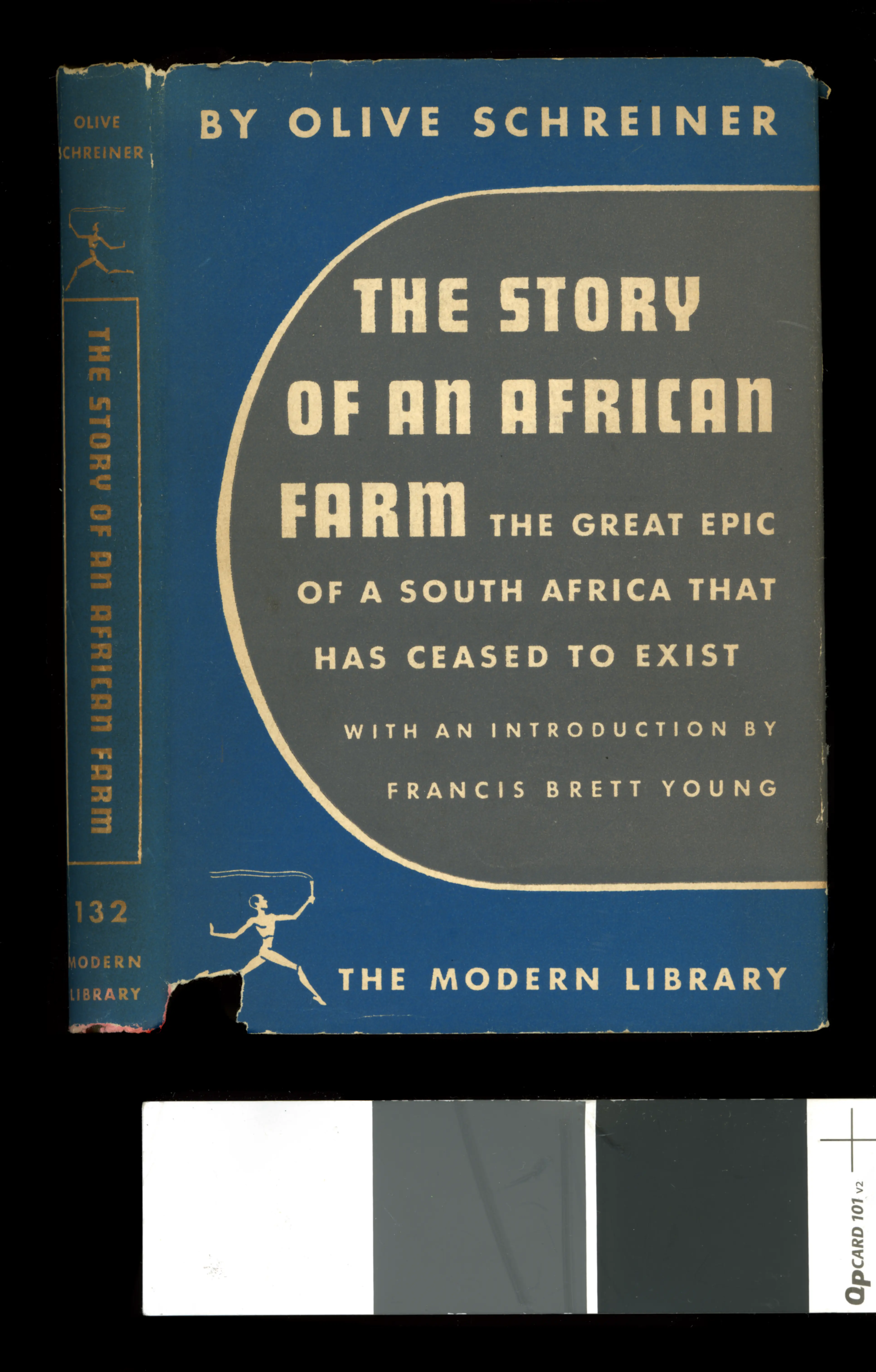
Jacket A: Non-pictorial in moderate blue (182) and brown on cream paper with title and additional lettering in reverse on curved brown panel at right; author, series and torchbearer in reverse against moderate blue background. Designed by Joseph Blumenthal.
Front flap as 142a jacket B. (1940).
Jacket B: As jacket A in moderate blue (182) and dark gray (266) on cream paper with curved dark gray panel at right; otherwise as jacket A. (Spring 1941)
{
  "full": "\n**OLIVE SCHREINER. THE STORY OF AN AFRICAN FARM. 1927–1942. (ML 132)** \n\n#### 142a. First printing (1927) \n\n[within double rules] THE STORY OF AN | AFRICAN FARM | [rule] | BY | OLIVE SCHREINER | [rule] | INTRODUCTION BY | FRANCIS BRETT YOUNG | [rule] | [torchbearer A2] | [rule] | THE MODERN LIBRARY | PUBLISHERS : NEW YORK \n\nPp. [1–6] 7–14, [vii] viii–ix [x], [1–3] 4–5 [6], [15–17] 18–375 [376–378]. [1–11]16 [12]16(16+1.2) \n\n[1] half title; [2] pub. note A5; [3] title; [4] *Introduction Copyright,* 1927, *by* | THE MODERN LIBRARY, INC. | [short double rule] | *First Modern Library Edition* | 1927; [5] dedication; [6] blank; 7–14 INTRODUCTION signed p. 14: Francis Brett Young. | *Anacapri:* 1926.; [vii]–ix AUTHOR’S PREFACE TO SECOND EDITION dated p. ix: June, 1883.; [x] blank; [1] GLOSSARY.; [2] epigraph signed: Alexis de Tocqueville.; [3]–5 CONTENTS.; [6] blank; [15] fly title; [16] blank; [17]–375 text; [376–378] ML list. (*Spring 1927*) \n\n< *Variant A:* Pagination as 142a except: [376–382]. [1–12]16 [13]4. Contents as 142a except: [2] pub. note A6; [376] blank; [377–382] ML list. (*Spring 1934*) > *Variant B:* Pp. Pagination and collation as variant A except: [1–7] 8–14 . . . . Contents as 142a except: [7]–14 INTRODUCTION; [376] blank; [377–381] ML list; [382] blank. (*Spring 1938*) *Note:* Page numeral “7” removed from plates. \n\n*Jacket A:* Uniform typographic jacket B. \n\n> Text on front:
 Olive Schreiner finished “The Story of An African Farm” in 1879. Like many other good books, it was promptly rejected times without number, but was accepted finally by the London house of Chapman and Hall, on the advice of their reader, George Meredith. \n> The book was an immediate success. It is difficult to imagine that a work so singular in atmosphere, so potent in its passion, should ever have been anything else. To this day, it ranks as the great epic of a South Africa that has ceased to exist—a civilization that heard its sentence of death when gold was discovered on the Ridge of the White Waters. (*Spring* *1927*) \n\n*Jacket B:* Uniform typographic jacket D. Text on front: “The great epic of a South Africa that has ceased to exist.” (*Spring 1929*) \n\nFront flap:
 To George Meredith, then a publisher’s reader, belongs the credit for having saved from oblivion a manuscript that has become the spiritual expression of South Africa. Upon its publication in 1879, *The Story of an African Farm* won world-wide acclaim for its author as a writer of genius. The burning passion that illuminates its pages gives conviction to a story unique in the annals of literature. Olive Schreiner was a child of the South Africa that has ceased to exist; her book is its crowning monument and memorial. (*Fall 1933*) \n\nOriginally published in U.S. by Roberts Brothers, 1888, and from 1898 by Little, Brown & Co. ML edition (pp. [5], [vii]–ix, [1]–5, [15]–375) printed from Roberts Brothers/Little, Brown plates with the reset dedication, repaginated preliminaries, and the added fly title of the 1924 Little, Brown printing. Young’s introduction replaced the introduction by S. C. Cronwright-Schreiner on pp. 7–14 of the 1924 Little, Brown printing. Publication announced for July 1927. *WR* 20 August 1927. First printing: Not ascertained. Discontinued fall 1942. \n\nYoung received the ML’s standard \\$50 fee for writing the introduction. \n\n#### 142b. Title page reset (1941) \n\nTHE STORY | OF AN | AFRICAN | FARM | BY | OLIVE SCHREINER | WITH AN INTRODUCTION BY | FRANCIS BRETT YOUNG | [torchbearer D4 at right; 3-line imprint at left] THE | MODERN LIBRARY | NEW YORK | [rule] \n\nPagination and collation as 142a variant B. \n\nContents as 142a variant except: [2] blank; [4] INTRODUCTION, COPYRIGHT, 1927, | BY THE MODERN LIBRARY, INC. (*Spring 1941*) \n\n*Jacket A:* Non-pictorial in moderate blue (182) and brown on cream paper with title and additional lettering in reverse on curved brown panel at right; author, series and torchbearer in reverse against moderate blue background. Designed by Joseph Blumenthal. \n\n> Front flap as 142a jacket B. (1940). \n\n*Jacket B:* As jacket A in moderate blue (182) and dark gray (266) on cream paper with curved dark gray panel at right; otherwise as jacket A. (*Spring 1941*) \n\n",
  "id": "142",
  "year": "1927",
  "label": "OLIVE SCHREINER. THE STORY OF AN AFRICAN FARM. 1927–1942. (ML 132)",
  "author": "OLIVE SCHREINER",
  "title": "THE STORY OF AN AFRICAN FARM.",
  "date": "1927–1942.",
  "something": "ML 132",
  "revisions": [
    {
      "id": "142a",
      "title": "First printing (1927) ",
      "full": "\n\n[within double rules] THE STORY OF AN | AFRICAN FARM | [rule] | BY | OLIVE SCHREINER | [rule] | INTRODUCTION BY | FRANCIS BRETT YOUNG | [rule] | [torchbearer A2] | [rule] | THE MODERN LIBRARY | PUBLISHERS : NEW YORK \n\nPp. [1–6] 7–14, [vii] viii–ix [x], [1–3] 4–5 [6], [15–17] 18–375 [376–378]. [1–11]16 [12]16(16+1.2) \n\n[1] half title; [2] pub. note A5; [3] title; [4] *Introduction Copyright,* 1927, *by* | THE MODERN LIBRARY, INC. | [short double rule] | *First Modern Library Edition* | 1927; [5] dedication; [6] blank; 7–14 INTRODUCTION signed p. 14: Francis Brett Young. | *Anacapri:* 1926.; [vii]–ix AUTHOR’S PREFACE TO SECOND EDITION dated p. ix: June, 1883.; [x] blank; [1] GLOSSARY.; [2] epigraph signed: Alexis de Tocqueville.; [3]–5 CONTENTS.; [6] blank; [15] fly title; [16] blank; [17]–375 text; [376–378] ML list. (*Spring 1927*) \n\n< *Variant A:* Pagination as 142a except: [376–382]. [1–12]16 [13]4. Contents as 142a except: [2] pub. note A6; [376] blank; [377–382] ML list. (*Spring 1934*) > *Variant B:* Pp. Pagination and collation as variant A except: [1–7] 8–14 . . . . Contents as 142a except: [7]–14 INTRODUCTION; [376] blank; [377–381] ML list; [382] blank. (*Spring 1938*) *Note:* Page numeral “7” removed from plates. \n\n*Jacket A:* Uniform typographic jacket B. \n\n> Text on front:
 Olive Schreiner finished “The Story of An African Farm” in 1879. Like many other good books, it was promptly rejected times without number, but was accepted finally by the London house of Chapman and Hall, on the advice of their reader, George Meredith. \n> The book was an immediate success. It is difficult to imagine that a work so singular in atmosphere, so potent in its passion, should ever have been anything else. To this day, it ranks as the great epic of a South Africa that has ceased to exist—a civilization that heard its sentence of death when gold was discovered on the Ridge of the White Waters. (*Spring* *1927*) \n\n*Jacket B:* Uniform typographic jacket D. Text on front: “The great epic of a South Africa that has ceased to exist.” (*Spring 1929*) \n\nFront flap:
 To George Meredith, then a publisher’s reader, belongs the credit for having saved from oblivion a manuscript that has become the spiritual expression of South Africa. Upon its publication in 1879, *The Story of an African Farm* won world-wide acclaim for its author as a writer of genius. The burning passion that illuminates its pages gives conviction to a story unique in the annals of literature. Olive Schreiner was a child of the South Africa that has ceased to exist; her book is its crowning monument and memorial. (*Fall 1933*) \n\nOriginally published in U.S. by Roberts Brothers, 1888, and from 1898 by Little, Brown & Co. ML edition (pp. [5], [vii]–ix, [1]–5, [15]–375) printed from Roberts Brothers/Little, Brown plates with the reset dedication, repaginated preliminaries, and the added fly title of the 1924 Little, Brown printing. Young’s introduction replaced the introduction by S. C. Cronwright-Schreiner on pp. 7–14 of the 1924 Little, Brown printing. Publication announced for July 1927. *WR* 20 August 1927. First printing: Not ascertained. Discontinued fall 1942. \n\nYoung received the ML’s standard \\$50 fee for writing the introduction. \n\n"
    },
    {
      "id": "142b",
      "title": "Title page reset (1941) ",
      "full": "\n\nTHE STORY | OF AN | AFRICAN | FARM | BY | OLIVE SCHREINER | WITH AN INTRODUCTION BY | FRANCIS BRETT YOUNG | [torchbearer D4 at right; 3-line imprint at left] THE | MODERN LIBRARY | NEW YORK | [rule] \n\nPagination and collation as 142a variant B. \n\nContents as 142a variant except: [2] blank; [4] INTRODUCTION, COPYRIGHT, 1927, | BY THE MODERN LIBRARY, INC. (*Spring 1941*) \n\n*Jacket A:* Non-pictorial in moderate blue (182) and brown on cream paper with title and additional lettering in reverse on curved brown panel at right; author, series and torchbearer in reverse against moderate blue background. Designed by Joseph Blumenthal. \n\n> Front flap as 142a jacket B. (1940). \n\n*Jacket B:* As jacket A in moderate blue (182) and dark gray (266) on cream paper with curved dark gray panel at right; otherwise as jacket A. (*Spring 1941*) \n\n"
    }
  ],
  "type": "book"
}