
The Modern Library Bibliography
EMILE ZOLA. NANA. 1928–1970. (ML 142)
151.1a. First printing (1928)
[within double rules] NANA | [rule] | BY | EMILE ZOLA | [rule] | INTRODUCTION BY | ERNEST BOYD | [rule] | [
Pp. [i–iv] v–xii, 1–517 [518–524]. [1–16]16 [17]12
[i] half title; [ii]
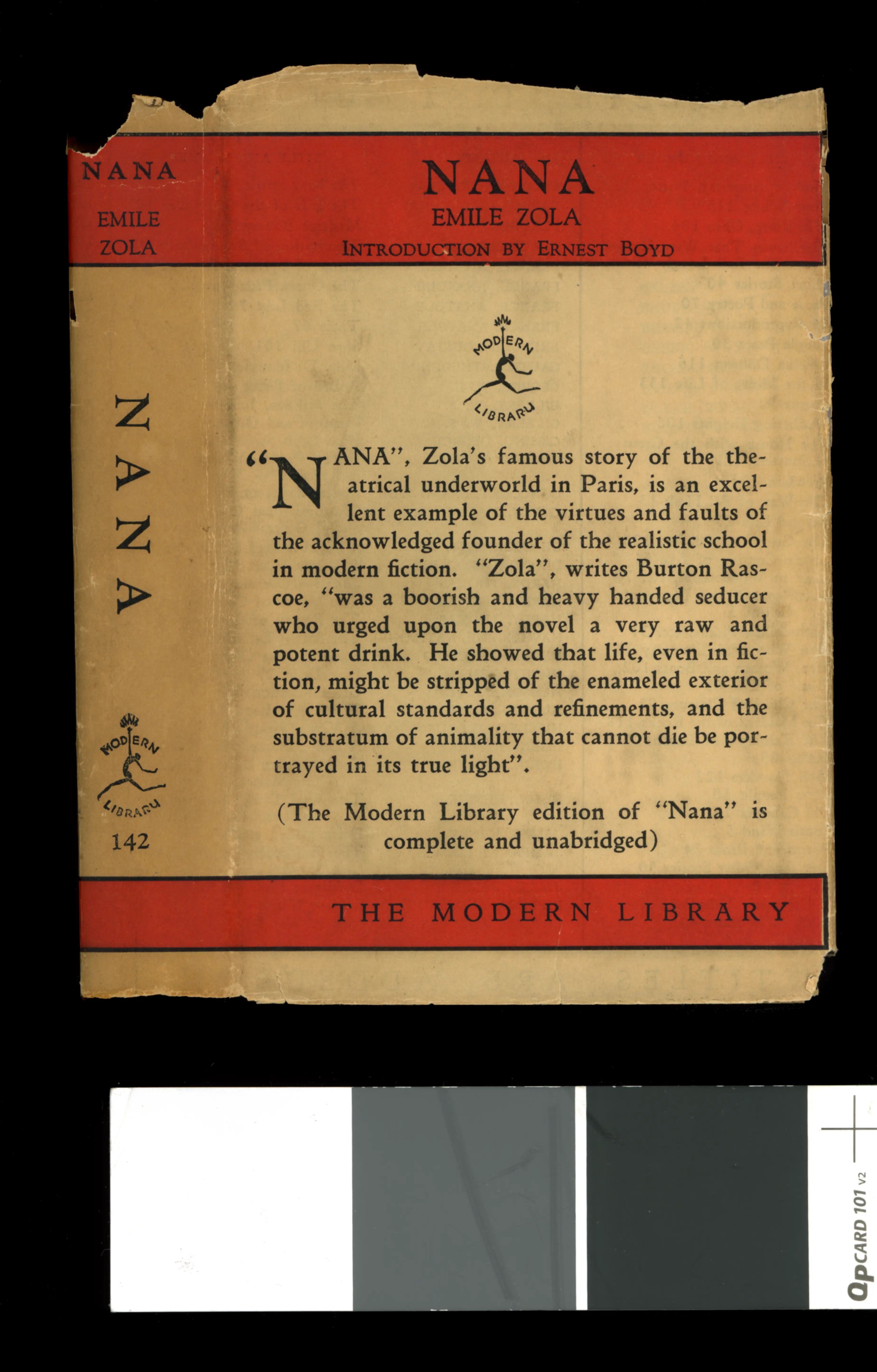
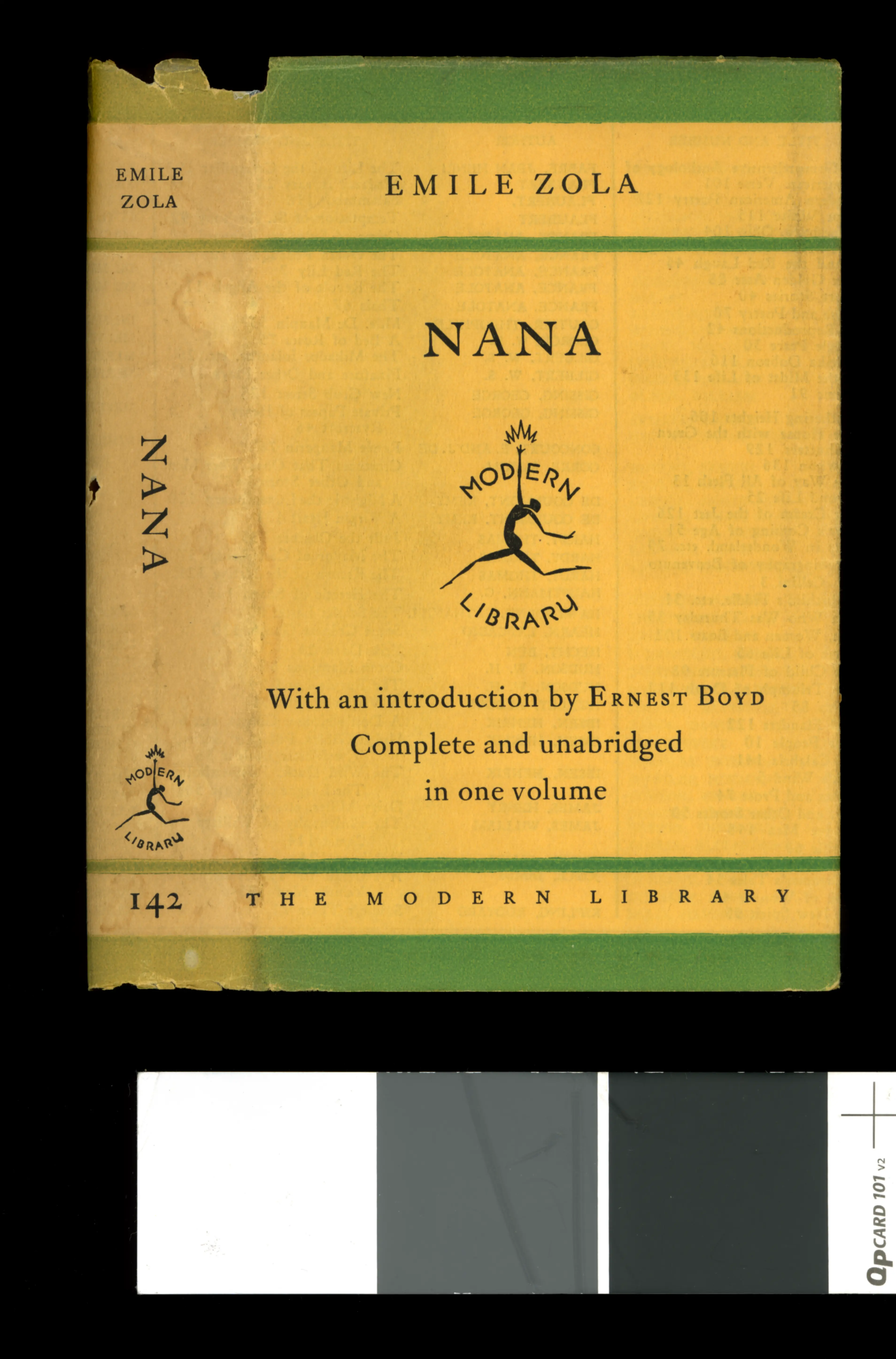
Jacket A:
Text on front:
“NANA”, Zola’s famous story of the theatrical underworld in Paris, is an excellent example of the virtues and faults of the acknowledged founder of the realistic school in modern fiction. “Zola”, writes Burton Rascoe, “was a boorish and heavy handed seducer who urged upon the novel a very raw and potent drink. He showed that life, even in fiction, might be stripped of the enameled exterior of cultural standards and refinements, and the substratum of animality that cannot die be portrayed in its true light.” (Fall 1927)
Jacket B:
Jacket C: Three French Romances gift box. (1929)
Jacket D: Pictorial in strong yellowish pink (26) and black on light pink paper with inset oval illustration of a woman with parasol and four winged cherubs; lettering in black except title in strong yellowish pink and black, borders in strong yellowish pink. (Fall 1932)
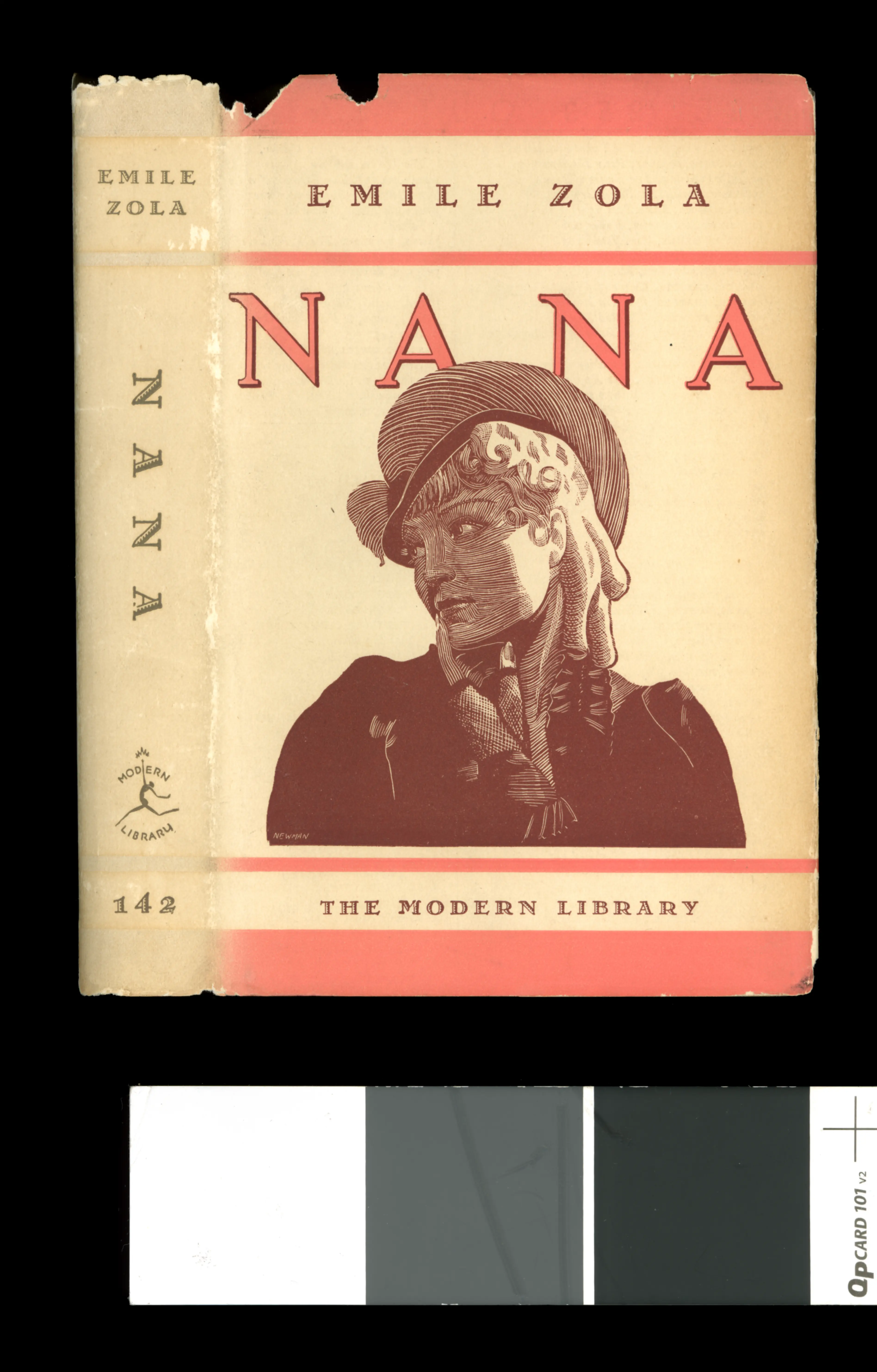
Jacket E: Pictorial in dark yellowish pink (30) and moderate reddish brown (43) on cream paper with head-and-shoulders illustration of a woman glancing to her right; lettering in moderate reddish brown except title in dark yellowish pink outlined in moderate reddish brown, borders in dark yellowish pink. Signed: Newman.
Front flap:
Banned in England in 1888 for its so-called obscenity, Nana has since come to be regarded the highest achievement among the novels of the Naturalist school. Its author is now acknowledged as the source from which the English realists and our own Frank Norris and Theodore Dreiser derive their greatest influence. Regardless of the sensational aspects of this work and its niche in literary history, Nana lives as a novel by its own vigor and the incomparable skill and fidelity with which it is written. (Spring 1935)
Plarr translation originally published in a limited edition by the Lutetian Society (London, 1894) and in U.S. by Boni & Liveright, 1924. ML edition printed from plates made from a new typesetting. Published January 1928. WR 18 February 1928. First printing: Not ascertained. Discontinued 1970/71.
The Modern Library used the Victor Plarr translation without identifying the translator. When a film version produced by Samuel Goldwyn and starring the Russian actress Anna Sten was released in 1934, the ML urged booksellers to stock Nana in quantity and distributed copies of the movie poster to major bookstores.
Sales of Nana during the first six months of 1928 placed it 2nd out of 147 ML titles. During the 18-month period May 1942–October 1943 it was low in the first quarter of ML titles in terms of sales. It did not rank among the 100 best-selling titles in the regular ML during the 12-month period November 1951–October 1952.
151.1b. Title page reset (c. 1941)
NANA | by | EMILE ZOLA | introduction by ERNEST BOYD | [
Pagination and collation as 151.1a. Contents as 151.1a except: [ii] blank; [iv] publication and manufacturing statements within single rules; [519–523] ML list; [524] blank. (Spring 1943)
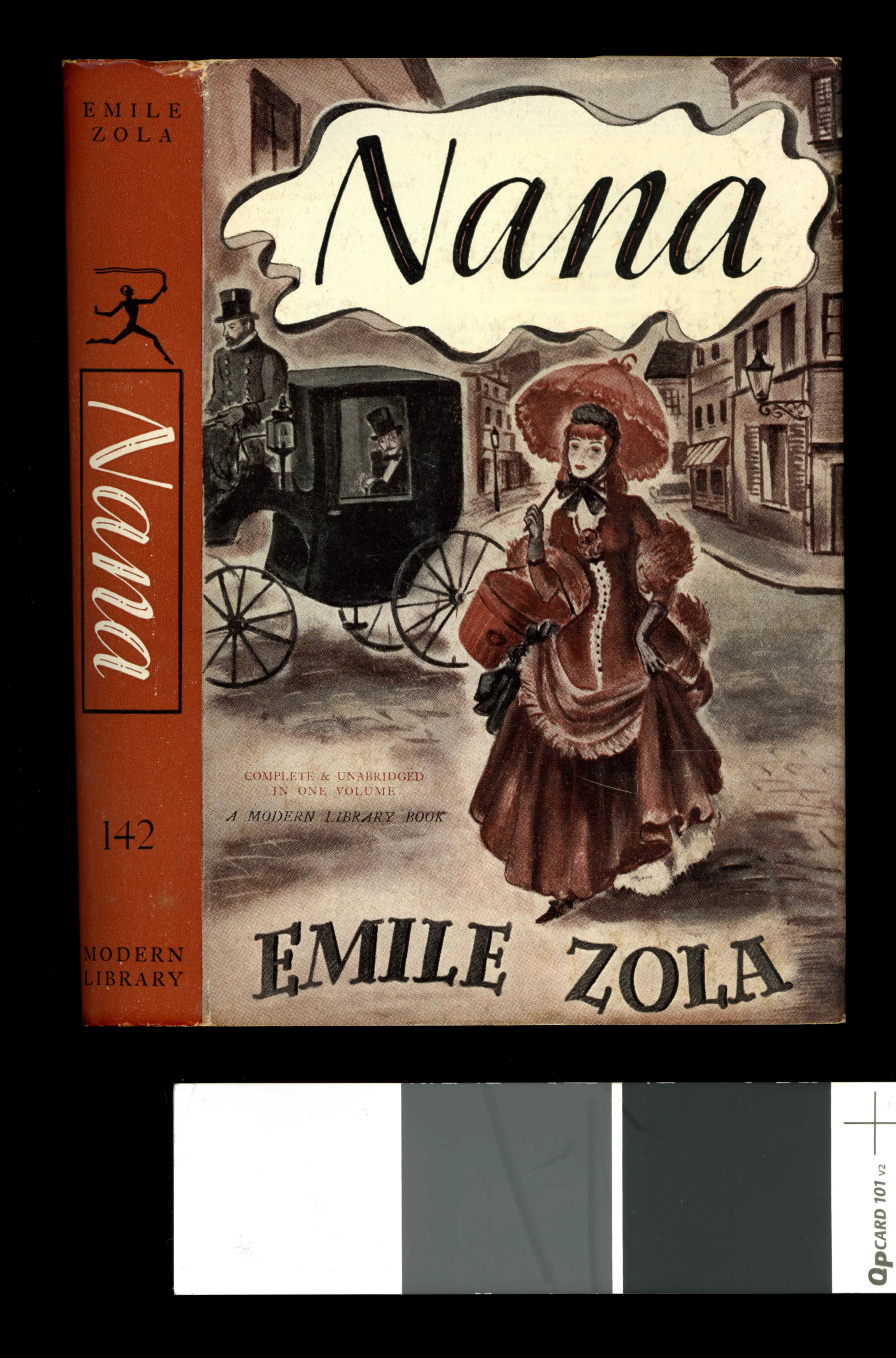
Jacket: Pictorial in dark reddish orange (38), light reddish brown (42) and black on coated cream paper depicting a woman with parasol and hatbox crossing a street while a man in top hat watches from a passing carriage; lettering in black and dark reddish orange.
Front flap as 151.1a jacket D. (Fall 1943)
151.2. Text reset (1946)
NANA | by | EMILE ZOLA | Introduction by ERNEST BOYD | [
Pp. [i–iv] v–xii, [1–2] 3–545 [546–548]. [1–16]16 [17]8 [18]16
[i] half title; [ii] blank; [iii] title; [iv] publication and manufacturing statements within single rules; v–xii INTRODUCTION signed p. xii: Ernest Boyd | New York, | November, 1927.; [1] fly title; [2] blank; 3–545 text; [546–548] blank.
Jacket: As 151.1b. (Fall 1947) Front flap reset with minor revisions and following phrase added at end: “. . . and with which it reflects actual life.” (Fall 1955)
Printed from plates made from a new typesetting.
The new typesetting, made in 1945, was designed by Stefan Salter to allow for the possible inclusion of Nana in the Illustrated Modern Library. Chapter openings were dropped to the center of the page so that illustrations or decorations could be added if desired (Ray Freiman to Salter, Wolff Mfg. Co., 17 July 1945). Nana never appeared in the Illustrated Modern Library.
{
  "full": "\n**EMILE ZOLA. NANA. 1928–1970. (ML 142)**  \n\n#### 151.1a. First printing (1928)  \n\n[within double rules] NANA | [rule] | BY | EMILE ZOLA | [rule] | INTRODUCTION BY | ERNEST BOYD | [rule] | [torchbearer A2] | [rule] | THE MODERN LIBRARY | PUBLISHERS : NEW YORK  \n\nPp. [i–iv] v–xii, 1–517 [518–524]. [1–16]16 [17]12  \n\n[i] half title; [ii] pub. note A5 without lower thin rule; [iii] title; [iv] *Introduction Copyright,* 1928, *by* | THE MODERN LIBRARY, INC. | [short double rule] | *First Modern Library Edition* | 1928; v–xii INTRODUCTION signed p. xii: Ernest Boyd. | New York, | *November,* 1927.; 1–517 text; [518] blank; [519–522] ML list; [523–524] blank. (*Fall 1927*)  \n\n*Jacket A:* Uniform typographic jacket B2.  \n\n>Text on front:\n“NANA”, Zola’s famous story of the theatrical underworld in Paris, is an excellent example of the virtues and faults of the acknowledged founder of the realistic school in modern fiction. “Zola”, writes Burton Rascoe, “was a boorish and heavy handed seducer who urged upon the novel a very raw and potent drink. He showed that life, even in fiction, might be stripped of the enameled exterior of cultural standards and refinements, and the substratum of animality that cannot die be portrayed in its true light.” (*Fall 1927*)  \n\n*Jacket B:* Uniform typographic jacket D. (*Fall 1928*)  \n\n*Jacket C*: Three French Romances gift box. (1929)  \n\n*Jacket D:* Pictorial in strong yellowish pink (26) and black on light pink paper with inset oval illustration of a woman with parasol and four winged cherubs; lettering in black except title in strong yellowish pink and black, borders in strong yellowish pink. (*Fall 1932*)  \n\n*Jacket E:* Pictorial in dark yellowish pink (30) and moderate reddish brown (43) on cream paper with head-and-shoulders illustration of a woman glancing to her right; lettering in moderate reddish brown except title in dark yellowish pink outlined in moderate reddish brown, borders in dark yellowish pink. Signed: Newman.  \n\n>Front flap:\nBanned in England in 1888 for its so-called obscenity, *Nana* has since come to be regarded the highest achievement among the novels of the Naturalist school. Its author is now acknowledged as the source from which the English realists and our own Frank Norris and Theodore Dreiser derive their greatest influence. Regardless of the sensational aspects of this work and its niche in literary history, *Nana* lives as a novel by its own vigor and the incomparable skill and fidelity with which it is written. (*Spring 1935*)  \n\nPlarr translation originally published in a limited edition by the Lutetian Society (London, 1894) and in U.S. by Boni & Liveright, 1924. ML edition printed from plates made from a new typesetting. Published January 1928. *WR* 18 February 1928. First printing: Not ascertained. Discontinued 1970/71.  \n\nThe Modern Library used the Victor Plarr translation without identifying the translator. When a film version produced by Samuel Goldwyn and starring the Russian actress Anna Sten was released in 1934, the ML urged booksellers to stock *Nana* in quantity and distributed copies of the movie poster to major bookstores.  \n\nSales of *Nana* during the first six months of 1928 placed it 2nd out of 147 ML titles. During the 18-month period May 1942–October 1943 it was low in the first quarter of ML titles in terms of sales. It did not rank among the 100 best-selling titles in the regular ML during the 12-month period November 1951–October 1952.  \n\n#### 151.1b. Title page reset (c. 1941)  \n\nNANA | *by* | EMILE ZOLA | *introduction by* ERNEST BOYD | [torchbearer D1 at right; 3-line imprint at left] THE | MODERN LIBRARY | NEW YORK | [rule]  \n\nPagination and collation as 151.1a. Contents as 151.1a except: [ii] blank; [iv] publication and manufacturing statements within single rules; [519–523] ML list; [524] blank. (*Spring 1943*)  \n\n*Jacket:* Pictorial in dark reddish orange (38), light reddish brown (42) and black on coated cream paper depicting a woman with parasol and hatbox crossing a street while a man in top hat watches from a passing carriage; lettering in black and dark reddish orange. \n\n> Front flap as 151.1a jacket D. (*Fall 1943*)  \n\n#### 151.2. Text reset (1946)  \n\nNANA | *by* | EMILE ZOLA | *Introduction by* ERNEST BOYD | [torchbearer D4 at right; 3-line imprint at left] THE | MODERN LIBRARY | NEW YORK | [rule]  \n\nPp. [i–iv] v–xii, [1–2] 3–545 [546–548]. [1–16]16 [17]8 [18]16  \n\n[i] half title; [ii] blank; [iii] title; [iv] publication and manufacturing statements within single rules; v–xii INTRODUCTION signed p. xii: Ernest Boyd | New York, | *November*, 1927.; [1] fly title; [2] blank; 3–545 text; [546–548] blank.  \n\n*Jacket:* As 151.1b. (*Fall 1947*) Front flap reset with minor revisions and following phrase added at end: “. . . and with which it reflects actual life.” (*Fall 1955*)  \n\nPrinted from plates made from a new typesetting.  \n\nThe new typesetting, made in 1945, was designed by Stefan Salter to allow for the possible inclusion of *Nana* in the Illustrated Modern Library. Chapter openings were dropped to the center of the page so that illustrations or decorations could be added if desired (Ray Freiman to Salter, Wolff Mfg. Co., 17 July 1945). *Nana* never appeared in the Illustrated Modern Library.  \n\n",
  "id": "151",
  "year": "1928",
  "label": "EMILE ZOLA. NANA. 1928–1970. (ML 142)",
  "author": "EMILE ZOLA",
  "title": "NANA.",
  "date": "1928–1970.",
  "something": "ML 142",
  "revisions": [],
  "type": "book"
}