
The Modern Library Bibliography
EUGENE O’NEILL. THE EMPEROR JONES; THE STRAW. 1928–1936. (ML 146)
157. First printing (1928)
[within double rules] THE EMPEROR JONES | THE STRAW | [rule] | BY | EUGENE O’NEILL | [rule] | INTRODUCTION BY | DUDLEY NICHOLS | [rule] | [
Pp. [6], ix–xxv [xxvi], [2], 1–223 [224–230]. [1–8]16
[1] half title; [2]
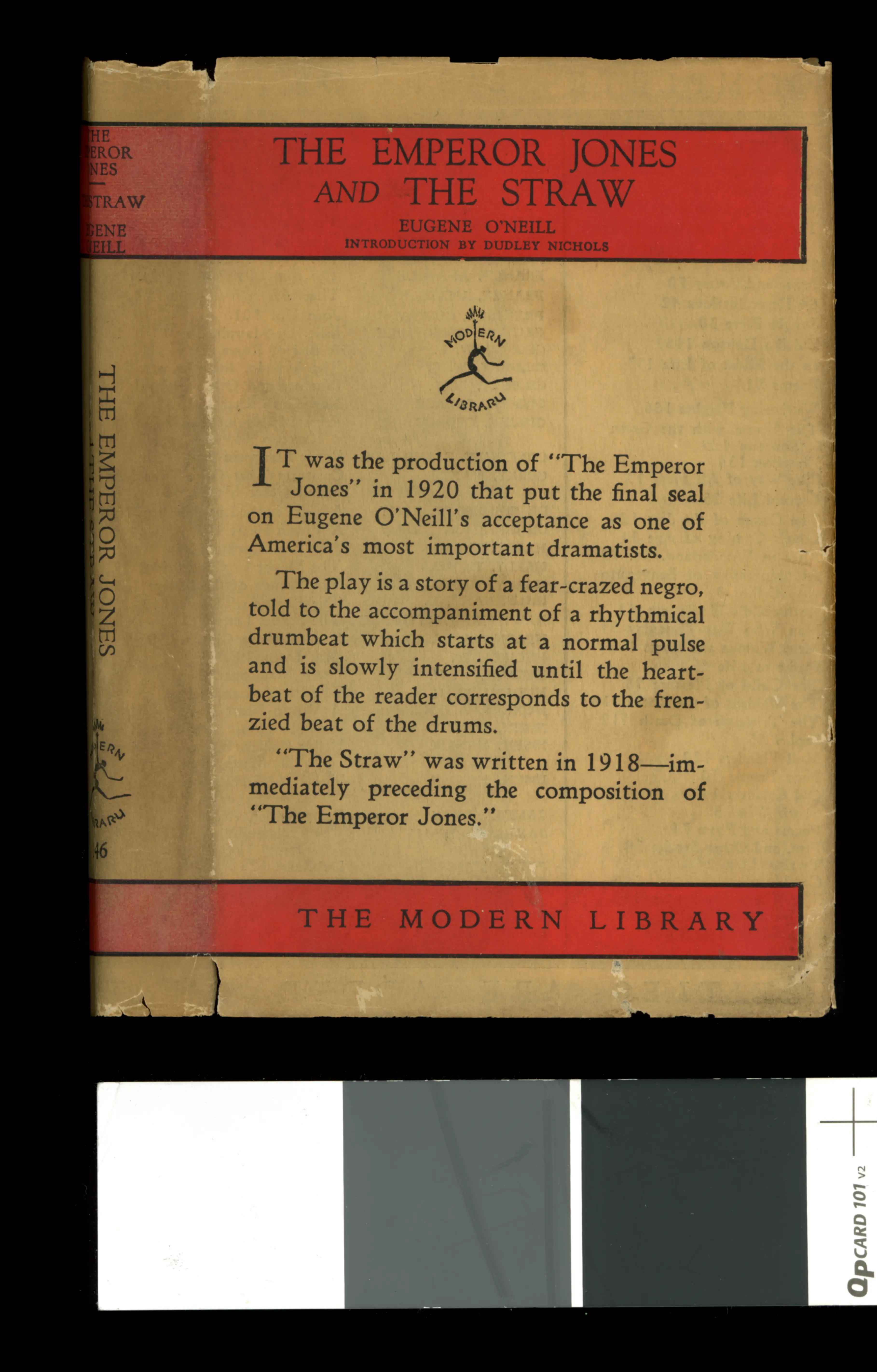
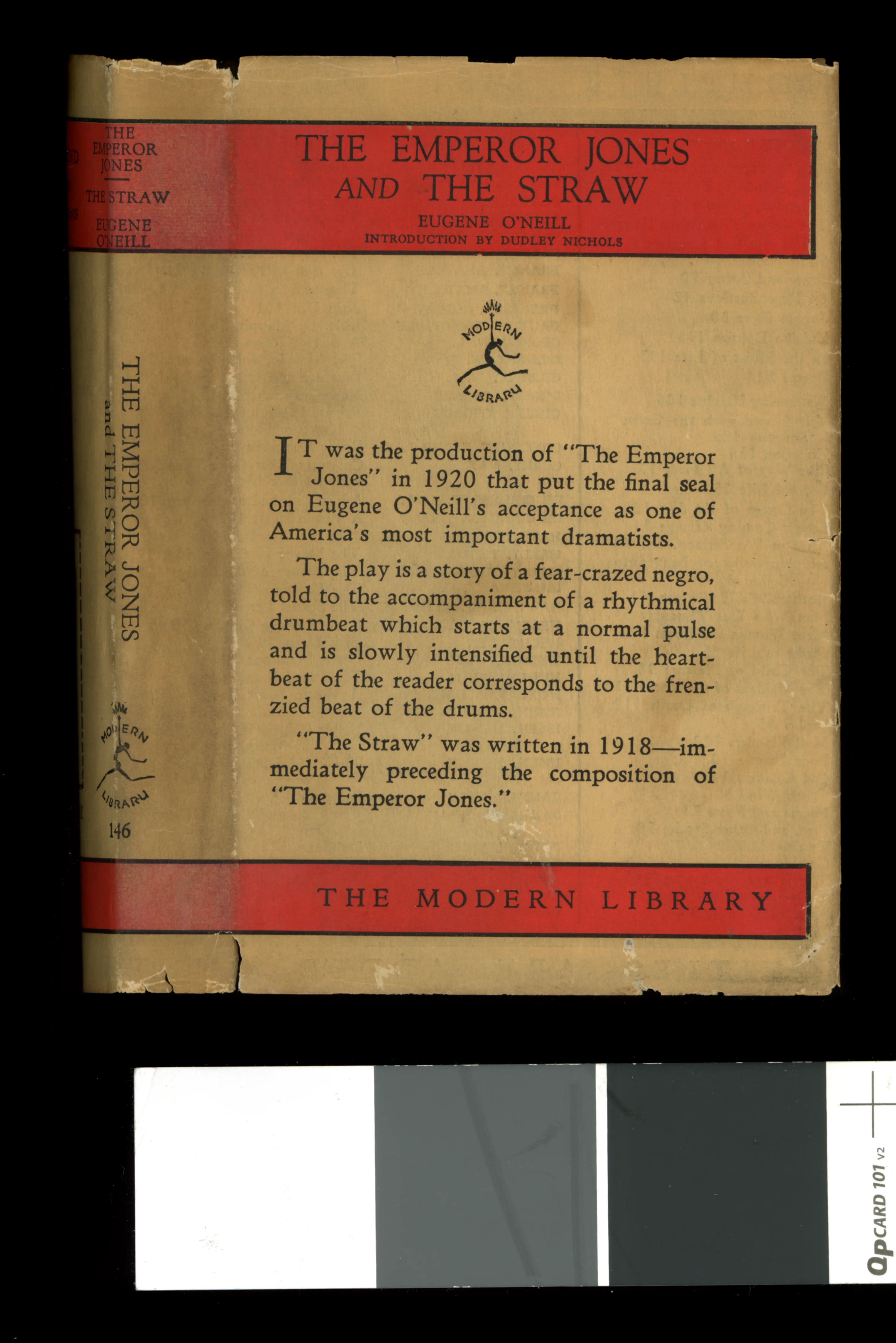
Jacket A:
Text on front:
It was the production of “The Emperor Jones” in 1920 that put the final seal on Eugene O’Neill’s acceptance as one of America’s most important dramatists.
The play is a story of a fear-crazed negro, told to the accompaniment of a rhythmical drumbeat which starts at a normal pulse and is slowly intensified until the heartbeat of the reader corresponds to the frenzied beat of the drums.
“The Straw” was written in 1918—immediately preceding the composition of “The Emperor Jones.” (Spring 1928)
Jacket B: Alternative pictorial jacket on pale blue (185) paper with inset illustration in black of a bare-chested black man making his way through jungle foliage; lettering in black without horizontal borders and rules. Signed: Davidson. (Spring 1928)
Jacket C:
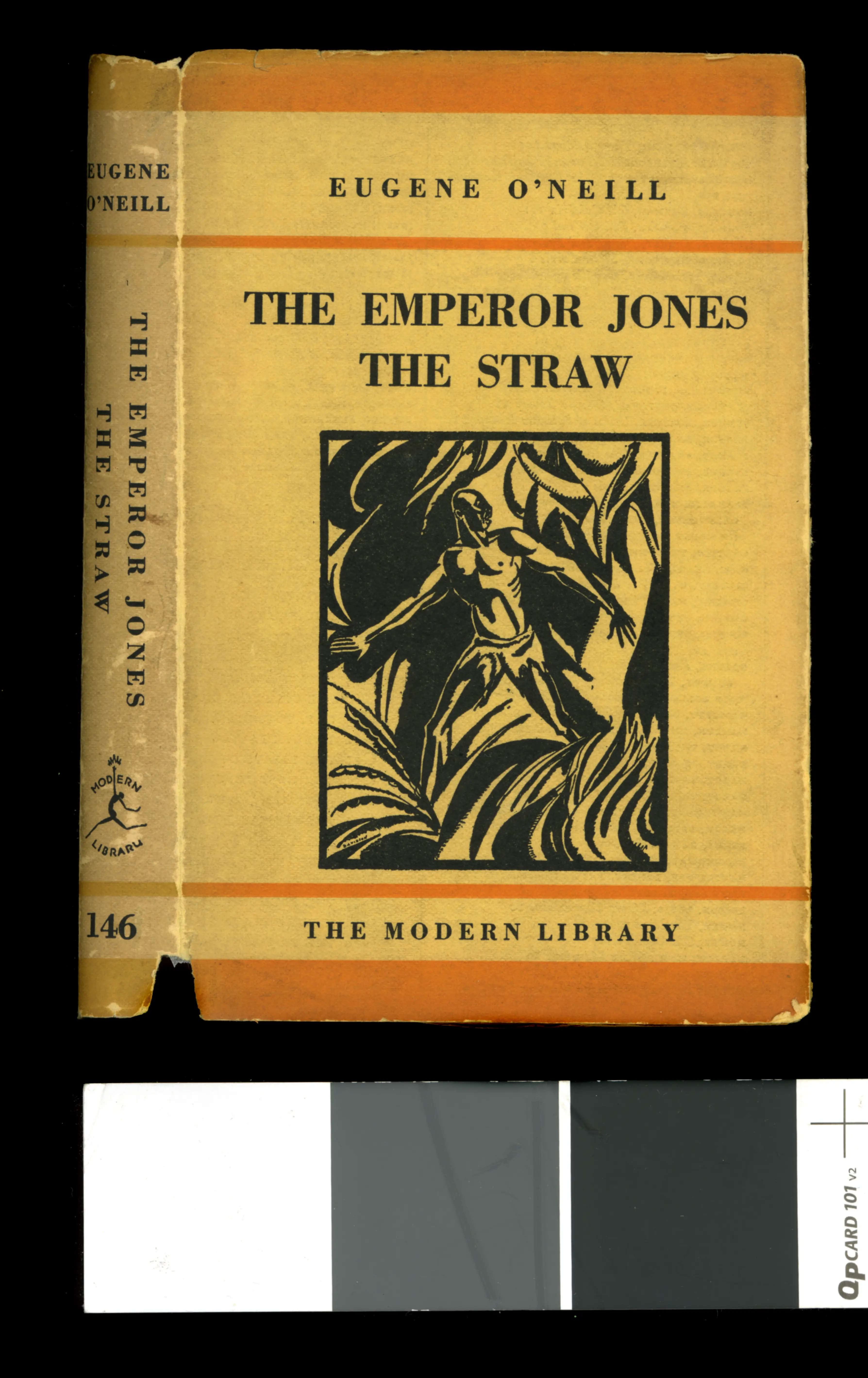
Jacket D: Pictorial in strong orange (50) and black on yellow paper with inset illustration of a bare-chested black man making his way through jungle foliage; lettering in black, borders in strong orange. Signed: Davidson. (Spring 1931)
Front flap:
Diversity of form and content, an unswerving artistic integrity and an ever-renewing imaginative strength have given Eugene O’Neill his unchallenged place among the first dramatists of the world. Even if his reputation did not draw sustenance from his other published works, his pre-eminence would be assured by The Emperor Jones alone. It is a tour de force of heart-pounding relentlessness that strips naked the terror-stricken soul of a Negro. The Straw reveals another facet of Eugene O’Neill’s many-sided genius. (Spring 1935)
The Emperor Jones and The Straw originally published by Boni & Liveright, 1921, in a volume with O’Neill’s Diff’rent. ML edition printed from plates made from a new typesetting. Publication announced for April 1928. WR 9 June 1928. First printing: Not ascertained. Discontinued 1 January 1937. Superseded February 1937 by The Emperor Jones, Anna Christie, The Hairy Ape (299).
Dudley Nichols of the New York World wrote the introduction after O’Neill declined to write it himself (Cerf to O’Neill, 7 December 1927; Cerf to Nichols, 7 February 1928).
O’Neill made several revisions in the text of The Emperor Jones when he prepared it for The Complete Works of Eugene O’Neill (2 vols., Boni & Liveright, 1924). The most notable were the cutting of speeches by Smithers at the end of Scene One and the end of the play. In the revised version Scene One ends as follows:
Smithers [Looks after him with a puzzled admiration]: ’E’s got ’is bloomin’ nerve with ’im, s’elp me. [Then angrily.] Ho—the bleedin’ nigger—puttin’ on ’is bloody airs! I ’opes they naps ’im an’ gives ’im an’ gives ’im what’s what!
The original version continues:
[Then putting business before the pleasure of this thought, looking around him with cupidity.] A bloke ought to find a ’ole lot in this palace that’d go for a bit of cash. Let’s take a look, ’Arry, me lad. [He starts for the doorway on right as
[The curtain falls]
The revised version of the play ends with Lem’s dialogue: “Gawd blimey, but yer died in the ’eighth o’ style, any’ow!” The original version continues:
[Lem makes a motion to the soldiers to carry the body out left. Smithers speaks to him sneeringly.]
Smithers—And I s’pose you think it’s yer bleedin’ charms and yer silly beatin’ the drum that made ’im run in a circle when ’e’d lost ’imself, don’t yer? [But Lem makes no reply, does not seem to hear the question, walks out left after his men. Smithers looks after him with contemptuous scorn.] Stupid as ’ogs, the lot of ’em. Blarsted niggers![Curtain falls]
The Modern Library used the original version of The Emperor Jones in some collections and the revised version in others. The Emperor Jones; The Straw was probably set in type from The Emperor Jones, Diff’rent, The Straw (Boni & Liveright, 1921) and uses the original version. The Emperor Jones, Anna Christie, The Hairy Ape (399), which superseded The Emperor Jones; The Straw in the ML in 1937, also follows the original text. The 1972 Vintage Books edition of The Emperor Jones, Anna Christie, The Hairy Ape, which superseded the Modern Library edition and is printed from plates made from a new typesetting, uses the original text. The original version also appears in Six Modern American Plays (441).
In contrast, O’Neill’s Nine Plays (G53), published in 1941 as a ML Giant and printed from plates originally used by Liveright, Inc. in 1932 and later by Random House, has the revised version of The Emperor Jones. The revised version also appears in the 3-volume Plays of Eugene O’Neill (624), published in the ML in 1982. The 3-volume edition was originally published by Random House in 1941 and revised in 1951 when The Iceman Cometh was added.
The Emperor Jones; The Straw, with sales of 3,622 copies, was the 14th best-selling ML title during the first six months of 1928. Sales through 1932 were as follows: 5,855 copies (1928); 2,901 copies (1929); 1,921 copies (1930); 1,405 copies (1931); 756 copies (1932) (Cerf to O’Neill, 2 June 1933).
The ML paid royalties to Boni & Liveright of 10 cents a copy.
O’Neill became a Random House author after the Liveright bankruptcy in 1933. Saxe Commins, his editor at Liveright, also moved to Random House. In choosing between Coward-McCann and Random House, O’Neill wrote:
Cerf . . . has drive and enthusiasm, coupled with keen shrewdness. Moreover, I felt Coward was trade publisher, pure and simple—but Cerf has more to his publishing than that, a love of beautiful books, an appreciation for good literature, an ambition to keep his firm above the level of the others, to expand only along lines of distinction. That, of course, appealed strongly to me. As for background for my stuff, there is no comparison. . . . Cerf has two unique things—Modern Library and Random House.
He also thought Random House would offer better opportunities for Commins:
I feel strongly that Cerf is the better bet for your present and future . . . with him, you will have a real chance to do your stuff and a most congenial atmosphere. . . . With Cerf you’ll undoubtedly be called upon to contribute real imagination and judgment of real writing, once you’ve fitted in there (O’Neill to Commins, June 1933; in Commins, ed., “Love and Admiration and Respect”, pp. 159-60).
Also in the Modern Library
O’Neill, Moon of the Caribbees and Six Other Plays of the Sea (1923–1940) 101
O’Neill, Emperor Jones, Anna Christie, The Hairy Ape (1937–1971) 299
O’Neill, Long Voyage Home (1940–1971) 101e
O’Neill, Nine Plays (Giant, 1941– ) G53
O’Neill, Ah, Wilderness! and Two Other Plays (1964–1973) 559
O’Neill, Plays of Eugene O’Neill, 3 vols. (1982– ) 624
{
  "full": "\n**EUGENE O’NEILL. THE EMPEROR JONES; THE STRAW. 1928–1936. (ML 146)**  \n\n#### 157. First printing (1928)  \n\n[within double rules] THE EMPEROR JONES | THE STRAW | [rule] | BY | EUGENE O’NEILL | [rule] | INTRODUCTION BY | DUDLEY NICHOLS | [rule] | [torchbearer A4] | [rule] | THE MODERN LIBRARY | PUBLISHERS: NEW YORK  \n\nPp. [*6*], ix–xxv [xxvi], [*2*], 1–223 [224–230]. [1–8]16  \n\n[*1*] half title; [*2*] pub. note A6; [*3*] title; [*4*] *Copyright*, 1921, *by* Boni and Liveright | [short double rule] | *Introduction copyright*, 1928, *by* | The Modern Library, Inc. | [short double rule] | *First* MODERN LIBRARY *Edition* | 1928; [*5*] CONTENTS; [*6*] blank; ix–xxv INTRODUCTION signed p. xxv: Dudley Nichols. | *New York* | *February*, *1928*; [xxvi] blank; [*1*] part title: THE EMPEROR JONES; [*2*] CHARACTERS; 1–57 text; [58] blank; [59] part title: THE STRAW; [60] CHARACTERS; [61] SCENES; [62] blank; 63–223 text; [224] blank; [225–228] ML list; [229–230] blank. (*Spring 1928*) *Note:* *First* statement retained on printing with fall 1928 list.  \n\n*Jacket A:* Uniform typographic jacket B2.  \n\n>Text on front:\nIt was the production of “The Emperor Jones” in 1920 that put the final seal on Eugene O’Neill’s acceptance as one of America’s most important dramatists. \nThe play is a story of a fear-crazed negro, told to the accompaniment of a rhythmical drumbeat which starts at a normal pulse and is slowly intensified until the heartbeat of the reader corresponds to the frenzied beat of the drums.\n“The Straw” was written in 1918—immediately preceding the composition of “The Emperor Jones.” (*Spring 1928*)  \n\n*Jacket B:* Alternative pictorial jacket on pale blue (185) paper with inset illustration in black of a bare-chested black man making his way through jungle foliage; lettering in black without horizontal borders and rules. Signed: Davidson. (*Spring 1928*)  \n\n*Jacket C:* Uniform typographic jacket D. (*1930*)  \n\n*Jacket D:* Pictorial in strong orange (50) and black on yellow paper with inset illustration of a bare-chested black man making his way through jungle foliage; lettering in black, borders in strong orange. Signed: Davidson. (*Spring 1931*)  \n\n>Front flap:\nDiversity of form and content, an unswerving artistic integrity and an ever-renewing imaginative strength have given Eugene O’Neill his unchallenged place among the first dramatists of the world. Even if his reputation did not draw sustenance from his other published works, his pre-eminence would be assured by *The Emperor Jones* alone. It is a *tour de force* of heart-pounding relentlessness that strips naked the terror-stricken soul of a Negro. *The Straw* reveals another facet of Eugene O’Neill’s many-sided genius. (*Spring 1935*)  \n\n*The Emperor Jones* and *The Straw* originally published by Boni & Liveright, 1921, in a volume with O’Neill’s *Diff’rent*. ML edition printed from plates made from a new typesetting. Publication announced for April 1928. *WR* 9 June 1928. First printing: Not ascertained. Discontinued 1 January 1937. Superseded February 1937 by *The Emperor Jones, Anna Christie, The Hairy Ape* (299).  \n\nDudley Nichols of the *New York World* wrote the introduction after O’Neill declined to write it himself (Cerf to O’Neill, 7 December 1927; Cerf to Nichols, 7 February 1928).  \n\nO’Neill made several revisions in the text of *The Emperor Jones* when he prepared it for *The Complete Works of Eugene O’Neill* (2 vols., Boni & Liveright, 1924). The most notable were the cutting of speeches by Smithers at the end of Scene One and the end of the play. In the revised version Scene One ends as follows:  \n\n>Smithers [*Looks after him with a puzzled admiration*]: ’E’s got ’is bloomin’ nerve with ’im, s’elp me. [*Then angrily*.] Ho—the bleedin’ nigger—puttin’ on ’is bloody airs! I ’opes they naps ’im an’ gives ’im an’ gives ’im what’s what!  \n\nThe original version continues:  \n\n>[*Then putting business before the pleasure of this thought, looking around him with cupidity.*] A bloke ought to find a ’ole lot in this palace that’d go for a bit of cash. Let’s take a look, ’Arry, me lad. [*He starts for the doorway on right as* \n>  [The curtain falls]  \n\nThe revised version of the play ends with Lem’s dialogue: “Gawd blimey, but yer died in the ’eighth o’ style, any’ow!” The original version continues:  \n\n>[Lem *makes a motion to the soldiers to carry the body out left*. Smithers speaks to him sneeringly.] \nSmithers—And I s’pose you think it’s yer bleedin’ charms and yer silly beatin’ the drum that made ’im run in a circle when ’e’d lost ’imself, don’t yer? [*But* Lem *makes no reply, does not seem to hear the question, walks out left after his men*. Smithers *looks after him with contemptuous scorn.*] Stupid as ’ogs, the lot of ’em. Blarsted niggers! \n>  [Curtain falls]  \n\n\nThe Modern Library used the original version of *The Emperor Jones* in some collections and the revised version in others. *The Emperor Jones; The Straw* was probably set in type from *The Emperor Jones, Diff’rent, The Straw* (Boni & Liveright, 1921) and uses the original version. *The Emperor Jones, Anna Christie, The Hairy Ape* (399), which superseded *The Emperor Jones; The Straw* in the ML in 1937, also follows the original text. The 1972 Vintage Books edition of *The Emperor Jones, Anna Christie, The Hairy Ape*, which superseded the Modern Library edition and is printed from plates made from a new typesetting, uses the original text. The original version also appears in *Six Modern American Plays* (441).  \n\nIn contrast, O’Neill’s *Nine Plays* (G53), published in 1941 as a ML Giant and printed from plates originally used by Liveright, Inc. in 1932 and later by Random House, has the revised version of *The Emperor Jones*. The revised version also appears in the 3-volume *Plays of Eugene O’Neill* (624), published in the ML in 1982. The 3-volume edition was originally published by Random House in 1941 and revised in 1951 when *The Iceman Cometh* was added.  \n\n*The Emperor Jones; The Straw*, with sales of 3,622 copies, was the 14th best-selling ML title during the first six months of 1928. Sales through 1932 were as follows: 5,855 copies (1928); 2,901 copies (1929); 1,921 copies (1930); 1,405 copies (1931); 756 copies (1932) (Cerf to O’Neill, 2 June 1933).  \n\nThe ML paid royalties to Boni & Liveright of 10 cents a copy.  \n\nO’Neill became a Random House author after the Liveright bankruptcy in 1933. Saxe Commins, his editor at Liveright, also moved to Random House. In choosing between Coward-McCann and Random House, O’Neill wrote:  \n\n>Cerf . . . has drive and enthusiasm, coupled with keen shrewdness. Moreover, I felt Coward was trade publisher, pure and simple—but Cerf has more to his publishing than that, a love of beautiful books, an appreciation for good literature, an ambition to keep his firm above the level of the others, to expand only along lines of distinction. That, of course, appealed strongly to me. As for background for my stuff, there is no comparison. . . . Cerf has two unique things—Modern Library and Random House.  \n\nHe also thought Random House would offer better opportunities for Commins:  \n\n>I feel strongly that Cerf is the better bet for your present and future . . . with him, you will have a real chance to do your stuff and a most congenial atmosphere. . . . With Cerf you’ll undoubtedly be called upon to contribute real imagination and judgment of real writing, once you’ve fitted in there (O’Neill to Commins, June 1933; in Commins, ed., *“Love and Admiration and Respect”*, pp. 159-60).  \n\nAlso in the Modern Library  \nO’Neill, *Moon of the Caribbees and Six Other Plays of the Sea* (1923–1940) 101  \nO’Neill, *Emperor Jones, Anna Christie, The Hairy Ape* (1937–1971) 299  \nO’Neill, *Long Voyage Home* (1940–1971) 101e  \nO’Neill, *Nine Plays* (Giant, 1941– ) G53  \nO’Neill, *Ah, Wilderness! and Two Other Plays* (1964–1973) 559  \nO’Neill, *Plays of Eugene O’Neill*, 3 vols. (1982– ) 624  \n\n",
  "id": "157",
  "year": "1928",
  "label": "EUGENE O’NEILL. THE EMPEROR JONES; THE STRAW. 1928–1936. (ML 146)",
  "author": "EUGENE O’NEILL",
  "title": "THE EMPEROR JONES; THE STRAW.",
  "date": "1928–1936.",
  "something": "ML 146",
  "revisions": [
    {
      "id": "157",
      "title": "First printing (1928)  ",
      "full": "\n\n[within double rules] THE EMPEROR JONES | THE STRAW | [rule] | BY | EUGENE O’NEILL | [rule] | INTRODUCTION BY | DUDLEY NICHOLS | [rule] | [torchbearer A4] | [rule] | THE MODERN LIBRARY | PUBLISHERS: NEW YORK  \n\nPp. [*6*], ix–xxv [xxvi], [*2*], 1–223 [224–230]. [1–8]16  \n\n[*1*] half title; [*2*] pub. note A6; [*3*] title; [*4*] *Copyright*, 1921, *by* Boni and Liveright | [short double rule] | *Introduction copyright*, 1928, *by* | The Modern Library, Inc. | [short double rule] | *First* MODERN LIBRARY *Edition* | 1928; [*5*] CONTENTS; [*6*] blank; ix–xxv INTRODUCTION signed p. xxv: Dudley Nichols. | *New York* | *February*, *1928*; [xxvi] blank; [*1*] part title: THE EMPEROR JONES; [*2*] CHARACTERS; 1–57 text; [58] blank; [59] part title: THE STRAW; [60] CHARACTERS; [61] SCENES; [62] blank; 63–223 text; [224] blank; [225–228] ML list; [229–230] blank. (*Spring 1928*) *Note:* *First* statement retained on printing with fall 1928 list.  \n\n*Jacket A:* Uniform typographic jacket B2.  \n\n>Text on front:\nIt was the production of “The Emperor Jones” in 1920 that put the final seal on Eugene O’Neill’s acceptance as one of America’s most important dramatists. \nThe play is a story of a fear-crazed negro, told to the accompaniment of a rhythmical drumbeat which starts at a normal pulse and is slowly intensified until the heartbeat of the reader corresponds to the frenzied beat of the drums.\n“The Straw” was written in 1918—immediately preceding the composition of “The Emperor Jones.” (*Spring 1928*)  \n\n*Jacket B:* Alternative pictorial jacket on pale blue (185) paper with inset illustration in black of a bare-chested black man making his way through jungle foliage; lettering in black without horizontal borders and rules. Signed: Davidson. (*Spring 1928*)  \n\n*Jacket C:* Uniform typographic jacket D. (*1930*)  \n\n*Jacket D:* Pictorial in strong orange (50) and black on yellow paper with inset illustration of a bare-chested black man making his way through jungle foliage; lettering in black, borders in strong orange. Signed: Davidson. (*Spring 1931*)  \n\n>Front flap:\nDiversity of form and content, an unswerving artistic integrity and an ever-renewing imaginative strength have given Eugene O’Neill his unchallenged place among the first dramatists of the world. Even if his reputation did not draw sustenance from his other published works, his pre-eminence would be assured by *The Emperor Jones* alone. It is a *tour de force* of heart-pounding relentlessness that strips naked the terror-stricken soul of a Negro. *The Straw* reveals another facet of Eugene O’Neill’s many-sided genius. (*Spring 1935*)  \n\n*The Emperor Jones* and *The Straw* originally published by Boni & Liveright, 1921, in a volume with O’Neill’s *Diff’rent*. ML edition printed from plates made from a new typesetting. Publication announced for April 1928. *WR* 9 June 1928. First printing: Not ascertained. Discontinued 1 January 1937. Superseded February 1937 by *The Emperor Jones, Anna Christie, The Hairy Ape* (299).  \n\nDudley Nichols of the *New York World* wrote the introduction after O’Neill declined to write it himself (Cerf to O’Neill, 7 December 1927; Cerf to Nichols, 7 February 1928).  \n\nO’Neill made several revisions in the text of *The Emperor Jones* when he prepared it for *The Complete Works of Eugene O’Neill* (2 vols., Boni & Liveright, 1924). The most notable were the cutting of speeches by Smithers at the end of Scene One and the end of the play. In the revised version Scene One ends as follows:  \n\n>Smithers [*Looks after him with a puzzled admiration*]: ’E’s got ’is bloomin’ nerve with ’im, s’elp me. [*Then angrily*.] Ho—the bleedin’ nigger—puttin’ on ’is bloody airs! I ’opes they naps ’im an’ gives ’im an’ gives ’im what’s what!  \n\nThe original version continues:  \n\n>[*Then putting business before the pleasure of this thought, looking around him with cupidity.*] A bloke ought to find a ’ole lot in this palace that’d go for a bit of cash. Let’s take a look, ’Arry, me lad. [*He starts for the doorway on right as* \n>  [The curtain falls]  \n\nThe revised version of the play ends with Lem’s dialogue: “Gawd blimey, but yer died in the ’eighth o’ style, any’ow!” The original version continues:  \n\n>[Lem *makes a motion to the soldiers to carry the body out left*. Smithers speaks to him sneeringly.] \nSmithers—And I s’pose you think it’s yer bleedin’ charms and yer silly beatin’ the drum that made ’im run in a circle when ’e’d lost ’imself, don’t yer? [*But* Lem *makes no reply, does not seem to hear the question, walks out left after his men*. Smithers *looks after him with contemptuous scorn.*] Stupid as ’ogs, the lot of ’em. Blarsted niggers! \n>  [Curtain falls]  \n\n\nThe Modern Library used the original version of *The Emperor Jones* in some collections and the revised version in others. *The Emperor Jones; The Straw* was probably set in type from *The Emperor Jones, Diff’rent, The Straw* (Boni & Liveright, 1921) and uses the original version. *The Emperor Jones, Anna Christie, The Hairy Ape* (399), which superseded *The Emperor Jones; The Straw* in the ML in 1937, also follows the original text. The 1972 Vintage Books edition of *The Emperor Jones, Anna Christie, The Hairy Ape*, which superseded the Modern Library edition and is printed from plates made from a new typesetting, uses the original text. The original version also appears in *Six Modern American Plays* (441).  \n\nIn contrast, O’Neill’s *Nine Plays* (G53), published in 1941 as a ML Giant and printed from plates originally used by Liveright, Inc. in 1932 and later by Random House, has the revised version of *The Emperor Jones*. The revised version also appears in the 3-volume *Plays of Eugene O’Neill* (624), published in the ML in 1982. The 3-volume edition was originally published by Random House in 1941 and revised in 1951 when *The Iceman Cometh* was added.  \n\n*The Emperor Jones; The Straw*, with sales of 3,622 copies, was the 14th best-selling ML title during the first six months of 1928. Sales through 1932 were as follows: 5,855 copies (1928); 2,901 copies (1929); 1,921 copies (1930); 1,405 copies (1931); 756 copies (1932) (Cerf to O’Neill, 2 June 1933).  \n\nThe ML paid royalties to Boni & Liveright of 10 cents a copy.  \n\nO’Neill became a Random House author after the Liveright bankruptcy in 1933. Saxe Commins, his editor at Liveright, also moved to Random House. In choosing between Coward-McCann and Random House, O’Neill wrote:  \n\n>Cerf . . . has drive and enthusiasm, coupled with keen shrewdness. Moreover, I felt Coward was trade publisher, pure and simple—but Cerf has more to his publishing than that, a love of beautiful books, an appreciation for good literature, an ambition to keep his firm above the level of the others, to expand only along lines of distinction. That, of course, appealed strongly to me. As for background for my stuff, there is no comparison. . . . Cerf has two unique things—Modern Library and Random House.  \n\nHe also thought Random House would offer better opportunities for Commins:  \n\n>I feel strongly that Cerf is the better bet for your present and future . . . with him, you will have a real chance to do your stuff and a most congenial atmosphere. . . . With Cerf you’ll undoubtedly be called upon to contribute real imagination and judgment of real writing, once you’ve fitted in there (O’Neill to Commins, June 1933; in Commins, ed., *“Love and Admiration and Respect”*, pp. 159-60).  \n\nAlso in the Modern Library  \nO’Neill, *Moon of the Caribbees and Six Other Plays of the Sea* (1923–1940) 101  \nO’Neill, *Emperor Jones, Anna Christie, The Hairy Ape* (1937–1971) 299  \nO’Neill, *Long Voyage Home* (1940–1971) 101e  \nO’Neill, *Nine Plays* (Giant, 1941– ) G53  \nO’Neill, *Ah, Wilderness! and Two Other Plays* (1964–1973) 559  \nO’Neill, *Plays of Eugene O’Neill*, 3 vols. (1982– ) 624  \n\n"
    }
  ],
  "type": "book"
}