
The Modern Library Bibliography
THEODORE DREISER. TWELVE MEN. 1928–1934. (ML 148)
159. First printing (1928)
[within double rules] TWELVE MEN | [rule] | BY | THEODORE DREISER | [rule] | INTRODUCTION BY | ROBERT BALLOU | [rule] | [
Pp. [i–iv] v–ix [x], [2], 1–360 [361–364]. [1–11]16 [12]12
[i] half title; [ii]
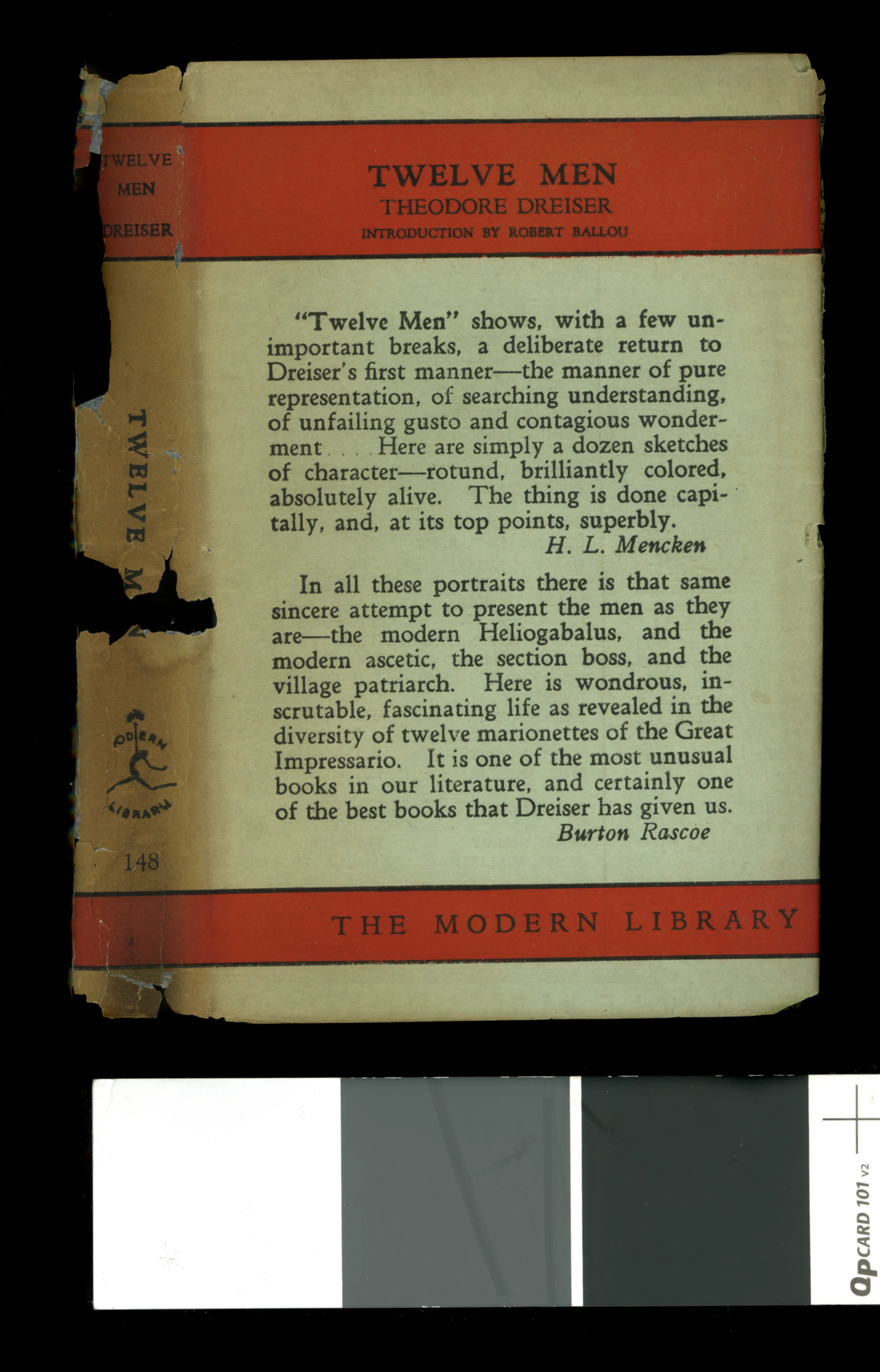
Jacket A:
Text on front:
“Twelve Men” shows, with a few unimportant breaks, a deliberate return to Drieser’s first manner—the manner of pure representation, of searching understanding, of unfailing gusto and contagious wonderment. . . . Here are simply a dozen sketches of character—rotund, brilliantly colored, absolutely alive. The thing is done capitally, and, at its top points, superbly. H. L. Mencken
In all these portraits there is that same sincere attempt to present the men as they are—the modern Heliogabalus, and the modern ascetic, the section boss, and the village patriarch. Here is wondrous, inscrutable, fascinating life as revealed in the diversity of twelve marionettes of the Great Impressario [sic]. It is one of the most unusual books in our literature, and certainly one of the best books that Dreiser has given us. Burton Rascoe (Spring 1928)
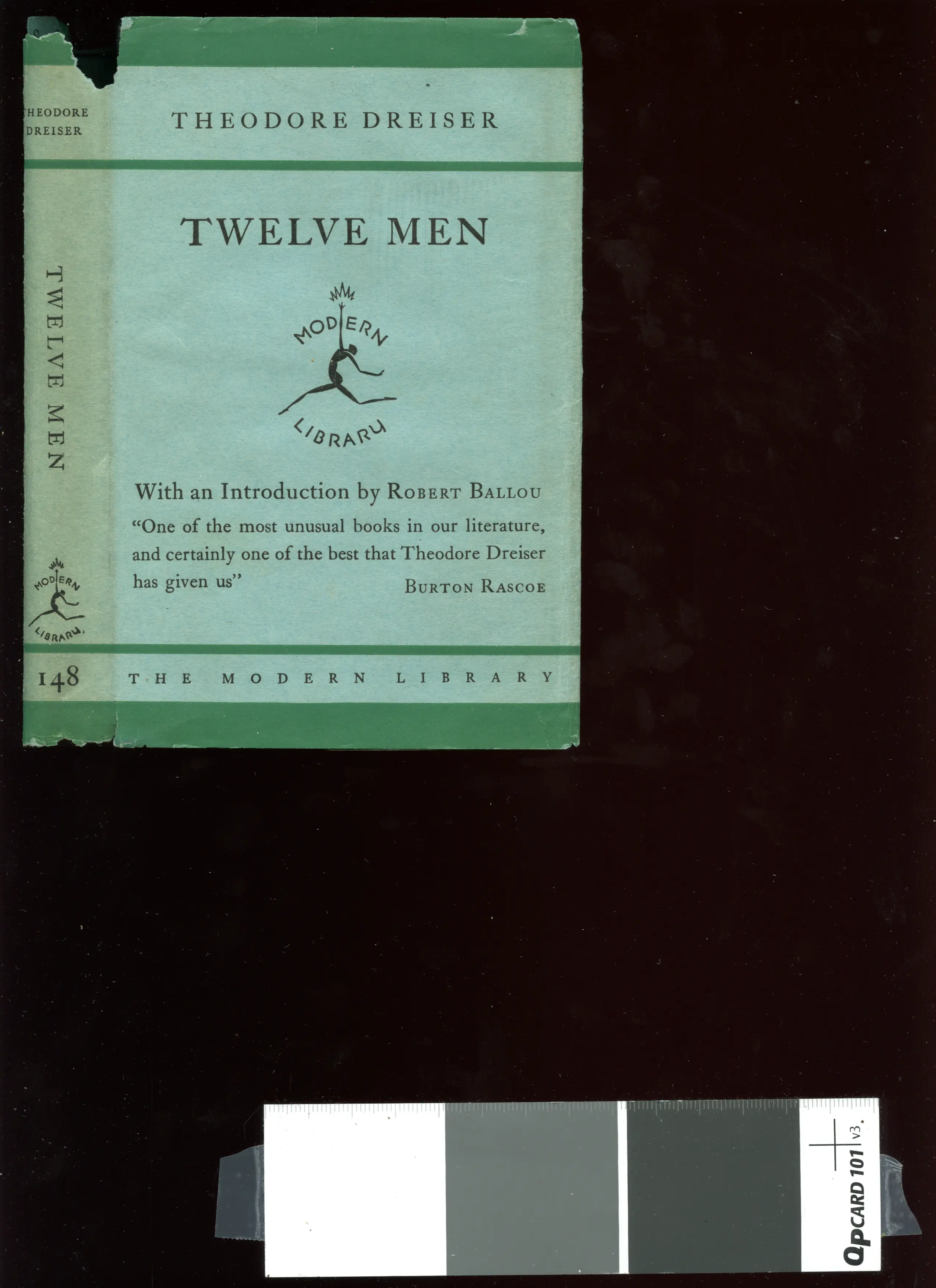
Jacket B:
Originally published by Boni & Liveright, 1919. ML edition (pp. [1]–360) printed from B&L plates with contents page omitted. Publication announced for June 1928. WR 4 August 1928. First (and only) printing: 10,000 copies. Discontinued fall 1934.
Cerf negotiated the ML edition directly with Dreiser, who controlled the rights to Twelve Men. He initially offered Dreiser an advance of $1,200 against royalties of 12 cents a copy (Cerf to Dreiser, 6 October 1927). The reprint agreement dated 13 October 1927 provided for royalties of 11 cents a copy to Dreiser and 1 cent a copy to B&L for the use of their plates. B&L received $200 for approving the ML reprint; this appears to have been an advance against the plate rental and was deducted from the advance initially offered to Dreiser, who received $1,000 when the contract was signed.
Dreiser wanted to use H. L. Mencken’s review in the New York Sun (13 April 1919) as an introduction to the ML edition. Cerf offered Mencken $50 for permission to reprint it (Cerf to Mencken, 4 November 1927), but Mencken either declined or did not reply. He then asked Sinclair Lewis to write the introduction. Lewis indicated that he liked Twelve Men very much but had no time since he was just beginning a new novel (Cerf to Sinclair Lewis, 13 December 1927; Lewis to Cerf, 3 January 1928). Charles Merz of the New York World also declined (Merz to Cerf, 9 February 1928). The introduction was finally written by Robert O. Ballou of the Chicago Daily News, who began it with the words, “Dreiser ought to be doing this himself” (p. v).
Sales of the ML edition were disappointing. Twelve Men ranked 34th among the best-selling titles in the ML during the first six months of 1928 with sales of 2,358 copies, most of which were advance sales. Sales fell off steadily thereafter. A memo in the RH Papers (Box 77, Dreiser file) indicates a total sale of 9,749 copies as follows: 4,718 copies (1928); 1,837 copies (1929); 1,546 copies (1930); 681 copies (1931); 421 copies (1932); 380 copies (1933); and 166 copies (to October 1934).
Several years after the ML edition was discontinued, Dreiser wrote that Twelve Men was no longer available in any edition. “My publishers, Simon and Schuster, have consistently refused, because of my inability to furnish them with a third volume of the Cowperwood Trilogy, to keep my works in print or to distribute them, and since that leaves me without a publisher other than yourself I would like to arrange for, at least, a reprint of this volume” (Dreiser to Cerf, 4 April 1939). Cerf explained why Twelve Men had been discontinued and added, “I believe that one of the main reasons that the Modern Library has remained popular all these years is that we have taken out the slow-moving titles each year and allowed the booksellers to return them for full credit, thereby assuring them a fresh stock with a turnover that warrants their keeping the line in a prominent position in their stores” (Cerf to Dreiser, 10 April 1939).
Also in the Modern Library
Dreiser, Free and Other Stories (1924–1931) 106
Dreiser, Sister Carrie (1932–1971) 230
Dreiser, American Tragedy (Giant, 1956–1968) G89
{
  "full": "\n**THEODORE DREISER. TWELVE MEN. 1928–1934. (ML 148)**  \n\n#### 159. First printing (1928)  \n\n[within double rules] TWELVE MEN | [rule] | BY | THEODORE DREISER | [rule] | INTRODUCTION BY | ROBERT BALLOU | [rule] | [torchbearer A2] | [rule] | THE MODERN LIBRARY | PUBLISHERS : NEW YORK  \n\nPp. [i–iv] v–ix [x], [*2*], 1–360 [361–364]. [1–11]16 [12]12  \n\n[i] half title; [ii] pub. note A6; [iii] title; [iv] *Copyright,* 1919, *by Boni & Liveright* | [short double rule] | *Introduction Copyright,* 1928, *by* | THE MODERN LIBRARY, INC. | [short double rule] | *First Modern Library Edition* | 1928; v–ix INTRODUCTION signed p. ix: Robert O. Ballou | Chicago, | April, 1928.; [x] blank; [*1*] fly title; [*2*] blank; 1–360 text; [361–364] ML list. (*Spring 1928*)  \n\n*Jacket A:* Uniform typographic jacket B2.  \n\n>Text on front:\n“Twelve Men” shows, with a few unimportant breaks, a deliberate return to Drieser’s first manner—the manner of pure representation, of searching understanding, of unfailing gusto and contagious wonderment. . . . Here are simply a dozen sketches of character—rotund, brilliantly colored, absolutely alive. The thing is done capitally, and, at its top points, superbly. *H. L. Mencken* \nIn all these portraits there is that same sincere attempt to present the men as they are—the modern Heliogabalus, and the modern ascetic, the section boss, and the village patriarch. Here is wondrous, inscrutable, fascinating life as revealed in the diversity of twelve marionettes of the Great Impressario [*sic*]. It is one of the most unusual books in our literature, and certainly one of the best books that Dreiser has given us. *Burton Rascoe* (*Spring 1928*)  \n\n*Jacket B:* Uniform typographic jacket D. (*Spring 1932*)  \n\nOriginally published by Boni & Liveright, 1919. ML edition (pp. [*1*]–360) printed from B&L plates with contents page omitted. Publication announced for June 1928. *WR* 4 August 1928. First (and only) printing: 10,000 copies. Discontinued fall 1934.  \n\nCerf negotiated the ML edition directly with Dreiser, who controlled the rights to *Twelve Men*. He initially offered Dreiser an advance of \\$1,200 against royalties of 12 cents a copy (Cerf to Dreiser, 6 October 1927). The reprint agreement dated 13 October 1927 provided for royalties of 11 cents a copy to Dreiser and 1 cent a copy to B&L for the use of their plates. B&L received \\$200 for approving the ML reprint; this appears to have been an advance against the plate rental and was deducted from the advance initially offered to Dreiser, who received \\$1,000 when the contract was signed.  \n\nDreiser wanted to use H. L. Mencken’s review in the *New York Sun* (13 April 1919) as an introduction to the ML edition. Cerf offered Mencken \\$50 for permission to reprint it (Cerf to Mencken, 4 November 1927), but Mencken either declined or did not reply. He then asked Sinclair Lewis to write the introduction. Lewis indicated that he liked *Twelve Men* very much but had no time since he was just beginning a new novel (Cerf to Sinclair Lewis, 13 December 1927; Lewis to Cerf, 3 January 1928). Charles Merz of the *New York World* also declined (Merz to Cerf, 9 February 1928). The introduction was finally written by Robert O. Ballou of the *Chicago Daily News*, who began it with the words, “Dreiser ought to be doing this himself” (p. v).  \n\nSales of the ML edition were disappointing. *Twelve Men* ranked 34th among the best-selling titles in the ML during the first six months of 1928 with sales of 2,358 copies, most of which were advance sales. Sales fell off steadily thereafter. A memo in the RH Papers (Box 77, Dreiser file) indicates a total sale of 9,749 copies as follows: 4,718 copies (1928); 1,837 copies (1929); 1,546 copies (1930); 681 copies (1931); 421 copies (1932); 380 copies (1933); and 166 copies (to October 1934).  \n\nSeveral years after the ML edition was discontinued, Dreiser wrote that *Twelve Men* was no longer available in any edition. “My publishers, Simon and Schuster, have consistently refused, because of my inability to furnish them with a third volume of the Cowperwood Trilogy, to keep my works in print or to distribute them, and since that leaves me without a publisher other than yourself I would like to arrange for, at least, a reprint of this volume” (Dreiser to Cerf, 4 April 1939). Cerf explained why *Twelve Men* had been discontinued and added, “I believe that one of the main reasons that the Modern Library has remained popular all these years is that we have taken out the slow-moving titles each year and allowed the booksellers to return them for full credit, thereby assuring them a fresh stock with a turnover that warrants their keeping the line in a prominent position in their stores” (Cerf to Dreiser, 10 April 1939).  \n\nAlso in the Modern Library  \nDreiser, *Free and Other Stories* (1924–1931) 106  \nDreiser, *Sister Carrie* (1932–1971) 230  \nDreiser, *American Tragedy* (Giant, 1956–1968) G89  \n\n",
  "id": "159",
  "year": "1928",
  "label": "THEODORE DREISER. TWELVE MEN. 1928–1934. (ML 148)",
  "author": "THEODORE DREISER",
  "title": "TWELVE MEN.",
  "date": "1928–1934.",
  "something": "ML 148",
  "revisions": [
    {
      "id": "159",
      "title": "First printing (1928)  ",
      "full": "\n\n[within double rules] TWELVE MEN | [rule] | BY | THEODORE DREISER | [rule] | INTRODUCTION BY | ROBERT BALLOU | [rule] | [torchbearer A2] | [rule] | THE MODERN LIBRARY | PUBLISHERS : NEW YORK  \n\nPp. [i–iv] v–ix [x], [*2*], 1–360 [361–364]. [1–11]16 [12]12  \n\n[i] half title; [ii] pub. note A6; [iii] title; [iv] *Copyright,* 1919, *by Boni & Liveright* | [short double rule] | *Introduction Copyright,* 1928, *by* | THE MODERN LIBRARY, INC. | [short double rule] | *First Modern Library Edition* | 1928; v–ix INTRODUCTION signed p. ix: Robert O. Ballou | Chicago, | April, 1928.; [x] blank; [*1*] fly title; [*2*] blank; 1–360 text; [361–364] ML list. (*Spring 1928*)  \n\n*Jacket A:* Uniform typographic jacket B2.  \n\n>Text on front:\n“Twelve Men” shows, with a few unimportant breaks, a deliberate return to Drieser’s first manner—the manner of pure representation, of searching understanding, of unfailing gusto and contagious wonderment. . . . Here are simply a dozen sketches of character—rotund, brilliantly colored, absolutely alive. The thing is done capitally, and, at its top points, superbly. *H. L. Mencken* \nIn all these portraits there is that same sincere attempt to present the men as they are—the modern Heliogabalus, and the modern ascetic, the section boss, and the village patriarch. Here is wondrous, inscrutable, fascinating life as revealed in the diversity of twelve marionettes of the Great Impressario [*sic*]. It is one of the most unusual books in our literature, and certainly one of the best books that Dreiser has given us. *Burton Rascoe* (*Spring 1928*)  \n\n*Jacket B:* Uniform typographic jacket D. (*Spring 1932*)  \n\nOriginally published by Boni & Liveright, 1919. ML edition (pp. [*1*]–360) printed from B&L plates with contents page omitted. Publication announced for June 1928. *WR* 4 August 1928. First (and only) printing: 10,000 copies. Discontinued fall 1934.  \n\nCerf negotiated the ML edition directly with Dreiser, who controlled the rights to *Twelve Men*. He initially offered Dreiser an advance of \\$1,200 against royalties of 12 cents a copy (Cerf to Dreiser, 6 October 1927). The reprint agreement dated 13 October 1927 provided for royalties of 11 cents a copy to Dreiser and 1 cent a copy to B&L for the use of their plates. B&L received \\$200 for approving the ML reprint; this appears to have been an advance against the plate rental and was deducted from the advance initially offered to Dreiser, who received \\$1,000 when the contract was signed.  \n\nDreiser wanted to use H. L. Mencken’s review in the *New York Sun* (13 April 1919) as an introduction to the ML edition. Cerf offered Mencken \\$50 for permission to reprint it (Cerf to Mencken, 4 November 1927), but Mencken either declined or did not reply. He then asked Sinclair Lewis to write the introduction. Lewis indicated that he liked *Twelve Men* very much but had no time since he was just beginning a new novel (Cerf to Sinclair Lewis, 13 December 1927; Lewis to Cerf, 3 January 1928). Charles Merz of the *New York World* also declined (Merz to Cerf, 9 February 1928). The introduction was finally written by Robert O. Ballou of the *Chicago Daily News*, who began it with the words, “Dreiser ought to be doing this himself” (p. v).  \n\nSales of the ML edition were disappointing. *Twelve Men* ranked 34th among the best-selling titles in the ML during the first six months of 1928 with sales of 2,358 copies, most of which were advance sales. Sales fell off steadily thereafter. A memo in the RH Papers (Box 77, Dreiser file) indicates a total sale of 9,749 copies as follows: 4,718 copies (1928); 1,837 copies (1929); 1,546 copies (1930); 681 copies (1931); 421 copies (1932); 380 copies (1933); and 166 copies (to October 1934).  \n\nSeveral years after the ML edition was discontinued, Dreiser wrote that *Twelve Men* was no longer available in any edition. “My publishers, Simon and Schuster, have consistently refused, because of my inability to furnish them with a third volume of the Cowperwood Trilogy, to keep my works in print or to distribute them, and since that leaves me without a publisher other than yourself I would like to arrange for, at least, a reprint of this volume” (Dreiser to Cerf, 4 April 1939). Cerf explained why *Twelve Men* had been discontinued and added, “I believe that one of the main reasons that the Modern Library has remained popular all these years is that we have taken out the slow-moving titles each year and allowed the booksellers to return them for full credit, thereby assuring them a fresh stock with a turnover that warrants their keeping the line in a prominent position in their stores” (Cerf to Dreiser, 10 April 1939).  \n\nAlso in the Modern Library  \nDreiser, *Free and Other Stories* (1924–1931) 106  \nDreiser, *Sister Carrie* (1932–1971) 230  \nDreiser, *American Tragedy* (Giant, 1956–1968) G89  \n\n"
    }
  ],
  "type": "book"
}