
The Modern Library Bibliography
FYODOR DOSTOYEVSKY. THE BROTHERS KARAMAZOV. 1929–1971. (ML 151)
171.1a. First printing (1929)
[within double rules] THE BROTHERS | KARAMAZOV | [rule] | BY | FYODOR DOSTOYEVSKY | [rule] | TRANSLATED BY | CONSTANCE GARNETT | [rule] | [
Pp. [i–iv] v–xii, [1–2] 3–975 [976]. [1–30]16 [31]14
[i] half title; [ii]
Binding and endpaper variants: The new binding design created by Rockwell Kent was introduced in April 1929, but Kent tested his design on copies of the first printing of The Brothers Karamazov, which was scheduled for publication in February. The Brothers Karamazov first appeared with Bernhard endpapers in balloon cloth binding A with spine lettering set from type. Copies of the first printing are also found in balloon cloth binding with Kent’s grapevine design on the spine, his torchbearer in gold on the front panel, and the title and author on the spine stamped from lettering drawn by hand rather than set from metal type. There is also an intermediate stage between binding A and binding B1 which incorporates all elements of Kent’s design except hand lettering on the spine. Later printings appeared in balloon cloth bindings B2, with Kent’s torchbearer blind stamped on the front panel. The ML appears to have rejected Kent’s recommendation to employ letterers to create title and author statements for the binding spines of subsequent titles.
Variant A: Pp. [2], [i–iv] v–xii, [1–2] 3–975 [976–978]. [1–31]16. Contents (including First statement) as 171.1a except: [1–2] blank; [976–978] blank. (Fall 1929 jacket) Note: Probably the second printing.
Variant B: Pp. [i–iv] v–xii, [1–2] 3–975 [976–980]. [1–31]16. Contents as 171.1a except: [ii]
pub. note A6 ; [iv] manufacturing statement; [976–980] ML list. (Spring 1931)
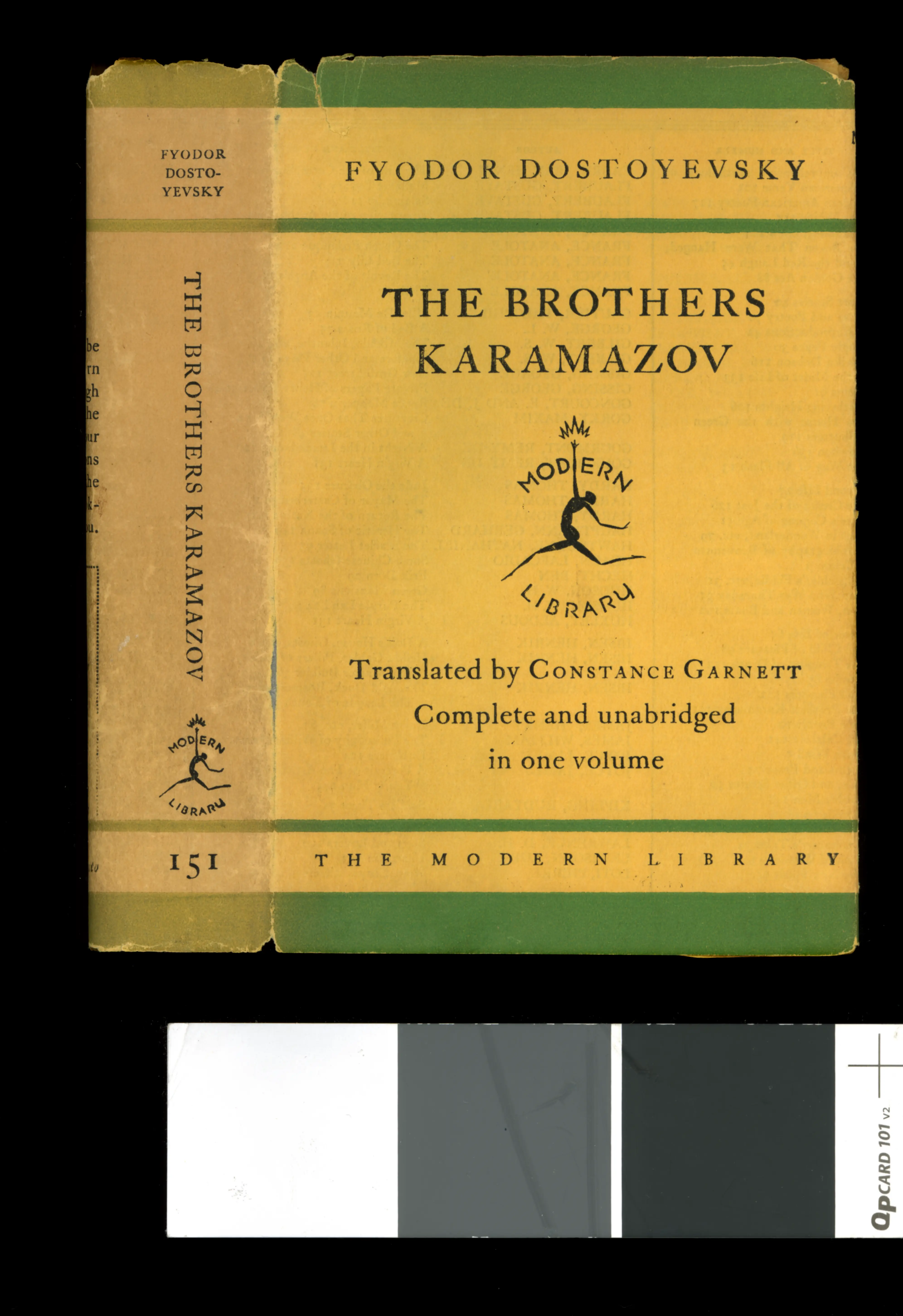
Jacket A:
Jacket B: Pictorial expressionist jacket in dark brown and bluish gray depicting an unclothed male figure with his head in his hand walking through a stylized landscape consisting of a flower, a combined moon and sun, and geometrical shapes. Signed: Hynd. (Spring 1929) Note: The ML experimented with several pictorial jackets in 1929 in connection with three boxed sets of three titles each that were intended for sale as Christmas gifts. The boxed sets, which were sold primarily in department stores, were Three Great French Romances, Three Great Renaissance Romances, and Three Great Modern Novels. Hynd’s jackets for the volumes in the Three Great Modern Novels gift box—Butler’s Way of All Flesh (13.1d jacket B) and Hardy’s Return of the Native (126b jacket B) in addition to The Brothers Karamazov—were exceptional examples of expressionist graphics. They were never adapted for use on regular ML printings.
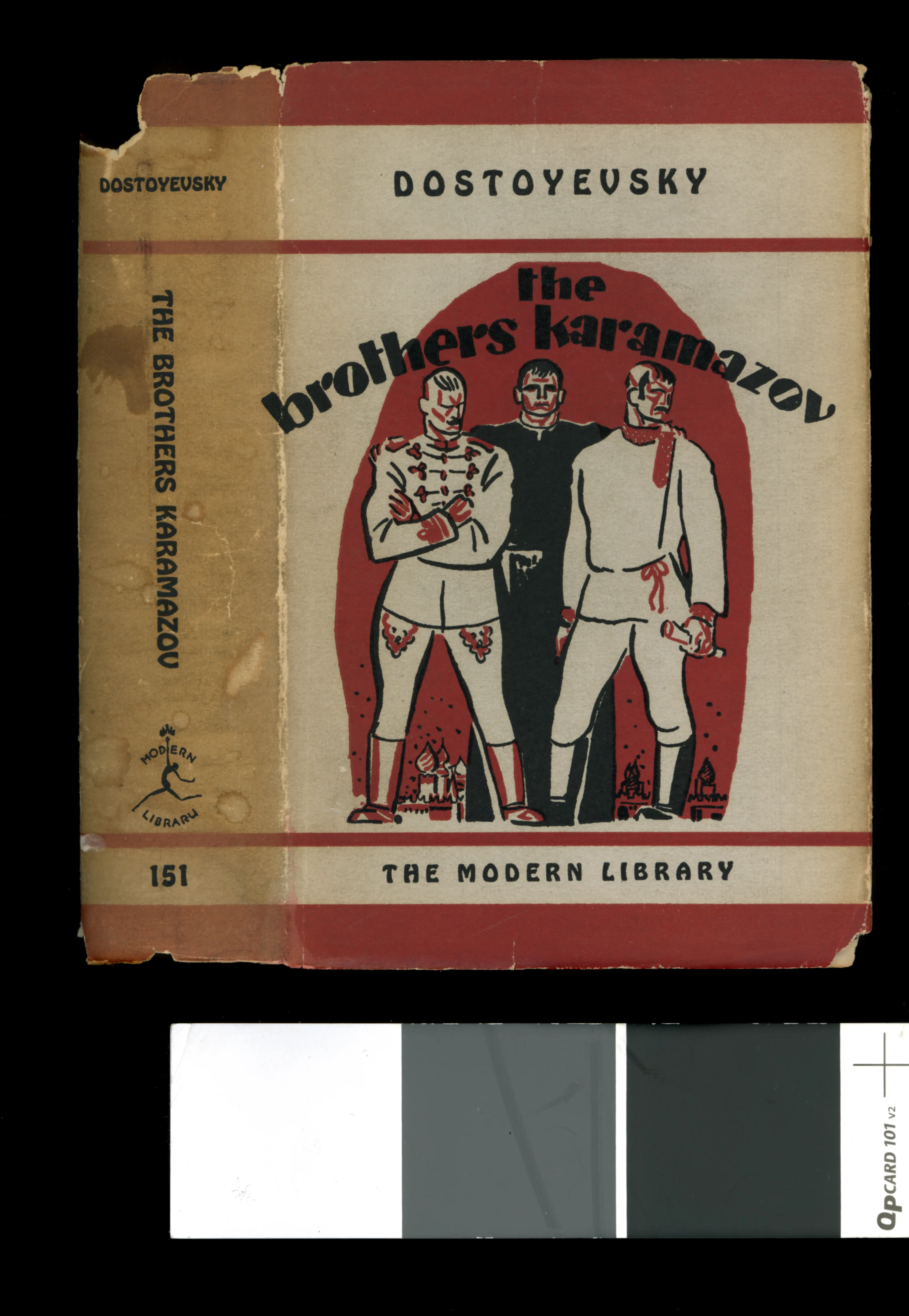
Jacket C: Pictorial jacket in dark red (16) and black on light gray paper with inset drawing of the three Karamazov brothers standing against a red background; lettering in black, borders in dark red. (Spring 1931)
Front flap:
Friedrich Nietzsche paid Fyodor Dostoyevsky the supreme compliment of acknowledging him his teacher, for he learned from the Russian that even a great criminal could be a great man. Dostoyevsky’s understanding of every exaltation and humiliation of the human spirit, his profound tenderness and compassion, his intensity and psychological clairvoyance are nowhere so completely realized as in The Brothers Karamazov. Here the mystic and the realist at last come into accord and give to the world this crowning achievement of Dostoyevsky’s tormented and almost fabulous life. (Fall 1933)
Garnett translation originally published in U.S. by the Macmillan Co., 1912. ML edition printed from plates made from a new typesetting. Published February 1929. WR 23 March 1929. First printing: 20,000. Discontinued 1971/72.
Klopfer inquired about the possibility of printing the ML edition from Macmillan plates but was informed that the Macmillan Co. in New York used printed sheets imported from England (Klopfer to George P. Brett, Jr., Macmillan, 31 October 1928; Harold S. Latham, Macmillan, to Klopfer, 9 November 1928). Cerf and Klopfer decided to assume the cost of original composition and announced that the ML edition was the first to be printed in the United States. Other publishers, they noted, “always imported it from England rather than undergo the great expense of making a new set of plates for so lengthy a book” (ML circular, RH box 133, Advertising 1929 folder 2). At 988 pages The Brothers Karamazov was longest book the ML had published up to that time.
The Brothers Karamazov sold about 30,000 copies in its first two-and-a-half years in the ML (Cerf to Robert Linscott, 9 October 1931). It ranked in the middle of the second quarter of ML titles in terms of sales during the 18-month period, May 1942–October 1943. In the early 1950s (November 1951–October 1952) it was the twelfth best-selling title in the ML; the Giant edition (G34) ranked in the second quarter of ML titles.
The Brothers Karamazov was one of four works to be published in the regular ML, ML Giants, and Illustrated ML. The other works included in all three series were Cervantes, Don Quixote (1930: 197), Giant (1934: G14), Illus ML (1946: IML 16); Fielding, History of Tom Jones (1931: 208), Giant (1940: G52), Illus ML (1943: IML 5); and Whitman, Poems (1921: 94.1), title changed to Leaves of Grass (1929), Leaves of Grass and Selected Prose (1951: 440); Leaves of Grass (Giant,1940: G48), Illus ML (1944: IML )
171.1b. Title page reset (c. 1940)
THE | BROTHERS | KARAMAZOV | BY | FYODOR DOSTOYEVSKY | Translated by CONSTANCE GARNETT | [
Pp. [i–iv] v–xii, [1–2] 3–975 [976–980]. [1–30]16 [31–32]8. Contents as 171.1a except: [ii] blank; [iv] publication and manufacturing statements; [976–980] blank.
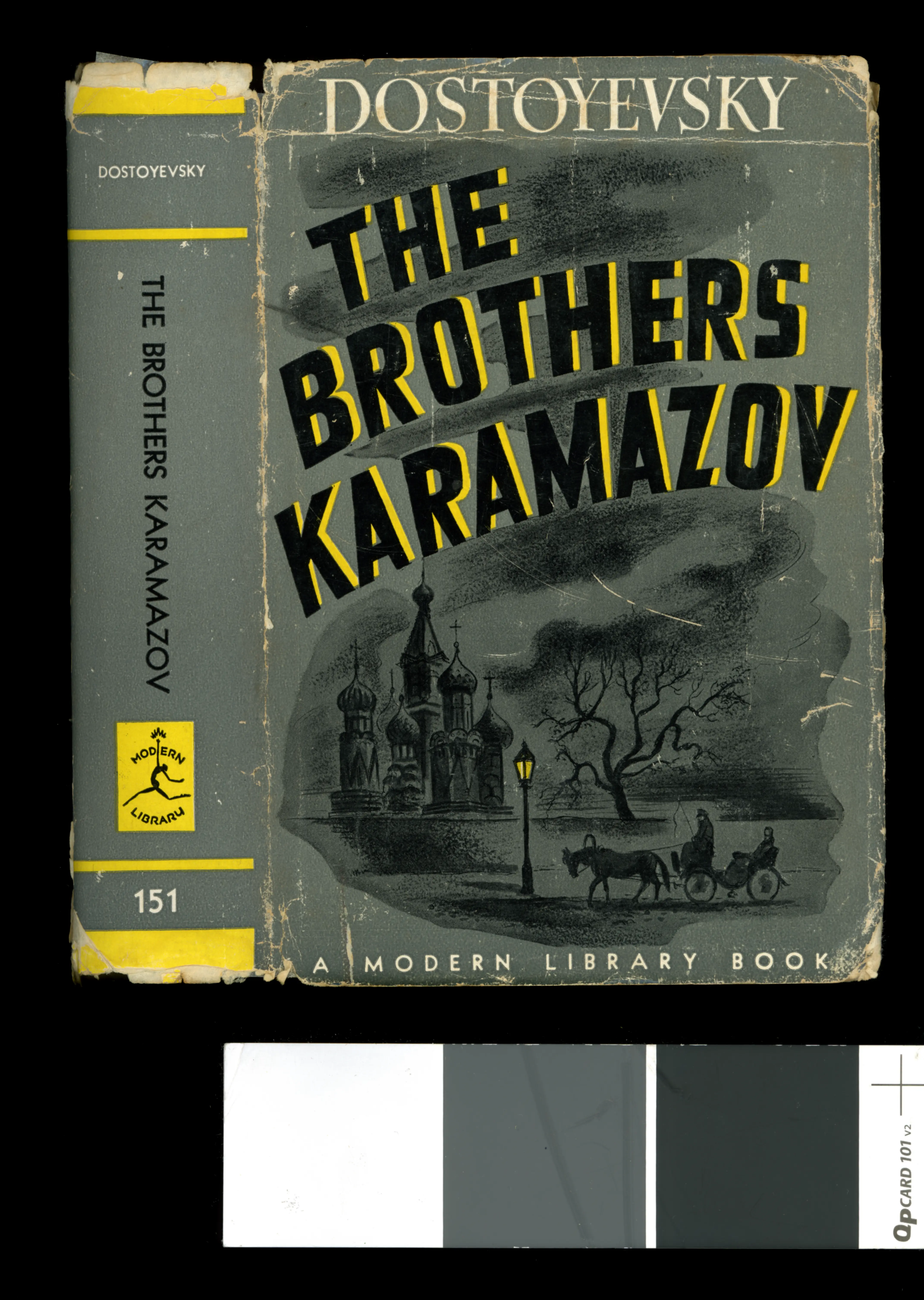
Jacket: Pictorial in bluish gray (191), brilliant yellow (83) and black depicting an open horse-drawn carriage approaching a streetlight with tree and orthodox church in background; title in black highlighted in brilliant yellow and other lettering in reverse, all against bluish gray background. Designed by Paul Galdone, May 1939; unsigned.
Front flap as 171.1a jacket B. (Spring 1943)
171.2a. Text reset (1944)
The | Brothers | KARAMAZOV | by Fyodor Dostoyevsky | Translated by CONSTANCE GARNETT | [
Pp. [i–iv] v–xii, [1–2] 3–939 [940]. [1–29]16 [30]12
[i] half title; [ii] blank; [iii] title; [iv] publication and manufacturing statements within single rules; v–vii TRANSLATOR’S PREFACE; [viii] blank; ix–xii CONTENTS; [1] part title: PART ONE | [illustration] | BOOK ONE | The History of a Family; [2] blank; 3–[940] text.
Variant: Pp. [i–iv] v–xii, [1–2] 3–939 [940–948]. [1–30]16. Contents as 171.2a except: [941–946] ML list; [947–948] ML Giants list. (Spring 1945)
Jacket: As 171.1b. (Fall 1944)
Printed from plates made for the Illustrated ML (IML 2.2a) and subsequently used for regular ML printings.
171.2b. Slonim introduction added (1950)
The | Brothers | KARAMAZOV | BY FYODOR DOSTOYEVSKY | TRANSLATED BY Constance Garnett | INTRODUCTION BY Marc Slonim | English Faculty, Sarah Lawrence College | [
Pp. [i–iv] v–xxiv, [1–2] 3–939 [940–952]. [1–29]16 [30]8 [31]16
Contents as 171.2a except: [iv] Copyright, 1950, by Random House, Inc.; v–xv [first 2 lines within curved single rules] INTRODUCTION | [rule] | By Marc Slonim; xvi SELECTED BIBLIOGRAPHY; [xvii] dedication to Anna Grigorievna Dostoyevsky; [xviii] epigraph from John 12:24; xix–xx FROM THE AUTHOR; xxi–xxiv CONTENTS; [941–946] ML list; [947–948] ML Giants list; [949–952] blank. (Spring 1951)
Variant: Pagination, collation and contents as 171.2b except: [iv] COPYRIGHT, 1950, BY RANDOM HOUSE, INC.; [941–948] ML list; [949–950] ML Giants list; [951–952] blank. (Spring 1965)
Jacket: As 171.1b.
Front flap rewritten:
Among the great novels of the world, The Brothers Karamazov stands preeminent. It captures and conveys the highest exaltation and the deepest humiliation of the human spirit; it probes the soul and reveals, with profound psychological clairvoyance, the plight of man in search for some truth about himself. In Fyodor Dostoyevsky the mystic and the realist at last come into accord, and by his compassion and understanding he creates one of the enduring novels in Russian and world literature. (Fall 1958)
Originally published with Slonim’s introduction in MLCE, 1950. Other additions were the dedication, the epigraph from John 12:24, and Dostoyevsky’s two-page preface “From the Author,” which Garnett had omitted and which the ML added on Slonim’s recommendation. Slonim received $200 for his introduction.
171.2c. Title page reset (1966)
The | BROTHERS | KARAMAZOV | BY FYODOR DOSTOYEVSKY | TRANSLATED BY Constance Garnett | INTRODUCTION BY Marc Slonim | English Faculty, Sarah Lawrence College | [
Pp. [i–iv] v–xvi [xvii–xx], [1–2] 3–940. [1]16 [2–15]32 [16]16
Contents as 171.2b except: [iv] [2-line dedication] | COPYRIGHT, 1950, BY RANDOM HOUSE, INC. | [xvii–xviii] FROM THE AUTHOR; [xix–xx] CONTENTS; [2] epigraph from John 12:24; 3–940 text. Note: 16 pages have been saved by shifting the dedication and epigraph, resetting the contents as 2 pages, and omitting ML lists at the end.
Jacket: Pictorial in moderate orange (53), strong blue (178) and black on coated white paper with the three Karamazov brothers depicted in black on spine and front and back panels; author in moderate orange on spine and front and back panels, title on spine and series on front panel in strong blue, title and other lettering in reverse against illustrations of brothers on front and back panels, all against white background. Designed by Paul Bacon; unsigned.
Front flap:
Among the great novels of the world, The Brothers Karamazov stands preeminent. It captures and conveys the highest exaltation and the deepest humiliation of the human spirit; it proves the soul and reveals, with profound psychological clairvoyance, the plight of man in search for some truth about himself. In Fyodor Dostoyevsky the mystic and the realist at last come into accord, and by his compassion and understanding he creates one of the enduring novels in Russian and world literature.
171.2d. Title page reset; 7½ inch format (1969/70)
Fyodor Dostoyevsky | The [drawing of head of Dostoyevsky extending above line] Brothers | KARAMAZOV | [drawing] | Translated by Constance Garnett | Introduction by Marc Slonim | Sarah Lawrence College | [
Pagination as 171.2c. [1–30]16
Contents as 171.2c except: [iv] [2-line dedication] | MODERN LIBRARY EDITION, 1929 | Copyright, 1950, by Random House, Inc.; v–xv INTRODUCTION | [rule] | By Marc Slonim. Note: Curved rule frame removed from introduction and other headings.
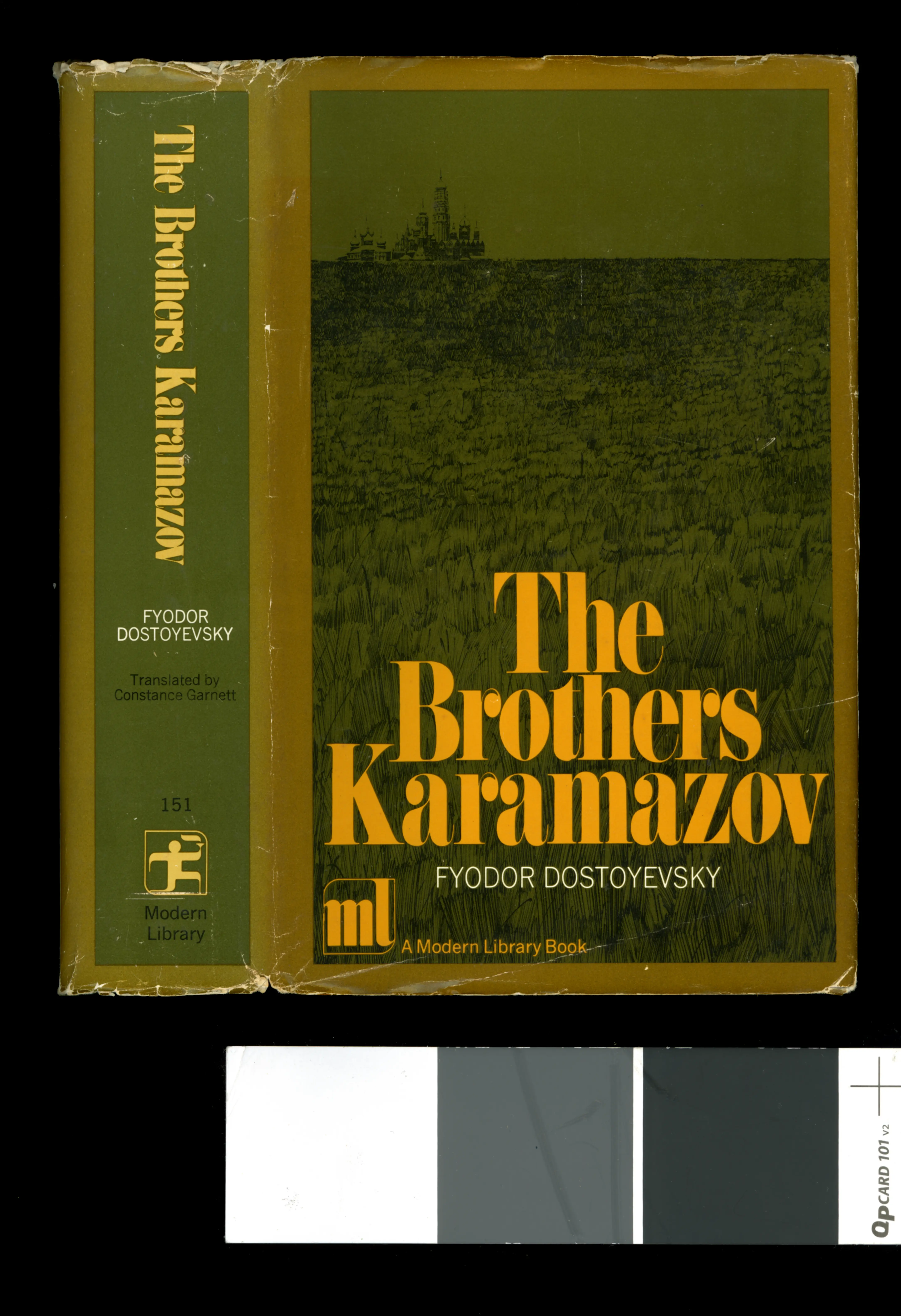
Jacket: Reduced version of G34b jacket B. Pictorial in moderate olive (107), deep orange yellow (69), light olive brown (94) and black on coated white paper with illustration in black and moderate olive depicting a field with buildings on the horizon at left; lettering in deep orange yellow except author in reverse, all within light olive brown frame.
Front flap:
The Brothers Karamazov was published in 1880, shortly before Dostoyevsky’s death. It is the most greatly conceived of all his works and one of the most enduring masterpieces ever written.
Also in the Modern Library
Dostoyevsky, Poor People (1917–1929) 10
Dostoyevsky, Crime and Punishment (1932) 228; (Illus ML, 1944) IML 10
Dostoyevsky, The Possessed (1936) 288
Dostoyevsky, Brothers Karamazov (Giant, 1937) G34; (Illus ML, 1943) IML 2
Dostoyevsky, The Idiot (Giant, 1942) G60
Dostoevsky, Best Short Stories (1955) 479*
*All ML editions used the spelling Dostoyevsky except Best Short Stories which uses the spelling Dostoevsky. In recent decades “Dostoevsky” has become the most common transliteration of the author’s name in English-language editions of his works. “Dostoyevsky, Fyodor, 1821–1881” remains the “authorized form” used in library catalogs to collocate the nearly 50 variant spellings that have been used to represent his name in the Roman alphabet.
{
  "full": "\n**FYODOR DOSTOYEVSKY. THE BROTHERS KARAMAZOV. 1929–1971. (ML 151)**  \n\n#### 171.1a. First printing (1929)  \n\n[within double rules] THE BROTHERS | KARAMAZOV | [rule] | BY | FYODOR DOSTOYEVSKY | [rule] | TRANSLATED BY | CONSTANCE GARNETT | [rule] | [torchbearer B] | [rule] | THE MODERN LIBRARY | PUBLISHERS : NEW YORK  \n\nPp. [i–iv] v–xii, [1–2] 3–975 [976]. [1–30]16 [31]14  \n\n[i] half title; [ii] pub. note D7; [iii] title; [iv] *First Modern Library Edition* | 1929 | [short double rule]; v–vii TRANSLATOR’S PREFACE; [viii] blank; ix–xii CONTENTS; [1] part title: PART I | Book I | THE HISTORY OF A FAMILY; [2] blank; 3–975 text; [976] blank.  \n\n*Binding and endpaper variants:* The new binding design created by Rockwell Kent was introduced in April 1929, but Kent tested his design on copies of the first printing of *The Brothers Karamazov*, which was scheduled for publication in February. *The Brothers Karamazov* first appeared with Bernhard endpapers in balloon cloth binding A with spine lettering set from type. Copies of the first printing are also found in balloon cloth binding with Kent’s grapevine design on the spine, his torchbearer in gold on the front panel, and the title and author on the spine stamped from lettering drawn by hand rather than set from metal type. There is also an intermediate stage between binding A and binding B1 which incorporates all elements of Kent’s design except hand lettering on the spine. Later printings appeared in balloon cloth bindings B2, with Kent’s torchbearer blind stamped on the front panel. The ML appears to have rejected Kent’s recommendation to employ letterers to create title and author statements for the binding spines of subsequent titles.  \n\n> *Variant A:* Pp. [*2*], [i–iv] v–xii, [1–2] 3–975 [976–978]. [1–31]16. Contents (including *First* statement) as 171.1a except: [*1*–*2*] blank; [976–978] blank. (*Fall 1929 jacket*) *Note:* Probably the second printing. \n\n> *Variant B:* Pp. [i–iv] v–xii, [1–2] 3–975 [976–980]. [1–31]16. Contents as 171.1a except: [ii] pub. note A6; [iv] manufacturing statement; [976–980] ML list. (*Spring 1931*)  \n\n*Jacket A:* Uniform typographic jacket D. (*Spring 1929*)  \n\n*Jacket B*: Pictorial expressionist jacket in dark brown and bluish gray depicting an unclothed male figure with his head in his hand walking through a stylized landscape consisting of a flower, a combined moon and sun, and geometrical shapes. Signed: Hynd. (*Spring 1929*) *Note:* The ML experimented with several pictorial jackets in 1929 in connection with three boxed sets of three titles each that were intended for sale as Christmas gifts. The boxed sets, which were sold primarily in department stores, were *Three Great French Romances*, *Three Great Renaissance Romances*, and *Three Great Modern Novels*. Hynd’s jackets for the volumes in the *Three Great Modern Novels* gift box—Butler’s *Way of All Flesh* (13.1d jacket B) and Hardy’s *Return of the Native* (126b jacket B) in addition to *The Brothers Karamazov*—were exceptional examples of expressionist graphics. They were never adapted for use on regular ML printings.  \n\n*Jacket C:* Pictorial jacket in dark red (16) and black on light gray paper with inset drawing of the three Karamazov brothers standing against a red background; lettering in black, borders in dark red. (*Spring 1931*)  \n\n> Front flap:
 Friedrich Nietzsche paid Fyodor Dostoyevsky the supreme compliment of acknowledging him his teacher, for he learned from the Russian that even a great criminal could be a great man. Dostoyevsky’s understanding of every exaltation and humiliation of the human spirit, his profound tenderness and compassion, his intensity and psychological clairvoyance are nowhere so completely realized as in *The Brothers Karamazov*. Here the mystic and the realist at last come into accord and give to the world this crowning achievement of Dostoyevsky’s tormented and almost fabulous life. (*Fall 1933*)  \n\nGarnett translation originally published in U.S. by the Macmillan Co., 1912. ML edition printed from plates made from a new typesetting. Published February 1929. *WR* 23 March 1929. First printing: 20,000. Discontinued 1971/72.  \n\nKlopfer inquired about the possibility of printing the ML edition from Macmillan plates but was informed that the Macmillan Co. in New York used printed sheets imported from England (Klopfer to George P. Brett, Jr., Macmillan, 31 October 1928; Harold S. Latham, Macmillan, to Klopfer, 9 November 1928). Cerf and Klopfer decided to assume the cost of original composition and announced that the ML edition was the first to be printed in the United States. Other publishers, they noted, “always imported it from England rather than undergo the great expense of making a new set of plates for so lengthy a book” (ML circular, RH box 133, Advertising 1929 folder 2). At 988 pages *The Brothers Karamazov* was longest book the ML had published up to that time.  \n\n*The Brothers Karamazov* sold about 30,000 copies in its first two-and-a-half years in the ML (Cerf to Robert Linscott, 9 October 1931). It ranked in the middle of the second quarter of ML titles in terms of sales during the 18-month period, May 1942–October 1943. In the early 1950s (November 1951–October 1952) it was the twelfth best-selling title in the ML; the Giant edition (G34) ranked in the second quarter of ML titles.  \n\n*The Brothers Karamazov* was one of four works to be published in the regular ML, ML Giants, and Illustrated ML. The other works included in all three series were Cervantes, *Don Quixote* (1930: 197), Giant (1934: G14), Illus ML (1946: IML 16); Fielding, *History of Tom Jones* (1931: 208), Giant (1940: G52), Illus ML (1943: IML 5); and Whitman, *Poems* (1921: 94.1), title changed to *Leaves of Grass* (1929), *Leaves of Grass and Selected Prose* (1951: 440); *Leaves of Grass* (Giant,1940: G48), Illus ML (1944: IML )  \n\n#### 171.1b. Title page reset (c. 1940)  \n\nTHE | BROTHERS | KARAMAZOV | BY | FYODOR DOSTOYEVSKY | *Translated by* CONSTANCE GARNETT | [torchbearer D3] | [rule] | THE MODERN LIBRARY · NEW YORK | [rule]  \n\nPp. [i–iv] v–xii, [1–2] 3–975 [976–980]. [1–30]16 [31–32]8. Contents as 171.1a except: [ii] blank; [iv] publication and manufacturing statements; [976–980] blank.  \n\n*Jacket:* Pictorial in bluish gray (191), brilliant yellow (83) and black depicting an open horse-drawn carriage approaching a streetlight with tree and orthodox church in background; title in black highlighted in brilliant yellow and other lettering in reverse, all against bluish gray background. Designed by Paul Galdone, May 1939; unsigned. \n\n> Front flap as 171.1a jacket B. (*Spring 1943*)  \n\n#### 171.2a. Text reset (1944)  \n\nThe | Brothers | KARAMAZOV | by Fyodor Dostoyevsky | *Translated by* CONSTANCE GARNETT | [torchbearer E2] | THE MODERN LIBRARY · NEW YORK  \n\nPp. [i–iv] v–xii, [1–2] 3–939 [940]. [1–29]16 [30]12  \n\n[i] half title; [ii] blank; [iii] title; [iv] publication and manufacturing statements within single rules; v–vii TRANSLATOR’S PREFACE; [viii] blank; ix–xii CONTENTS; [1] part title: PART ONE | [illustration] | *BOOK ONE* | *The History of a Family*; [2] blank; 3–[940] text.  \n\n> *Variant:* Pp. [i–iv] v–xii, [1–2] 3–939 [940–948]. [1–30]16. Contents as 171.2a except: [941–946] ML list; [947–948] ML Giants list. (*Spring 1945*)  \n\n*Jacket:* As 171.1b. (*Fall 1944*)  \n\nPrinted from plates made for the Illustrated ML (IML 2.2a) and subsequently used for regular ML printings.  \n\n#### 171.2b. Slonim introduction added (1950)  \n\nThe | Brothers | KARAMAZOV | BY FYODOR DOSTOYEVSKY | TRANSLATED BY *Constance Garnett* | INTRODUCTION BY *Marc Slonim* | *English Faculty, Sarah Lawrence College* | [torchbearer E5] | *The Modern Library* · *New York*  \n\nPp. [i–iv] v–xxiv, [1–2] 3–939 [940–952]. [1–29]16 [30]8 [31]16  \n\nContents as 171.2a except: [iv] *Copyright, 1950, by Random House, Inc.*; v–xv [first 2 lines within curved single rules] INTRODUCTION | [rule] | *By Marc Slonim*; xvi SELECTED BIBLIOGRAPHY; [xvii] dedication to Anna Grigorievna Dostoyevsky; [xviii] epigraph from John 12:24; xix–xx FROM THE AUTHOR; xxi–xxiv CONTENTS; [941–946] ML list; [947–948] ML Giants list; [949–952] blank. (*Spring 1951*)  \n\n> *Variant:* Pagination, collation and contents as 171.2b except: [iv] COPYRIGHT, 1950, BY RANDOM HOUSE, INC.; [941–948] ML list; [949–950] ML Giants list; [951–952] blank. (*Spring 1965*)  \n\n*Jacket:* As 171.1b.  \n\n>Front flap rewritten:
 Among the great novels of the world, *The Brothers Karamazov* stands preeminent. It captures and conveys the highest exaltation and the deepest humiliation of the human spirit; it probes the soul and reveals, with profound psychological clairvoyance, the plight of man in search for some truth about himself. In Fyodor Dostoyevsky the mystic and the realist at last come into accord, and by his compassion and understanding he creates one of the enduring novels in Russian and world literature. (*Fall 1958*)  \n\nOriginally published with Slonim’s introduction in MLCE, 1950. Other additions were the dedication, the epigraph from John 12:24, and Dostoyevsky’s two-page preface “From the Author,” which Garnett had omitted and which the ML added on Slonim’s recommendation. Slonim received \\$200 for his introduction.  \n\n#### 171.2c. Title page reset (1966)  \n\nThe | BROTHERS | KARAMAZOV | BY FYODOR DOSTOYEVSKY | TRANSLATED BY *Constance Garnett* | INTRODUCTION BY *Marc Slonim* | *English Faculty, Sarah Lawrence College* | [torchbearer J] | *The Modern Library* · *New York*  \n\nPp. [i–iv] v–xvi [xvii–xx], [1–2] 3–940. [1]16 [2–15]32 [16]16  \n\nContents as 171.2b except: [iv] [2-line dedication] | COPYRIGHT, 1950, BY RANDOM HOUSE, INC. | [xvii–xviii] FROM THE AUTHOR; [xix–xx] CONTENTS; [2] epigraph from John 12:24; 3–940 text. *Note:* 16 pages have been saved by shifting the dedication and epigraph, resetting the contents as 2 pages, and omitting ML lists at the end.  \n\n*Jacket:* Pictorial in moderate orange (53), strong blue (178) and black on coated white paper with the three Karamazov brothers depicted in black on spine and front and back panels; author in moderate orange on spine and front and back panels, title on spine and series on front panel in strong blue, title and other lettering in reverse against illustrations of brothers on front and back panels, all against white background. Designed by Paul Bacon; unsigned.  \n\n> Front flap:
 Among the great novels of the world, *The Brothers Karamazov* stands preeminent. It captures and conveys the highest exaltation and the deepest humiliation of the human spirit; it proves the soul and reveals, with profound psychological clairvoyance, the plight of man in search for some truth about himself. In Fyodor Dostoyevsky the mystic and the realist at last come into accord, and by his compassion and understanding he creates one of the enduring novels in Russian and world literature.  \n\n#### 171.2d. Title page reset; 7½ inch format (1969/70)  \n\nFyodor Dostoyevsky | The [drawing of head of Dostoyevsky extending above line] Brothers | KARAMAZOV | [drawing] | Translated by *Constance Garnett* | Introduction by *Marc Slonim* | *Sarah Lawrence College* | [torchbearer K] | THE MODERN LIBRARY · *New York*  \n\nPagination as 171.2c. [1–30]16  \n\nContents as 171.2c except: [iv] [2-line dedication] | MODERN LIBRARY EDITION, 1929 | Copyright, 1950, by Random House, Inc.; v–xv INTRODUCTION | [rule] | *By Marc Slonim.* *Note:* Curved rule frame removed from introduction and other headings.  \n\n*Jacket:* Reduced version of G34b jacket B. Pictorial in moderate olive (107), deep orange yellow (69), light olive brown (94) and black on coated white paper with illustration in black and moderate olive depicting a field with buildings on the horizon at left; lettering in deep orange yellow except author in reverse, all within light olive brown frame.  \n\n> Front flap:
 The Brothers Karamazov was published in 1880, shortly before Dostoyevsky’s death. It is the most greatly conceived of all his works and one of the most enduring masterpieces ever written.  \n\nAlso in the Modern Library  \nDostoyevsky, *Poor People* (1917–1929) 10  \nDostoyevsky, *Crime and Punishment* (1932) 228; (Illus ML, 1944) IML 10  \nDostoyevsky, *The Possessed* (1936) 288  \nDostoyevsky, *Brothers Karamazov* (Giant, 1937) G34; (Illus ML, 1943) IML 2  \nDostoyevsky, *The Idiot* (Giant, 1942) G60  \nDostoevsky, *Best Short Stories* (1955) 479\\*  \n\n\\*All ML editions used the spelling Dostoyevsky except *Best Short Stories* which uses the spelling Dostoevsky. In recent decades “Dostoevsky” has become the most common transliteration of the author’s name in English-language editions of his works. “Dostoyevsky, Fyodor, 1821–1881” remains the “authorized form” used in library catalogs to collocate the nearly 50 variant spellings that have been used to represent his name in the Roman alphabet.  \n\n",
  "id": "171",
  "year": "1929",
  "label": "FYODOR DOSTOYEVSKY. THE BROTHERS KARAMAZOV. 1929–1971. (ML 151)",
  "author": "FYODOR DOSTOYEVSKY",
  "title": "THE BROTHERS KARAMAZOV.",
  "date": "1929–1971.",
  "something": "ML 151",
  "revisions": [],
  "type": "book"
}