
The Modern Library Bibliography
ERNEST HEMINGWAY. THE SUN ALSO RISES. 1930–1953. (ML 170)
190a. First printing (1930)
[within double rules] THE SUN ALSO RISES | [rule] | BY | ERNEST HEMINGWAY | [rule] | INTRODUCTION BY | HENRY SEIDEL CANBY | [rule] | [
Pp. [i–v] vi–ix [x–xii], [1–2] 3–259 [260]. [1–8]16 [9]8
[i] half title; [ii]
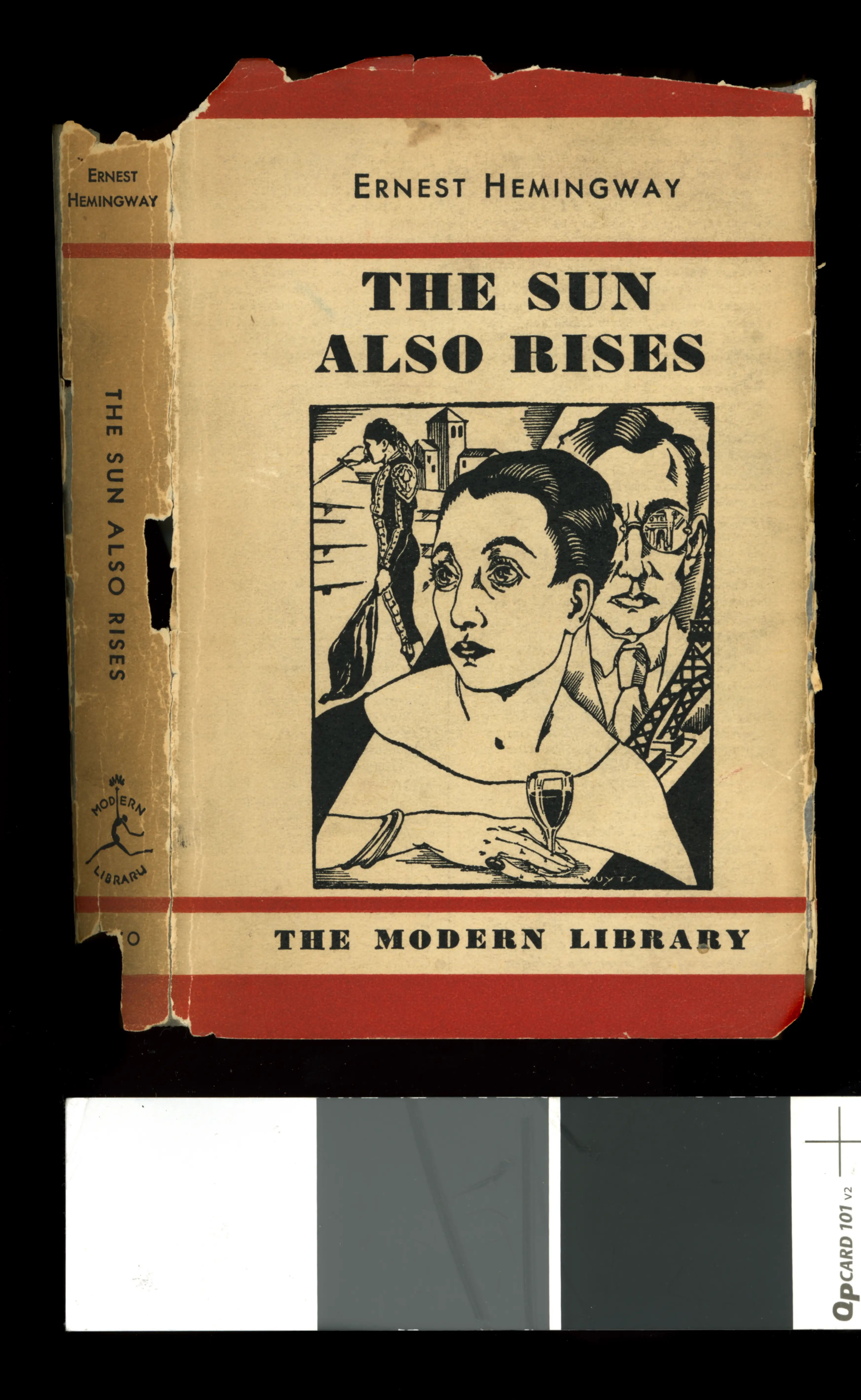
Jacket A: Pictorial in deep reddish orange (36) and black on cream paper with inset illustration of a woman with a glass of wine in the foreground and a bullfighter, a man’s head, and base of the Eiffel Tower in the background; borders in deep reddish orange, lettering in black. Signed: Wuyts. (Spring 1930)
Front flap:
Instead of beginning his career as a writer of promise, Ernest Hemingway startled the world, and especially his own generation, with The Sun Also Rises, his first full-length novel. The disinherited and disillusioned survivors of the World War discovered in him their spokesman, a writer free of sentimentality and cant who could summon forth characters true to their own experience and way of life. The Sun Also Rises is a chronicle of a lost generation drifting, frustrated and demoralized, to its doom. (Spring 1939)
Originally published by Charles Scribner’s Sons, 1926. ML edition (pp. [xi]–259) printed from Scribner plates. Published February 1930. WR 8 March 1930. First printing: 15,000 copies. Discontinued 1953.
The ML paid Scribner’s a $6,000 advance against royalties of 12 cents a copy. Cerf had approached Scribner’s about a ML edition as early as 1927, when he offered a $1,200 advance against royalties of 12 cents a copy (Cerf to Scribner’s, 17 September 1927). After meeting Cerf in New York Hemingway urged Scribner’s to let the ML have the book. He was pleased that The Sun Also Rises was to appear in the series. But he declined Cerf’s offer of $200 to write an introduction—four times what F. Scott Fitzgerald received in 1934 for his introduction to the ML edition of The Great Gatsby—explaining that he couldn’t write an introduction to any book, least of all to one of his own. “I feel to write it would be taking $200 out of some critics [sic] pocket—but beside that I swear to you I couldn’t write it if I tried” (Hemingway to Cerf, 4 January 1930).
Printings through 1934 were as follows: 5,000 copies (November 1930), 5,000 copies (October 1931), 3,000 copies (July 1933), 2,000 copies (December 1934). The Sun Also Rises was the eighteenth best-selling ML title during the first six months of 1931 (RH box 117, Publicity file). It sold 7,054 copies during the 18-month period May 1942–October 1943, placing it the second quarter of ML and Giant titles in terms of sales. It sold 5,678 copies during the twelve-month period November 1951–October 1952, making it thirty-third out of the 100 best-selling titles in the regular ML.
Curiously, the 1949 Bantam paperback edition of The Sun Also Rises, despite the claim on the front cover that the text is “Complete and Unabridged,’ omits more than twenty references to Robert Cohn being Jewish. The first paragraph of Chapter 1 retains the passage that he learned boxing “to counteract the feeling of inferiority and shyness he had felt on being treated as a Jew at Princeton” (p. 1) but alters the third paragraph from “Robert Cohn was a member, through his father, of one of the richest Jewish families in New York . . .” to “one of the richest families in New York” (p. 2). Another example comes from Chapter XVIII, where the Scribner/Modern Library text reads “Brett’s got a bull-fighter,” he said. “She had a Jew named Cohn, but he turned out badly” (p. 214). The 1949 Bantam edition reads: “Brett’s got a bull-fighter,” Mike said. “A beautiful, bloody bull fighter” (p. 176).
Scribner’s decided in the early 1950s to promote its backlist more vigorously and terminated the ML’s reprint contracts for all three Hemingway titles in the series (Whitney Darrow, Scribner’s, to Cerf, 29 October 1952). A few months later the ML reported that The Sun Also Rises would be out of stock soon (ML to Charles Burgess, Jr., Scribner’s, 16 February 1953). Scribner’s published a $3.00 hardbound reprint in April 1953 and a $1.45 paperback in August 1957.
190b. Title page reset (c. 1940)
[within single rules] [8-line title and statement of responsibility within second single-rule frame] THE SUN | ALSO | RISES | BY | ERNEST | HEMINGWAY | INTRODUCTION BY | HENRY SEIDEL CANBY | [below inner frame:
Pagination and collation as 190a.
Contents as 190a except: [ii] blank; [iv] COPYRIGHT, 1926, BY CHARLES SCRIBNER’S SONS.
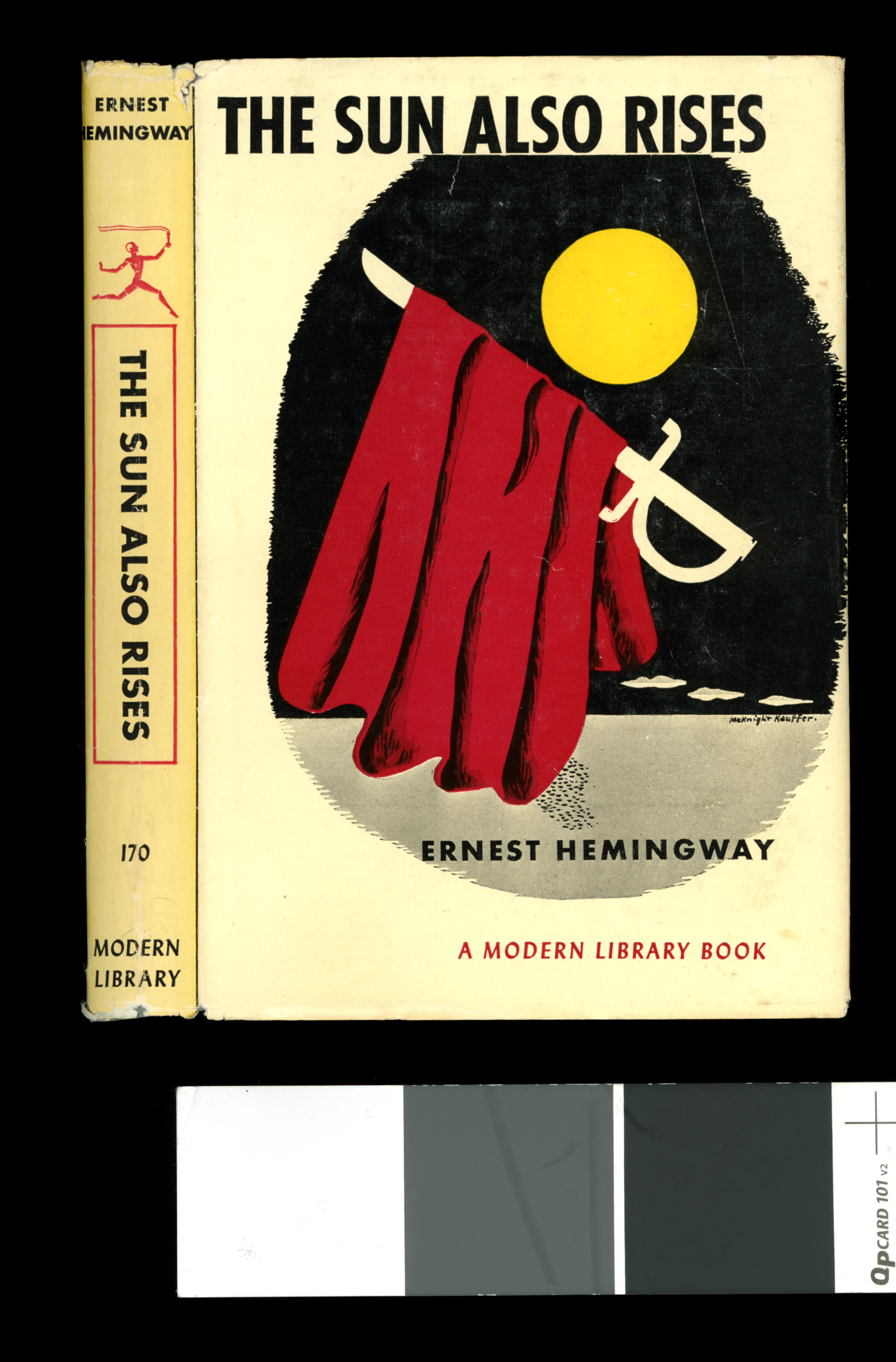
Jacket B: Pictorial in vivid red (11), vivid yellow (82), yellowish gray (93) and black on coated white paper with inset illustration of a sword draped with a vivid red cloth, suspended against a black sky with vivid yellow sun and over yellowish gray earth; lettering in black and vivid red, background in white. Signed: McKnight Kauffer.
Front flap as 190a. (Spring 1942)
Also in the Modern Library
Hemingway, Farewell to Arms (1932–1953) 237
Hemingway, Short Stories (Giant, 1942–1954) G59
{
  "full": "\n**ERNEST HEMINGWAY. THE SUN ALSO RISES. 1930–1953. (ML 170)**  \n\n#### 190a. First printing (1930)  \n\n[within double rules] THE SUN ALSO RISES | [rule] | BY | ERNEST HEMINGWAY | [rule] | INTRODUCTION BY | HENRY SEIDEL CANBY | [rule] | [torchbearer A3] | rule | THE MODERN LIBRARY | PUBLISHERS : NEW YORK  \n\nPp. [i–v] vi–ix [x–xii], [1–2] 3–259 [260]. [1–8]16 [9]8  \n\n[i] half title; [ii] pub. note D8; [iii] title; [iv] *Copyright, 1926, by* CHAS. SCRIBNER’S SONS | [short double rule] | *First Modern Library Edition* | 1930; [v]–ix INTRODUCTION signed p. ix: Henry Seidel Canby. | New York | *January,* 1930; [x] blank; [xi] dedication; [xii] epigraphs from Gertrude Stein and *Ecclesiastes*; [1] part title: THE SUN ALSO RISES | [short rule] | *BOOK I*; [2] blank; 3–259 text; [260] blank.  \n\n*Jacket A:* Pictorial in deep reddish orange (36) and black on cream paper with inset illustration of a woman with a glass of wine in the foreground and a bullfighter, a man’s head, and base of the Eiffel Tower in the background; borders in deep reddish orange, lettering in black. Signed: Wuyts. (*Spring 1930*)  \n\n> Front flap:
 Instead of beginning his career as a writer of promise, Ernest Hemingway startled the world, and especially his own generation, with *The Sun Also Rises*, his first full-length novel. The disinherited and disillusioned survivors of the World War discovered in him their spokesman, a writer free of sentimentality and cant who could summon forth characters true to their own experience and way of life. *The Sun Also Rises* is a chronicle of a lost generation drifting, frustrated and demoralized, to its doom. (*Spring 1939*)  \n\nOriginally published by Charles Scribner’s Sons, 1926. ML edition (pp. [xi]–259) printed from Scribner plates. Published February 1930. *WR* 8 March 1930. First printing: 15,000 copies. Discontinued 1953.  \n\nThe ML paid Scribner’s a \\$6,000 advance against royalties of 12 cents a copy. Cerf had approached Scribner’s about a ML edition as early as 1927, when he offered a \\$1,200 advance against royalties of 12 cents a copy (Cerf to Scribner’s, 17 September 1927). After meeting Cerf in New York Hemingway urged Scribner’s to let the ML have the book. He was pleased that *The Sun Also Rises* was to appear in the series. But he declined Cerf’s offer of \\$200 to write an introduction—four times what F. Scott Fitzgerald received in 1934 for his introduction to the ML edition of *The Great Gatsby*—explaining that he couldn’t write an introduction to any book, least of all to one of his own. “I feel to write it would be taking \\$200 out of some critics [*sic*] pocket—but beside that I swear to you I couldn’t write it if I tried” (Hemingway to Cerf, 4 January 1930).  \n\nPrintings through 1934 were as follows: 5,000 copies (November 1930), 5,000 copies (October 1931), 3,000 copies (July 1933), 2,000 copies (December 1934). *The Sun Also Rises* was the eighteenth best-selling ML title during the first six months of 1931 (RH box 117, Publicity file). It sold 7,054 copies during the 18-month period May 1942–October 1943, placing it the second quarter of ML and Giant titles in terms of sales. It sold 5,678 copies during the twelve-month period November 1951–October 1952, making it thirty-third out of the 100 best-selling titles in the regular ML.  \n\nCuriously, the 1949 Bantam paperback edition of *The Sun Also Rises*, despite the claim on the front cover that the text is “Complete and Unabridged,’ omits more than twenty references to Robert Cohn being Jewish. The first paragraph of Chapter 1 retains the passage that he learned boxing “to counteract the feeling of inferiority and shyness he had felt on being treated as a Jew at Princeton” (p. 1) but alters the third paragraph from “Robert Cohn was a member, through his father, of one of the richest Jewish families in New York . . .” to “one of the richest families in New York” (p. 2). Another example comes from Chapter XVIII, where the Scribner/Modern Library text reads “Brett’s got a bull-fighter,” he said. “She had a Jew named Cohn, but he turned out badly” (p. 214). The 1949 Bantam edition reads: “Brett’s got a bull-fighter,” Mike said. “A beautiful, bloody bull fighter” (p. 176).  \n\nScribner’s decided in the early 1950s to promote its backlist more vigorously and terminated the ML’s reprint contracts for all three Hemingway titles in the series (Whitney Darrow, Scribner’s, to Cerf, 29 October 1952). A few months later the ML reported that *The Sun Also Rises* would be out of stock soon (ML to Charles Burgess, Jr., Scribner’s, 16 February 1953). Scribner’s published a \\$3.00 hardbound reprint in April 1953 and a \\$1.45 paperback in August 1957.  \n\n#### 190b. Title page reset (c. 1940)  \n\n[within single rules] [8-line title and statement of responsibility within second single-rule frame] THE SUN | ALSO | RISES | BY | ERNEST | HEMINGWAY | INTRODUCTION BY | HENRY SEIDEL CANBY | [below inner frame: torchbearer D5 at right; 3-line imprint at left] THE | MODERN LIBRARY | NEW YORK  \n\nPagination and collation as 190a.  \n\nContents as 190a except: [ii] blank; [iv] COPYRIGHT, 1926, BY CHARLES SCRIBNER’S SONS.  \n\n*Jacket B:* Pictorial in vivid red (11), vivid yellow (82), yellowish gray (93) and black on coated white paper with inset illustration of a sword draped with a vivid red cloth, suspended against a black sky with vivid yellow sun and over yellowish gray earth; lettering in black and vivid red, background in white. Signed: McKnight Kauffer. \n\n> Front flap as 190a. (*Spring 1942*)  \n\nAlso in the Modern Library  \nHemingway, *Farewell to Arms* (1932–1953) 237  \nHemingway, *Short Stories* (Giant, 1942–1954) G59  \n\n",
  "id": "190",
  "year": "1930",
  "label": "ERNEST HEMINGWAY. THE SUN ALSO RISES. 1930–1953. (ML 170)",
  "author": "ERNEST HEMINGWAY",
  "title": "THE SUN ALSO RISES.",
  "date": "1930–1953.",
  "something": "ML 170",
  "revisions": [],
  "type": "book"
}